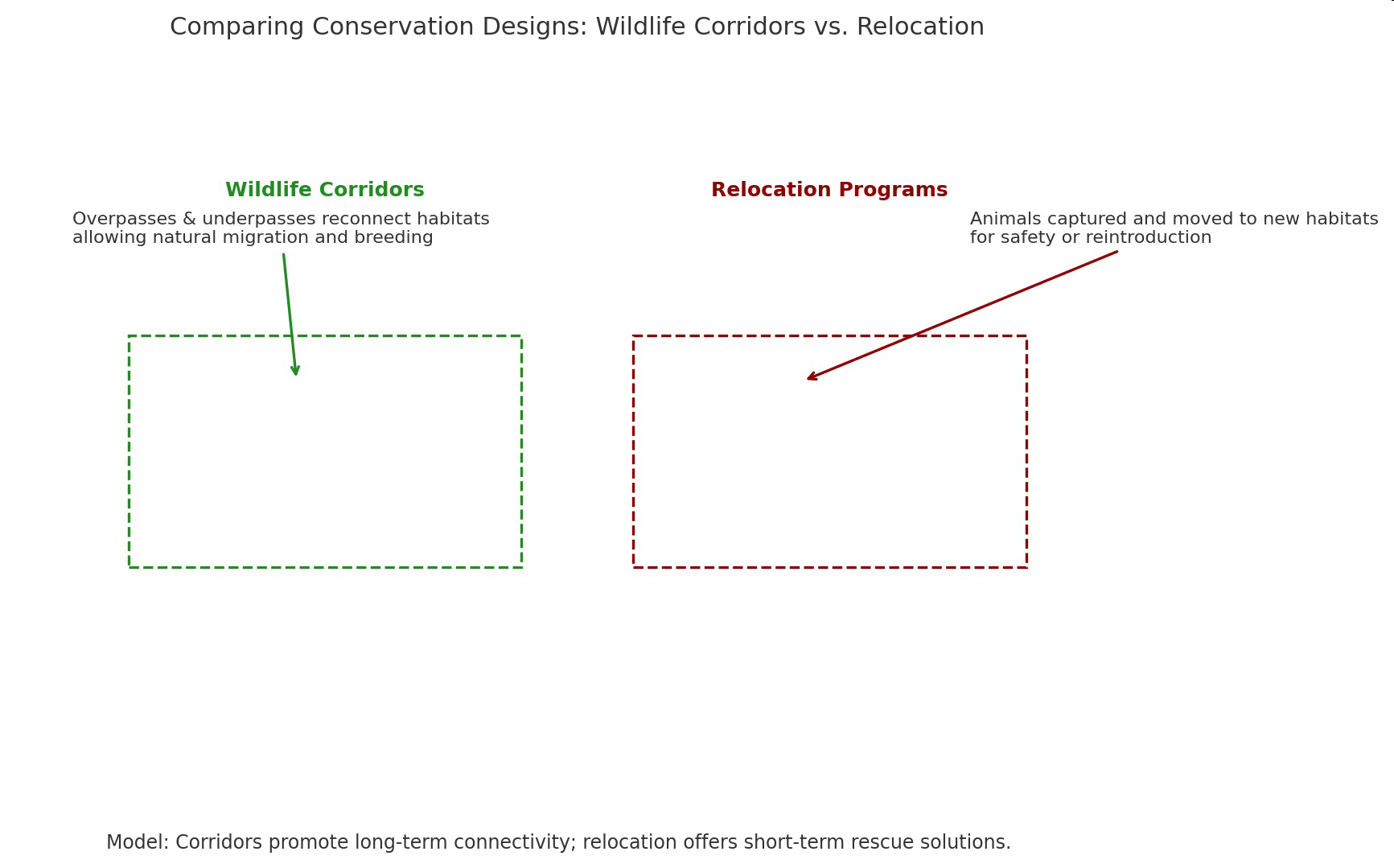
Habitat Corridors
Wildlife overpasses and corridors are physical structures that allow animals to cross human-made barriers like highways, railroads, or urban zones safely. They can take the form of vegetated bridges, tunnels, or restored land strips connecting separate habitats. When designed properly, corridors allow safe migration and interbreeding, which helps maintain genetic diversity and reduces roadkill.
Examples include the Banff Wildlife Overpasses in Canada and the new Wallis Annenberg Wildlife Crossing in California, both designed for species like deer, cougars, and bears. Research shows that after corridors are built, wildlife crossings increase and population genetics improve. These structures, however, require careful design to match animal behavior - and they can be expensive to construct and maintain.
Relocation programs, in contrast, physically capture and move animals from one habitat to another. This method can be useful when a population is immediately threatened by habitat loss, drought, or wildfire. By translocating animals to new regions, scientists can quickly re-establish populations in safer or larger habitats. However, relocation comes with risks: moved animals may struggle to adapt, face new predators, or carry diseases that affect native species.
In comparing the two solutions, wildlife corridors tend to support long-term ecosystem stability by allowing natural movement and reproduction. Relocation programs are best for emergency interventions or restoring species to areas where natural migration routes no longer exist.
Both methods reflect the balance between engineering and ecology - using human design to solve biodiversity problems. Evaluating these strategies helps students see that conservation often requires trade-offs among cost, speed, and ecological integrity.
Table 1.
Strategy | Average Annual Crossings (per 100 animals) | Gene Flow Index (1 - 10) | Survival Rate (%) |
|---|
Wildlife Overpass | 74 | 9.1 | 95 |
Underpass Corridor | 63 | 8.7 | 93 |
Relocation Program | 0 | 5.4 | 82 |
Table 2.
Strategy | Construction Cost ($ millions) | Annual Maintenance ($ thousands) | Long-Term Success (10 yrs, %) | Public Support Index (1 - 5) |
|---|
Wildlife Overpass | 32 | 600 | 90 | 5 |
Underpass Corridor | 24 | 550 | 88 | 4 |
Relocation Program | 7 | 120 | 60 | 3 |
Graph of Information - Figure 1.
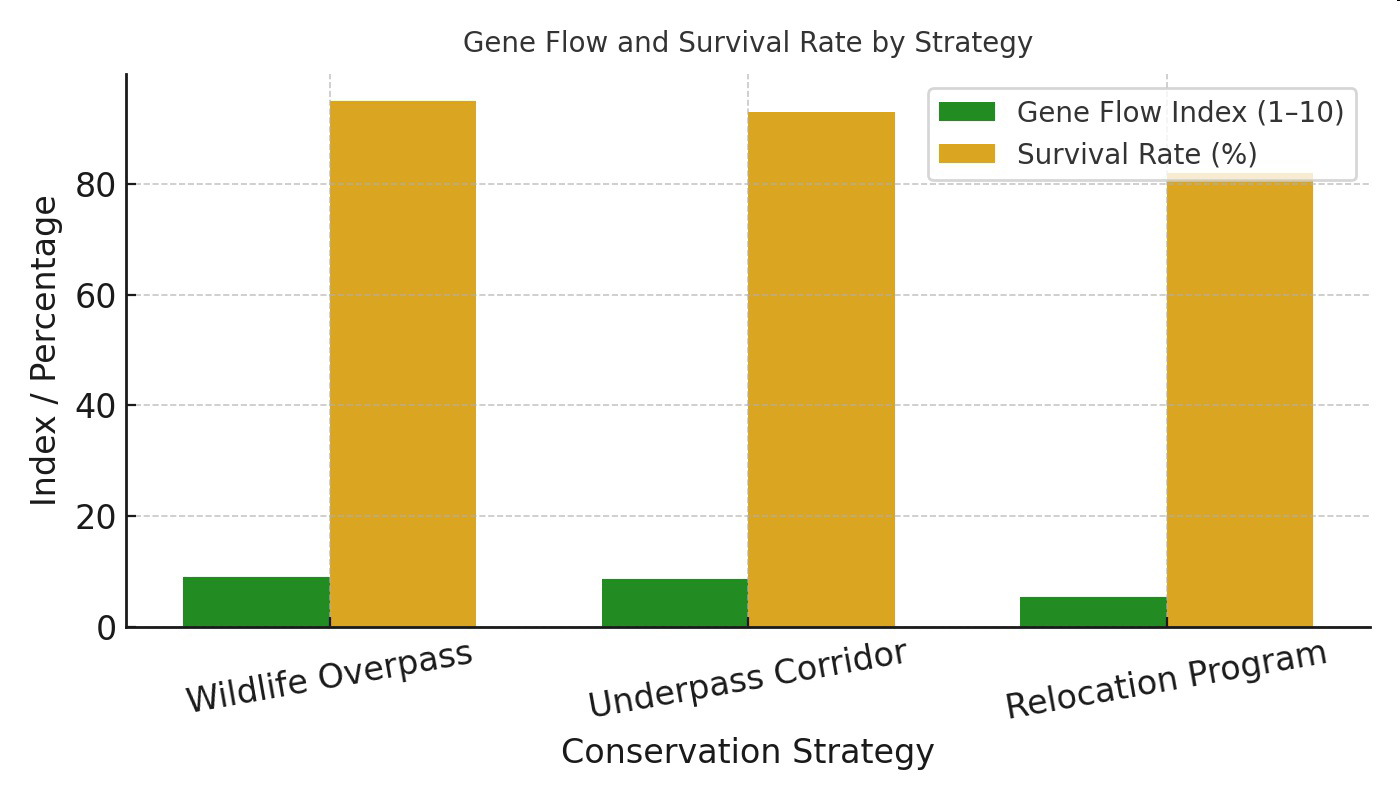
Graph of Information - Figure 2.
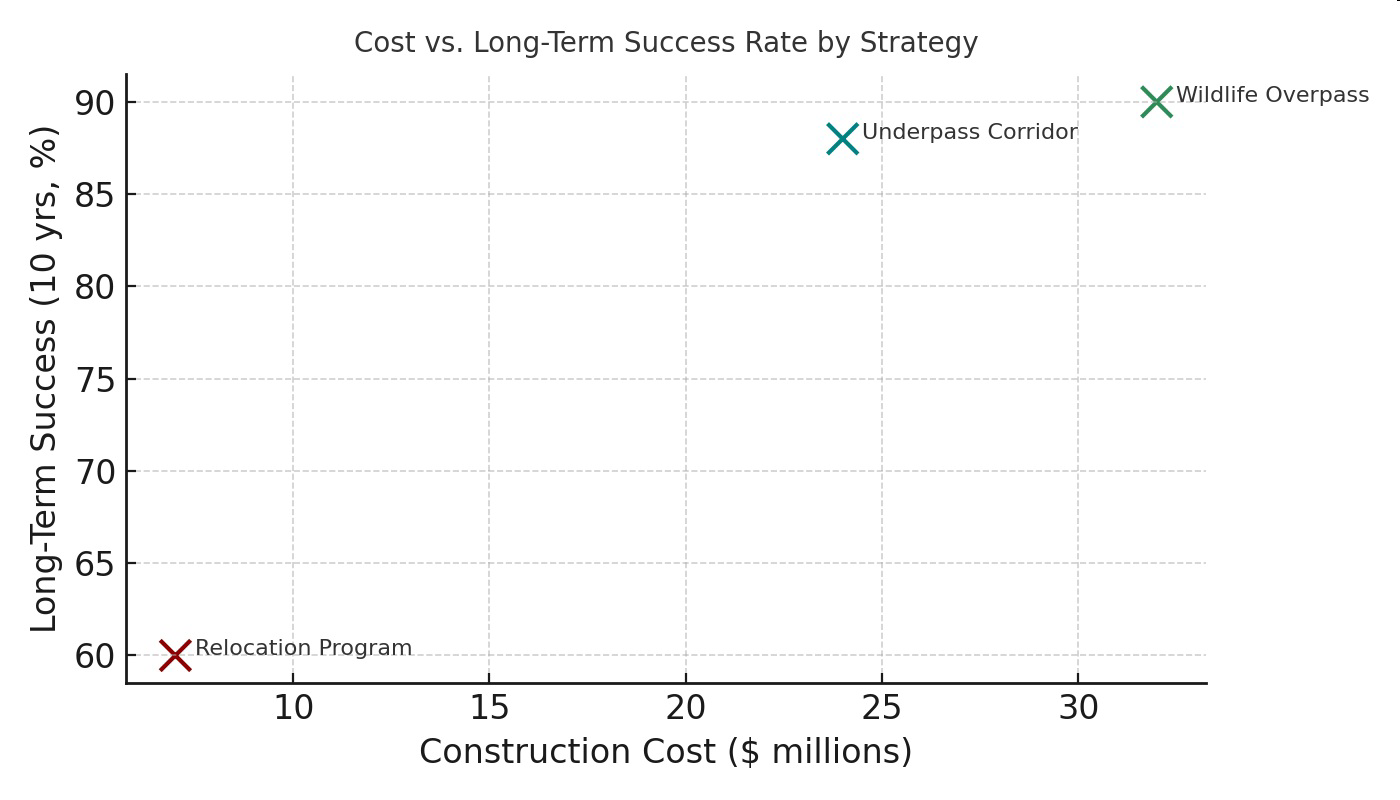
Figure 3.