Ɛhia
1
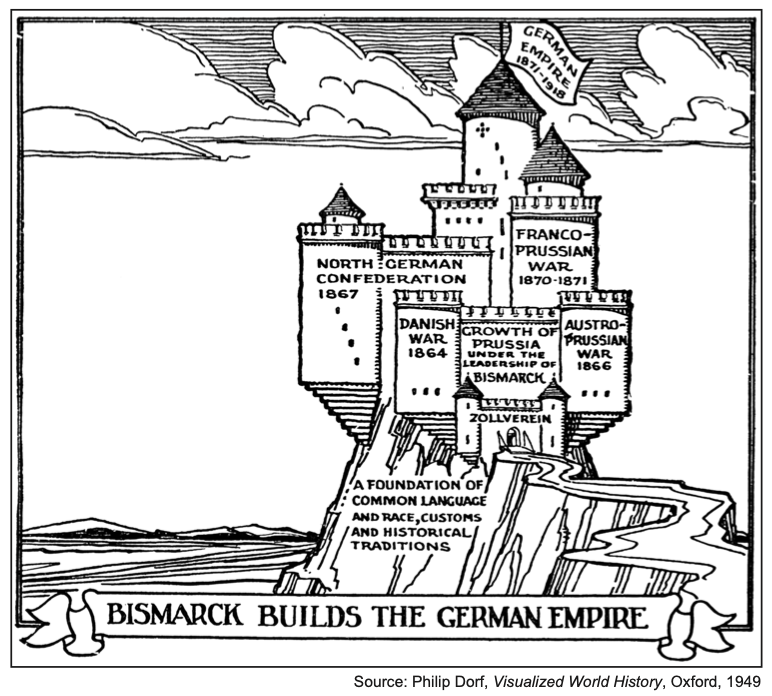
Based on this illustration, which claim about the formation of the German Empire is most accurate?
Based on this illustration, which claim about the formation of the German Empire is most accurate?
DOK 2
10.2.d.i
Ɛhia
1
DOK 3
10.2.d.i
Base your answers to questions 1 and 2 on the passage below and on your knowledge of social studies.
. . . Stock [typical] descriptions of Tokugawa Japan depict the continuing trade through Nagasaki as a minor exception to an isolationist policy, seeing it as a “tiny loophole” or a “crack in the door.” I prefer the metaphor of a relay or an “antenna” by means of which Japan received a continual flow of knowledge and information from both China and the West, as well as countless cultural objects that worked their own ways of change. It is impossible to tell the story of Tokugawa art, for example, without reference to the transformations wrought [shaped] by continuing input from both Chinese paintings and Western copperplate prints. The highly developed internal network of communications in Japan by way of the sankin kōtai [alternate residence] further insured that new knowledge spread rapidly to even the most remote castle towns. . . .
Source: Henry D. Smith, II, “Five Myths About Early Modern Japan,” Asia in Western and World History, M.E. Sharpe, 1997
Based on this illustration, which claim about the formation of the German Empire is most accurate?
Base your answers to questions 5 and 6 on the passage below and your knowledge of social studies.
The roots of the Opium War (or First China War) lay in a trade dispute between the British and the Chinese Qing Dynasty. By the start of the 19th century, the trade in Chinese goods such as tea, silks and porcelain was extremely lucrative for British merchants. The problem was that the Chinese would not buy British products in return. They would only sell their goods in exchange for silver, and as a result large amounts of silver were leaving Britain.
In order to stop this, the East India Company and other British merchants began to smuggle Indian opium into China illegally, for which they demanded payment in silver. This was then used to buy tea and other goods. By 1839, opium sales to China paid for the entire tea trade. . .
Source: “Opium War,” National Army Museum of the United Kingdom
Base your answers to questions 7 and 8 on the passage below and your knowledge of social studies.
. . . The most terrible outbreak of cholera which ever occurred in this kingdom [Great Britain], is probably that which took place in Broad Street, Golden Square, and the adjoining streets, a few weeks ago. Within two hundred and fifty yards of the spot where Cambridge Street joins Broad Street, there were upwards of five hundred fatal attacks of cholera in ten days. The mortality in this limited area probably equals any that was ever caused in this country, even by the plague, and it was much more sudden, as the greater number of cases terminated in a few hours. The mortality would undoubtedly have been much greater had it not been for the flight of the population. Persons in furnished lodgings left first, then other lodgers went away, leaving their furniture to be sent for when they could meet with a place to put it in. Many houses were closed altogether, owing to the death of the proprietors; and, in a great number of instances, the tradesmen who remained had sent away their families: so that in less than six days from the commencement of the outbreak, the most afflicted streets were deserted by more than three-quarters of their inhabitants. . . .
Source: John Snow, On the Mode of Communication of Cholera, 1855
Base your answer to question 9 on the maps below and on your knowledge of social studies.
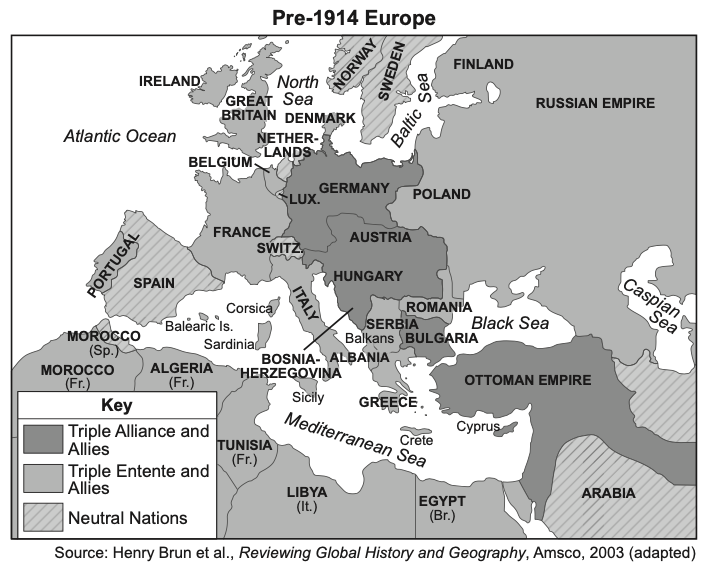
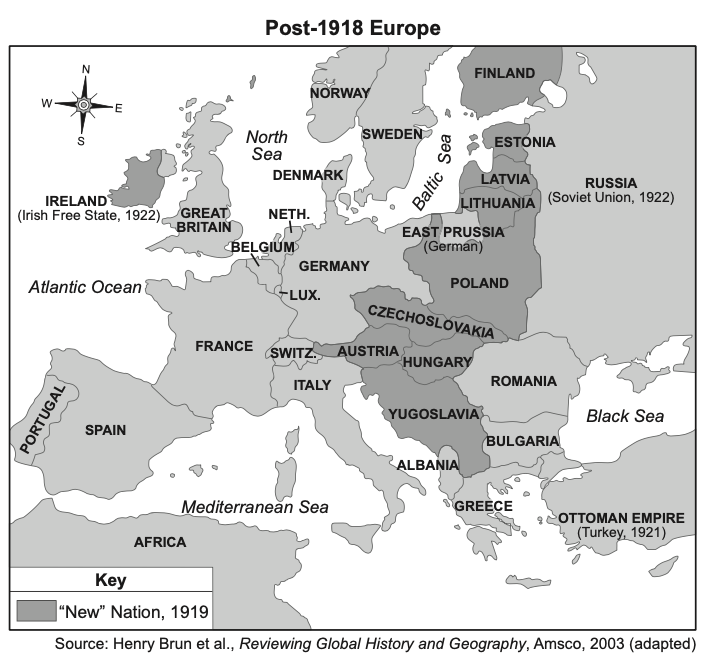
Based on these maps, which statement best describes Europe following World War I?
Base your answers to questions 10 and 11 on the passage below and on your knowledge of social studies.
. . . The most important duty of women is motherhood. If we remember that a child’s first school is his mother’s bosom, we can understand the utmost importance of this duty better. Our nation has decided to be a powerful one. One of the ways to ensure a powerful nation is to make sure our women are competent in every aspect. For that, our women will acquire scientific and technical information, and complete every phase of education that men complete. Thus women and men will walk side by side in social life helping and protecting each other.
Source: Speech by Mustafa Kemal Atatürk, 1923
Based on this passage, which statement best describes Atatürk’s point of view?
Base your answers to questions 12 and 13 on the passage below and on your knowledge of social studies.
. . . The Potsdam Conference is perhaps best known for President Truman’s July 24, 1945 conversation with Stalin, during which time the President informed the Soviet leader that the United States had successfully detonated the first atomic bomb on July 16, 1945. Historians have often interpreted Truman’s somewhat firm stance during negotiations to the U.S. negotiating team’s belief that U.S. nuclear capability would enhance its bargaining power. Stalin, however, was already well-informed about the U.S. nuclear program thanks to the Soviet intelligence network; so he also held firm in his positions. This situation made negotiations challenging. The leaders of the United States, Great Britain, and the Soviet Union, who, despite their differences, had remained allies throughout the war, never met again collectively to discuss cooperation in postwar reconstruction.
Source: “The Potsdam Conference, 1945,” Office of the Historian, United States Department of State
Base your answers to questions 14 and 15 on the passage below and on your knowledge of social studies.
. . . Nevertheless, for more than eighty years, the French imperialists, abusing the standard of Liberty, Equality and Fraternity, have violated our Fatherland and oppressed our fellow-citizens. They have acted contrary to the ideals of humanity and justice. . . .
Source: Speech by Ho Chi Minh, Declaration of Independence of the Republic of Vietnam, September 2, 1945
Which historical circumstance in Vietnam led to the statements in this speech?
Base your answers to questions 16 and 17 on the document below and on your knowledge of social studies.
Article 2
. . . Everyone is entitled to all the rights and freedoms set forth in this Declaration, without distinction of any kind, such as race, colour, sex, language, religion, political or other opinion, national or social origin, property, birth or other status. Furthermore, no distinction shall be made on the basis of the political, jurisdictional or international status of the country or territory to which a person belongs, whether it be independent, trust, non-self-governing or under any other limitation or sovereignty.
Article 3
Everyone has the right to life, liberty and security of person. . . .
Article 18
Everyone has the right to freedom of thought, conscience and religion; this right includes freedom to change his religion or belief, and freedom, either alone or in community with others and in public or private, to manifest his religion or belief in teaching, practice, worship and observance. . . .
Source: Universal Declaration of Human Rights, United Nations, 1948
Base your answer to question 18 on the passage below and on your knowledge of social studies.
. . . We value the friendship of the great countries and, if I may on your part, I should like to say that we send our greetings to the great countries of Europe and America. It is not in any spirit of hatred or dislike or aggressiveness we meet here with regard to Europe or America; certainly not. We send our greetings to them I hope from all of us here, and we want to be friends with them and to cooperate with them. But, we shall only cooperate in future and we shall obviously only be friends and equals; there is no friendship when nations are not equal, when one has to obey another and when one only dominates another. That is why we raise our voices against the domination and colonialism from which many of us have suffered for so long, and that is why we have to be very careful that any other form of domination does not come in our way. Therefore, we want to be friends with the West and friends with the East and friends with everybody, because if there is something that may be called the approach to the mind and spirit of Asia, it is one of toleration and friendship and cooperation; not one of aggressiveness.
Source: Speech by Jawaharlal Nehru at the Asian-African Conference, April 24, 1955
According to Nehru, the best path forward is to
Base your answer to question 19 on the speech excerpt below and on your knowledge of social studies.
. . . For centuries, Europeans dominated the African continent. The white man arrogated [claimed] to himself the right to rule and to be obeyed by the non-white; his mission, he claimed, was to “civilise” Africa. Under this cloak, the Europeans robbed the continent of vast riches and inflicted unimaginable suffering on the African people. . . .
It is clear that we must find an African solution to our problems, and that this can only be found in African unity. Divided we are weak; united, Africa could become one of the greatest forces for good in the world. . . .
Source: Kwame Nkrumah, I Speak of Freedom, Praeger, 1961
A major goal of this speech was to
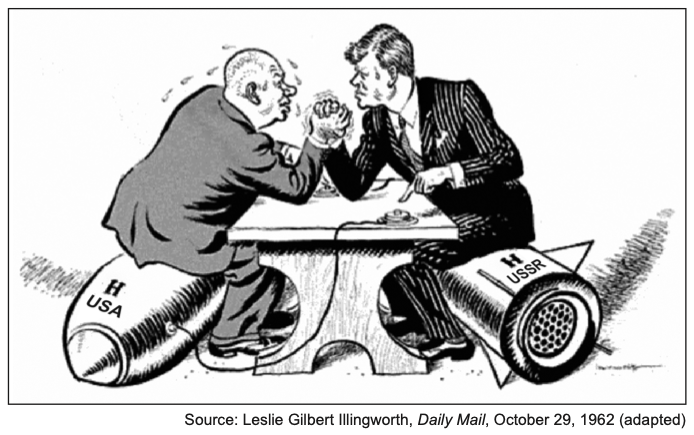
Which statement best describes the cartoonist’s purpose in creating this cartoon?
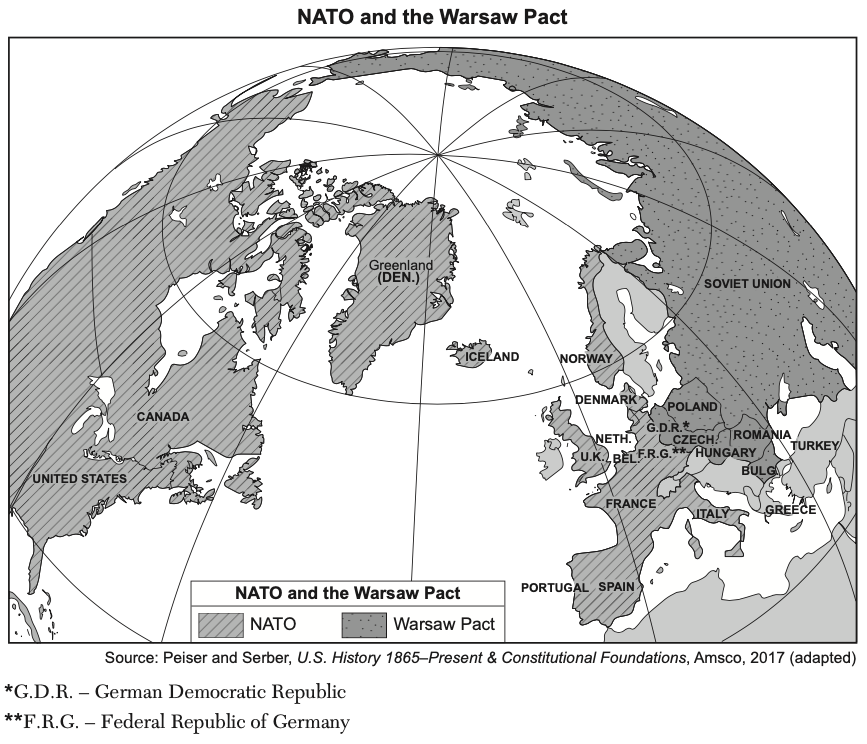
Which situation led to the creation of the alliances shown on this map?
Base your answers to questions 24 and 25 on the passage below and on your knowledge of social studies.
In the late 1970s, China emerged from three decades of economic isolation imposed by Mao Zedong, the leader of China’s communist revolution. Mao’s policies had produced a society that valued equality and uniformity. China was able to feed and clothe its population, the largest in the world, but there were few opportunities for individual advancement.
At the time of Mao’s death in 1976, Li Xiaohua was a peasant working on a state-run wheat farm in northern China. Like millions of his countrymen, Li closely followed the struggle for power among China’s political elite that followed Mao’s death. He was pleased when Deng Xiaoping emerged as the head of China’s Communist Party, and he supported Deng’s program of economic reform.
Today, Li is one symbol of China’s transformation. He has become a multi-millionaire businessman, and drives around Beijing, China’s capital, in a red Ferrari. He was the first person in China to own one. Under Mao, private cars were unheard of. As late as 1981, only twenty people in Beijing owned their own vehicles. The China that Deng and Li helped to create now has annual vehicle sales approaching twenty million. . . .
Source: China on the World Stage, Choices Program, Brown University, 2012
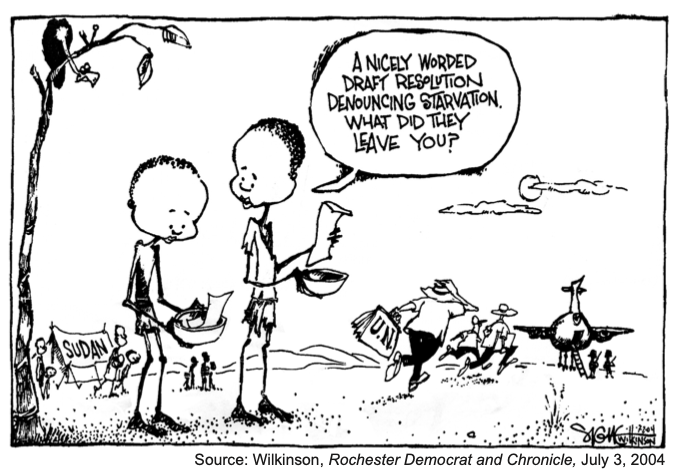
Which statement best describes this cartoonist’s point of view?
Base your answers to questions 27 and 28 on the article below and on your knowledge of social studies.
LAGOS, Nigeria — Rapidly growing countries generally see sharp increases in air pollution as their populations and economies expand. But a new study of air quality in Africa published on Monday has found the opposite: One of the continent’s most vibrant regions is becoming less polluted.
The study, published in Proceedings of the National Academy of Sciences, found that levels of dangerous nitrogen oxides, a byproduct of combustion, in the northern part of sub-Saharan Africa have declined sharply as wealth and population in the area have increased.
“The traditional paradigm [model] is that as middle and low-income countries grow you often see more emissions, and to see a different kind of trajectory [path] is very interesting,” said Jonathan Hickman, a researcher at the NASA Goddard Institute for Space Studies who was the lead author on the study. “It’s nice to see a decline occurring when you’d expect to see pollution increasing.”
The reason, according to researchers, is that an increase in pollution from industry and transportation in the area studied — from Senegal and Ivory Coast in the west to South Sudan, Uganda and Kenya in the east — appears to have been offset by a decline in the number of fires set by farmers. . . .
Source: Shola Lawal, “A Surprise in Africa: Air Pollution Falls as Economies Rise,” New York Times, February 8, 2021
CRQ Set 1 Directions (29–31): Analyze the documents and answer the short-answer questions that follow each document in the space provided.
Short-Answer CRQ Set 1 Structure
• Question 29 uses Document 1 (Context)
• Question 30 uses Document 2 (Source)
• Question 31 uses Documents 1 and 2 (Relationship between documents)
Base your answer to question 29 on Document 1 below and on your knowledge of social studies.
Document 1
Men being, as has been said, by nature, all free, equal and independent, no one can be put out of this estate, and subjected to the political power of another, without his own consent. The only way whereby any one divests [surrenders] himself of his natural liberty, and puts on the bonds of civil society, is by agreeing with other men to join and unite into a community for their comfortable, safe, and peaceable living one amongst another, in a secure enjoyment of their properties, and a greater security against any, that are not of it. This any number of men may do, because it injures not the freedom of the rest; they are left as they were in the liberty of the state of nature. When any number of men have so consented to make one community or government, they are thereby presently incorporated, and make one body politic [state], where in the majority have a right to act and conclude the rest. . . .
Source: John Locke, Second Treatise of Government, 1690
Explain the historical circumstances that led to the ideas described in this document.
Base your answer to question 30 on Document 2 below and on your knowledge of social studies.
Document 2
Olympe de Gouges wrote pamphlets and plays on a variety of political and social issues. This excerpt is from the Declaration of the Rights of Woman and of the Female Citizen, which she modeled on the Declaration of the Rights of Man and of the Citizen (1789). The declaration was presented to the French Legislative Assembly on October 28, 1791, and was later published in the booklet The Rights of Women.
Article I
Woman is born free and lives equal to man in her rights. Social distinctions can be based only on the common utility.
Article II
The purpose of any political association is the conservation of the natural and imprescriptible [undeniable] rights of woman and man; these rights are liberty, property, security, and especially resistance to oppression. . . .
Article IV
Liberty and justice consist of restoring all that belongs to others; thus, the only limits on the exercise of the natural rights of woman are perpetual male tyranny; these limits are to be reformed by the laws of nature and reason. . . . Article VI The law must be the expression of the general will; all female and male citizens must contribute either personally or through their representatives to its formation; it must be the same for all: male and female citizens, being equal in the eyes of the law, must be equally admitted to all honors, positions, and public employment according to their capacity and without other distinctions besides those of their virtues and talents. . . .
Source: Olympe de Gouges, Declaration of the Rights of Woman and of the Female Citizen, 1791
Based on this excerpt, explain how audience affects what Olympe de Gouges includes in this document.
Document 1
Men being, as has been said, by nature, all free, equal and independent, no one can be put out of this estate, and subjected to the political power of another, without his own consent. The only way whereby any one divests [surrenders] himself of his natural liberty, and puts on the bonds of civil society, is by agreeing with other men to join and unite into a community for their comfortable, safe, and peaceable living one amongst another, in a secure enjoyment of their properties, and a greater security against any, that are not of it. This any number of men may do, because it injures not the freedom of the rest; they are left as they were in the liberty of the state of nature. When any number of men have so consented to make one community or government, they are thereby presently incorporated, and make one body politic [state], where in the majority have a right to act and conclude the rest. . . .
Source: John Locke, Second Treatise of Government, 1690
Identify and explain a cause-and-effect relationship associated with the historical developments in Documents 1 and 2. Be sure to use evidence from both Documents 1 and 2 in your response.
CRQ Set 2 Directions (32–34): Analyze the documents and answer the short-answer questions that follow each document in the space provided.
Short-Answer CRQ Set 2 Structure
• Question 32 uses Document 1 (Context)
• Question 33 uses Document 2 (Source)
• Questions 34a and 34b use Documents 1 and 2 (Relationship between documents)
Base your answer to question 32 on Document 1 below and on your knowledge of social studies.
Document 1
This excerpt is from notes taken by General Lieutenant Liebmann as he was listening to a speech by Adolf Hitler. This speech was delivered at a dinner party attended by the chiefs of the German army and navy on February 3, 1933.
. . . The sole aim of general policy: the regaining of political power. The whole State administration must be geared to this end (all departments!). . . .
2. Foreign policy: Battle against Versailles. Equality of rights in Geneva; but useless if people do not have the will to fight. Concern for allies.
3. Economics: The farmer must be saved! Settlement policy! Further increase of exports useless. The capacity of the world is limited and production is forced up everywhere. The only possibility of re-employing part of the army of unemployed lies in settlement. But time is needed and radical improvement not to be expected since living space too small for German people.
4. Building up of the armed forces: Most important prerequisite [requirement] for achieving the goal of regaining political power. National Service must be reintroduced. But beforehand the State leadership must ensure that the men subject to military service are not, even before their entry, poisoned by pacifism, Marxism, Bolshevism or do not fall victim to this poison after their service.
How should political power be used when it has been gained? That is impossible to say yet. Perhaps fighting for new export possibilities, perhaps—and probably better—the conquest of new living space in the east and its ruthless Germanization. Certain that only through political power and struggle can the present economic circumstances be changed. The only things that can happen now—settlement—stopgap measures. . . .
Source: Noakes and Pridham, eds., Nazism 1919–1945, Exeter University Press, 2000
Explain the historical circumstances that led to the ideas expressed in these notes taken from Adolf Hitler’s speech.
Base your answer to question 33 on Document 2 below and on your knowledge of social studies.
Document 2
Hashimoto Kingorō was a colonel in the Imperial Japanese Army and the founder of a Japanese ultranationalist society. This excerpt is from a speech he delivered in response to criticism of Japan’s expansion into Manchuria.
We have already said that there are only three ways left to Japan to escape from the pressure of surplus population. We are like a great crowd of people packed into a small and narrow room, and there are only three doors through which we might escape, namely emigration, advance into world markets, and expansion of territory. The first door, emigration, has been barred to us by the anti-Japanese immigration policies of other countries. The second door, advance into world markets, is being pushed shut by tariff barriers and the abrogation [discontinuation] of commercial treaties. What should Japan do when two of the three doors have been closed against her?
It is quite natural that Japan should rush upon the last remaining door.
It may sound dangerous when we speak of territorial expansion, but the territorial expansion of which we speak does not in any sense of the word involve the occupation of the possessions of other countries, the planting of the Japanese flag thereon, and the declaration of annexation to Japan. It is just that since the [world] Powers have suppressed [restricted] the circulation of Japanese materials and merchandise abroad, we are looking for some place overseas where Japanese capital, Japanese skills, and Japanese labor can have free play, free from the oppression of the white race.
We would be satisfied with just this much. What moral right do the world powers who have themselves closed to us the two doors of emigration and advance into world markets have to criticize Japan’s attempt to rush out of the third and last door?
If they do not approve of this, they should open the doors which they have closed against us and permit the free movement overseas of Japanese emigrants and merchandise. . . .
Source: Hashimoto Kingorō, “The Need for Emigration and Expansion,” Address to Young Men, 1937
Based on this excerpt, explain how Hashimoto’s speech shows bias in his description of the treatment
of Japan.
Document 1
This excerpt is from notes taken by General Lieutenant Liebmann as he was listening to a speech by Adolf Hitler. This speech was delivered at a dinner party attended by the chiefs of the German army and navy on February 3, 1933.
. . . The sole aim of general policy: the regaining of political power. The whole State administration must be geared to this end (all departments!). . . .
2. Foreign policy: Battle against Versailles. Equality of rights in Geneva; but useless if people do not have the will to fight. Concern for allies.
3. Economics: The farmer must be saved! Settlement policy! Further increase of exports useless. The capacity of the world is limited and production is forced up everywhere. The only possibility of re-employing part of the army of unemployed lies in settlement. But time is needed and radical improvement not to be expected since living space too small for German people.
4. Building up of the armed forces: Most important prerequisite [requirement] for achieving the goal of regaining political power. National Service must be reintroduced. But beforehand the State leadership must ensure that the men subject to military service are not, even before their entry, poisoned by pacifism, Marxism, Bolshevism or do not fall victim to this poison after their service.
How should political power be used when it has been gained? That is impossible to say yet. Perhaps fighting for new export possibilities, perhaps—and probably better—the conquest of new living space in the east and its ruthless Germanization. Certain that only through political power and struggle can the present economic circumstances be changed. The only things that can happen now—settlement—stopgap measures. . . .
Source: Noakes and Pridham, eds., Nazism 1919–1945, Exeter University Press, 2000
Document 1
Martinique is an island in the Caribbean Sea.
Great General [Governor of the Colony of Martinique]:
. . . We end our reflections by declaring to you that the entire Nation of Black Slaves united together has a single wish, a singly desire for independence, and all the slaves with a unanimous voice send out only one cry, one clamor to reclaim the liberty they have gained through centuries of suffering and ignominious [humiliating] servitude.
This is no longer a Nation that is blinded by ignorance and that trembles at the threat of the lightest punishments; its suffering has enlightened it and has determined it to spill to its last drop of blood rather than support the yoke of slavery, a horrible yoke attacked by the laws, by humanity, and by all of nature, by the Divinity and by our good King Louis XVI. We hope it will be condemned by the illustrious [Governor] Viome’nil. Your response, Great General, will decide our destiny and that of the colony. Please send it to the parish priests who will inform us about it at the announcements at the end of mass. We await it with the greatest impatience, but without leaving behind the respect that is due to your dignity, and the Nation asks you to believe it to be, [Great] Grand General, your most humble and obedient servant.
Signed,
The Entire Nation
Source: Letter from the Slaves of Martinique, August 29, 1789
Enduring Issues Essay:
Which claim related to Tokugawa policies is best supported by this passage?
What is the purpose of this passage?
What was one result of the events depicted in this illustration?
Which statement is best supported by this passage?
Which statement identifies a long-term effect of the conflict described in this passage?
Which claim is best supported by this passage?
This passage could best be used to study which topic?
What was one result of Atatürk’s policies described in this passage?
During which war did the conference described in this passage take place?
One major effect of the historical developments described in this passage was
The main purpose of this speech was to
Which statement best describes the purpose of this document?
Which event most directly influenced the writing of this document?
Which action was the direct result of the situation depicted in this cartoon?
Which claim is best supported by this map?
Which of Deng Xiaoping’s actions contributed most directly to the changes experienced by Li Xiaohua as described in this passage?
Based on this passage, one can infer that the increase in vehicle usage in China has led to
A student would find this article most useful for researching the
Which piece of evidence would best support the claim about the environment in this article?
Identify a similarity or a difference between the foreign policies of Japan and Germany in the 1930s.
Explain the similarity or difference you identified using evidence from both documents.
Enduring Issues Essay Optional Planning Page