Preskoči na glavni sadržaj
Prijava
Sign up for FREE
arrow_back
Biblioteka

Coral Bleaching and Reef Fish Decline - MS - LS - Matter and Energy

star
star
star
star
star
Posljednje ažuriranje 6 months ago
6
Napomena autora:

Directions: Use the information provided and your knowledge of Life Science to answer the following questions. Show all work where necessary.

Directions: Use the information provided and your knowledge of Life Science to answer the following questions. Show all work where necessary.

0
Obavezno
4
DOK 2
MS-LS2-4
Obavezno
6
DOK 3
MS-LS2-2
Obavezno
2
DOK 1
MS-LS2-4
Obavezno
4
DOK 2
MS-LS2-4
Obavezno
6
DOK 3
MS-LS2-4
Obavezno
2
DOK 1
MS-LS2-2

Coral Bleaching and Reef Fish Decline

Coral reefs are among the most diverse and productive ecosystems on the planet. Though they occupy less than 1% of the ocean floor, they provide habitat for nearly 25% of all marine species. Corals are tiny animals that live in colonies and build calcium carbonate skeletons, forming massive reef structures over centuries. Inside their tissues live microscopic algae called zooxanthellae, which perform photosynthesis. These algae provide the coral with most of its energy and give it its brilliant colors.

This partnership is delicate and depends on specific environmental conditions — especially temperature, sunlight, and water chemistry. When ocean temperatures rise, even by just $1–2^\circ\text{C}$ above normal, corals experience stress. In response, they expel their symbiotic algae, turning the corals white in a process known as bleaching. Without their algae, corals lose their main food source and become more vulnerable to disease and starvation.

As bleached corals die, the reef’s physical structure begins to deteriorate. Many reef fish species depend on the coral framework for food, shelter, and breeding sites. When coral cover decreases, fish populations decline as well. For example, studies in the Great Barrier Reef and the Caribbean have shown that fish diversity can drop by $30–50\%$ following severe bleaching events.

Bleaching not only affects fish but also disrupts the entire reef food web. Herbivorous fish that graze on algae lose food sources, while predators have fewer prey to eat. The result is a cascade of population changes that alters the balance of the entire ecosystem.

These impacts illustrate how changes to both physical components (temperature, water chemistry) and biological components (coral health, algae symbiosis) can dramatically affect populations. Over time, repeated bleaching events may lead to the collapse of reef ecosystems, reducing biodiversity and the ecosystem services reefs provide - such as coastal protection and fisheries that support millions of people.

Understanding coral bleaching helps scientists predict how climate change will reshape ocean ecosystems and highlights why maintaining stable environmental conditions is vital for sustaining biodiversity.
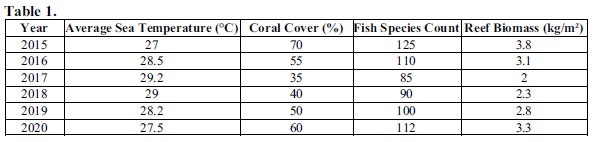
Graph of Information - Figure 1.
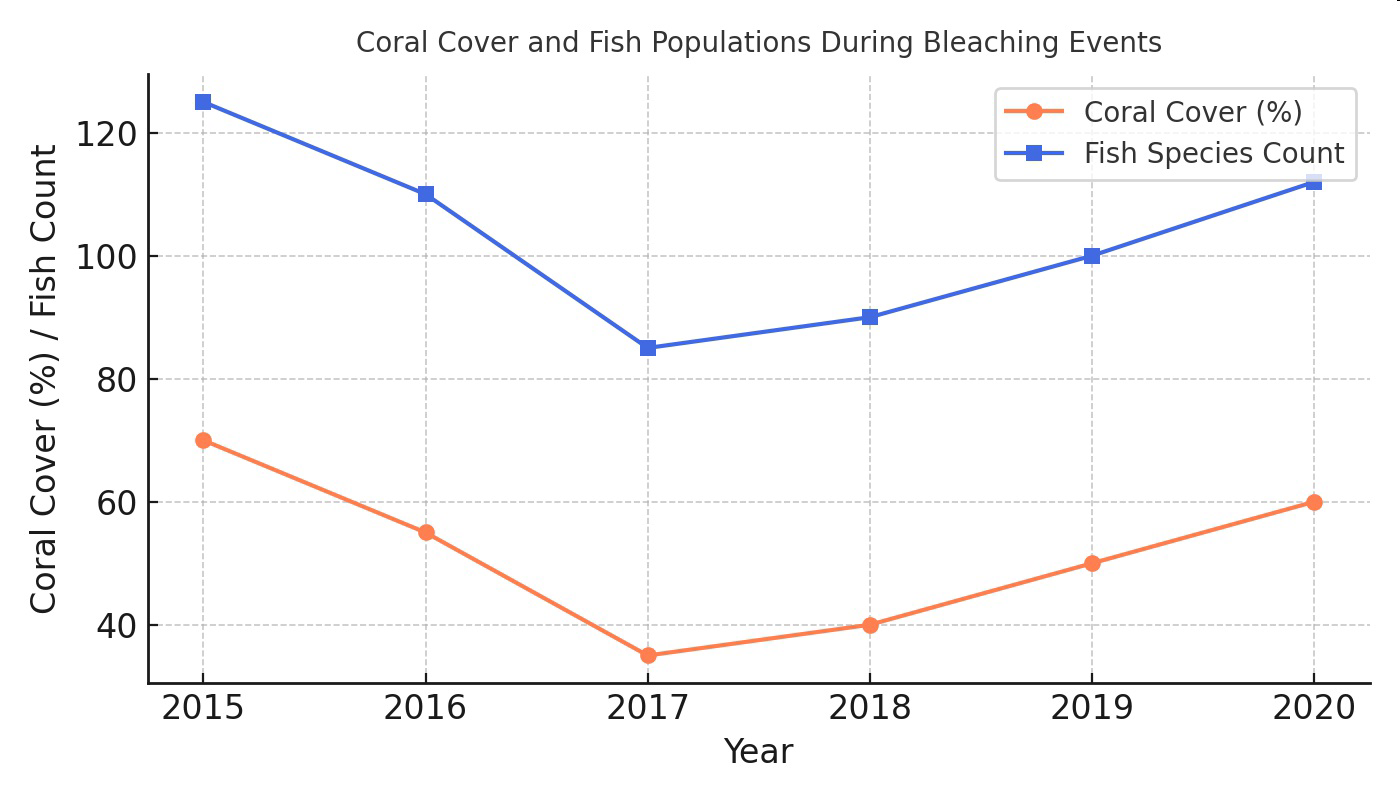
Line graph titled 'Coral Cover and Fish Populations During Bleaching Events' showing coral cover percentage and fish species count from 2015 to 2020.

Figure 2.

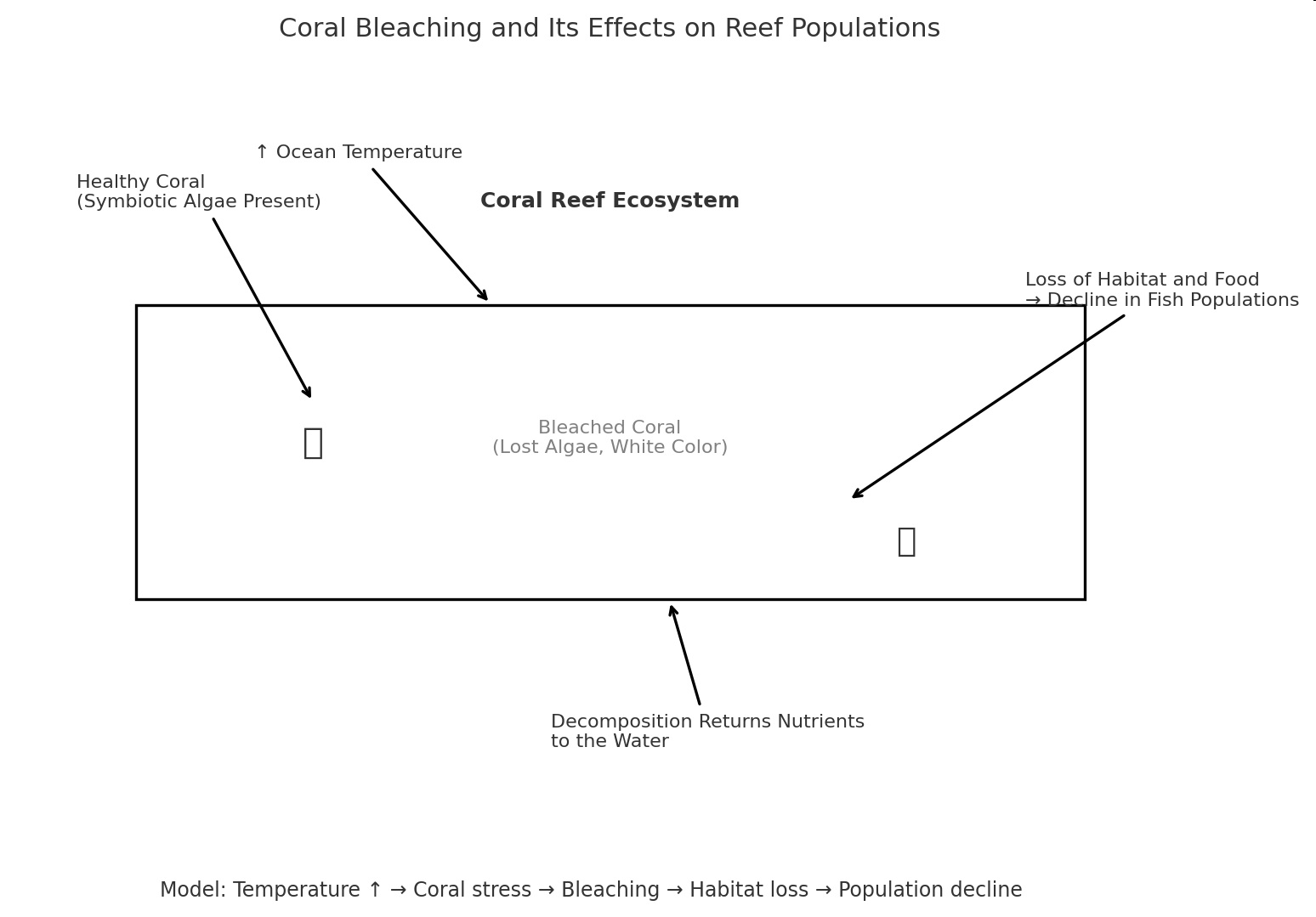
Diagram of coral bleaching and its effects on reef populations, showing changes from healthy coral to bleached coral, and impacts on habitat and fish populations.

Pitanje 1
1.

Using Table 1, describe how coral cover changed from 2015 to 2020 and identify the temperature pattern associated with this change.

Pitanje 2
2.

Explain how declining coral cover can affect reef fish populations in this ecosystem.

Pitanje 3
3.

Which factor in Table 1 most directly contributes to coral bleaching in the years with the largest coral declines?

Pitanje 4
4.

Compare fish species count in 2015 and 2017. What does this change show about the relationship between coral health and fish diversity?

Pitanje 5
5.

Does the data support the idea that changes in abiotic factors (such as temperature) can affect populations in an ecosystem?

Claim:
Evidence:
Reasoning:

Pitanje 6
6.

Which statement best explains why repeated bleaching events may lead to long-term ecosystem collapse?