Middle School
Life Science
Plant Growth Without Soil Cluster
Plant Growth Without Soil
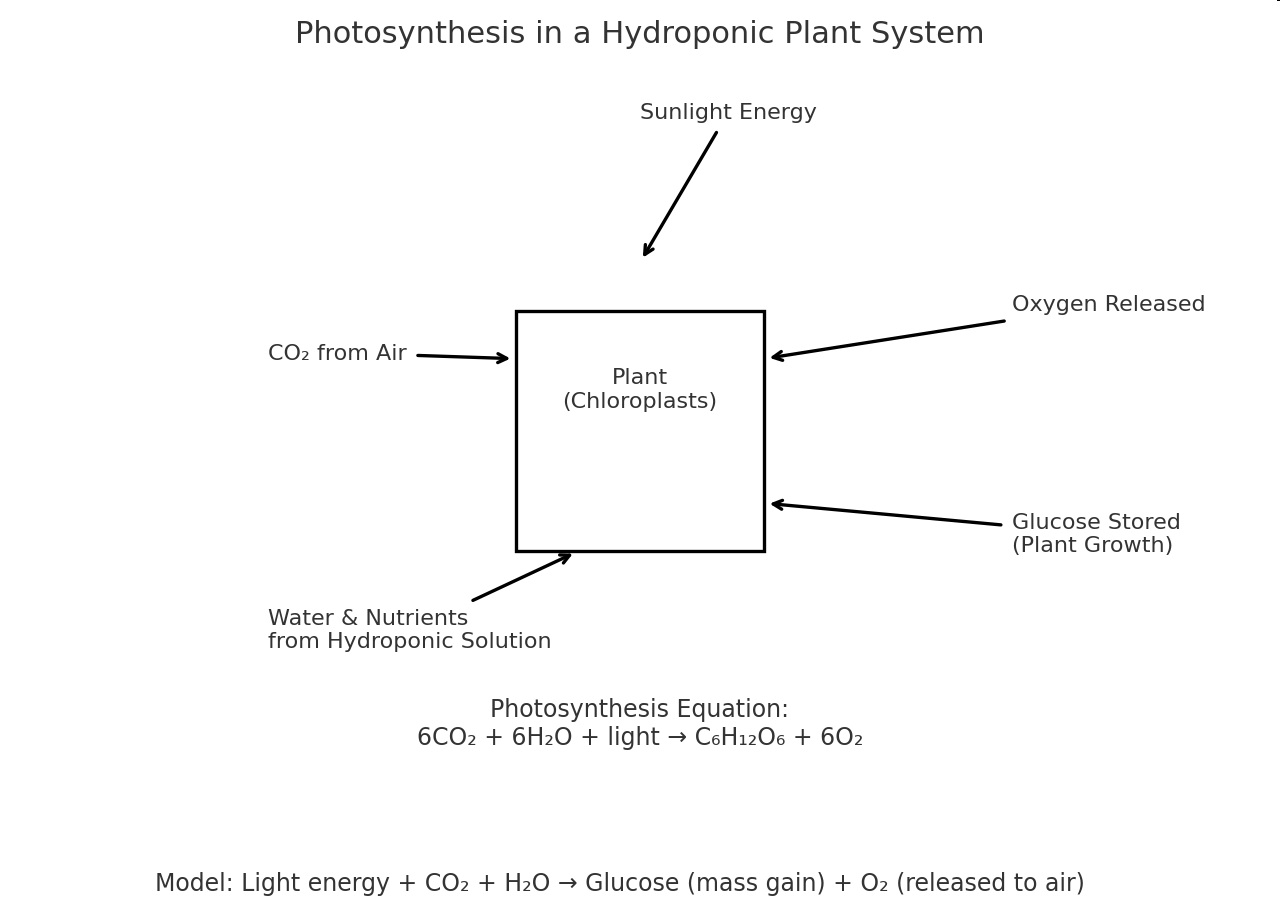
All living things need matter and energy to grow. For plants, that process begins with photosynthesis - a chemical reaction that converts carbon dioxide (CO$_2$) and water (H$_2$O) into glucose (C$_6$H$_{12}$O$_6$) and oxygen (O$_2$) using energy from sunlight. This reaction takes place inside chloroplasts, specialized cell organelles containing the green pigment chlorophyll, which captures light energy.
The general chemical equation for photosynthesis is:
$6\ \text{CO}_2 + 6\ \text{H}_2\text{O} + \text{light} \rightarrow 6\ \text{C}_6\text{H}_{12}\text{O}_6 + 6\ \text{O}_2$
In soil-based systems, plants also absorb minerals through their roots, but most of the plant’s mass actually comes from the carbon in carbon dioxide - not from the soil itself. Hydroponics provides a clear way to see this: plants growing in only water and light still gain weight because photosynthesis builds carbohydrates using carbon from the air and hydrogen and oxygen from water.
This demonstrates how photosynthesis drives the cycling of matter and flow of energy - sunlight energy enters the system, chemical energy is stored in sugars, and oxygen is released to the environment. The plant’s growth is visible evidence of energy transformation and matter conversion.
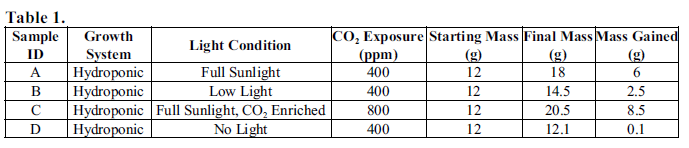
Graph of Information - Figure 1.
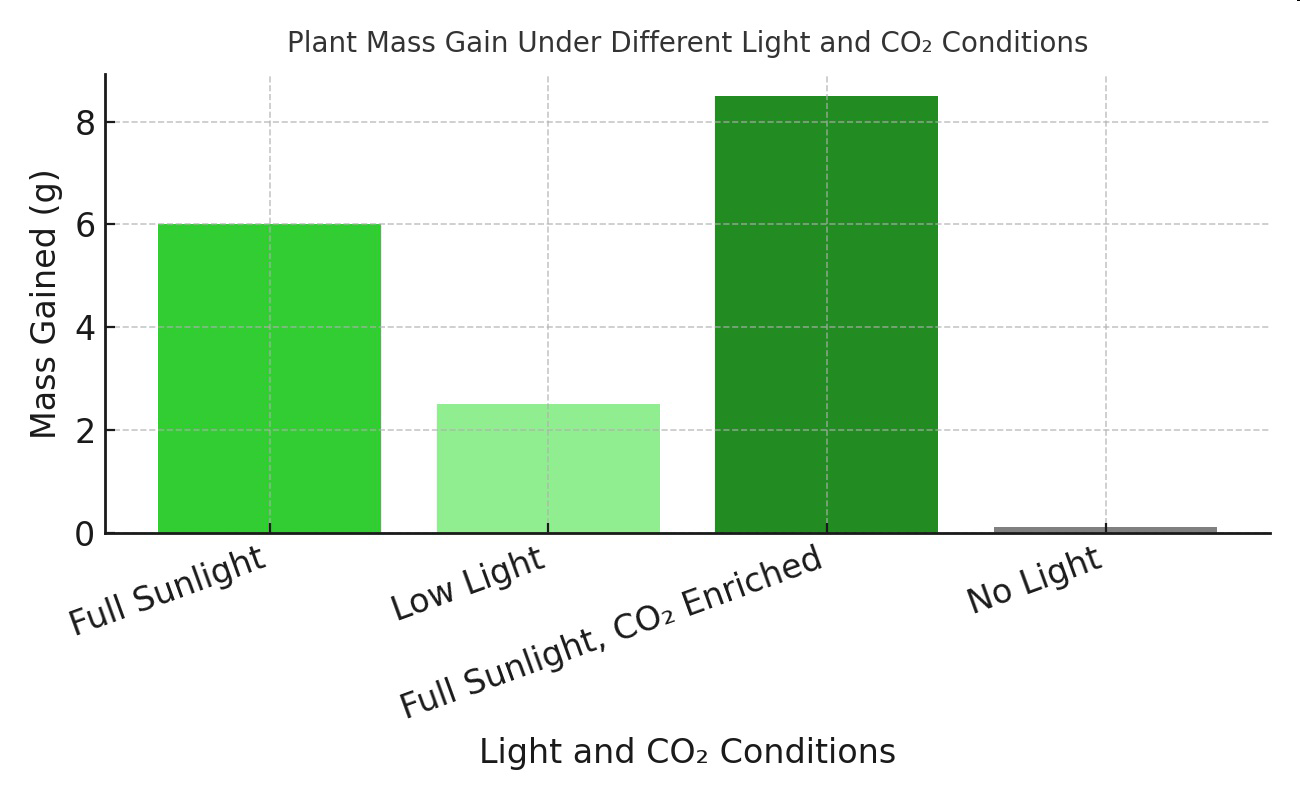
Figure 2.