Summative #6 - No Ducks for Dinner/The Peanut Man
star
star
star
star
star
Last updated 6 months ago
22 Nsɛmmisa
by Janna Matthies
1 Orville Duck spread his wings to dry in the morning sun. He blinked his eyes and felt a tingle in his tummy. No slugs for me today, he thought. Just like Mother always said, Sunshine on a spring day means company’s coming.
2 “They’ll be here soon,” said Otis Duck, rearranging his tail feathers. “I can almost taste the cracked corn now!”
3 “We wish for bread crust,” said Ophelia Duckling and Olivia Duckling in unison. The fuzzy twins tossed pebbles into the pond with their bills and watched the rings that formed grow wide.
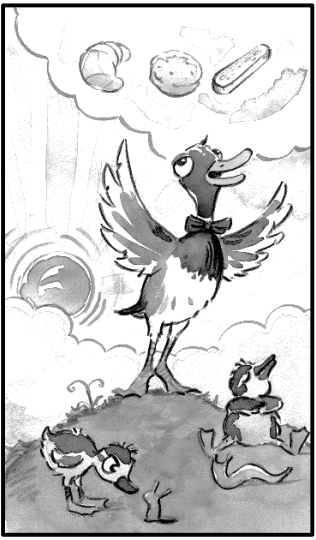
4 Orville, who had always had a taste for the finer things in life, was dreaming of croissants and scones and biscotti—pleasures he had only heard about from the ducks upstream.
5 From out of the woods dashed a boy in a red cap. He skidded to a halt on the gravel path. “Ducks! Lots of them!” he called to his family.
6 Orville tried to remain calm as his eyes darted from the mother to the father, the brother to the sister. He searched for signs of food—a white bakery box, or an old bread bag. He saw a line of fish over the father’s shoulder and a bucket of berries in the mother’s hand, but nothing that looked like it was meant for ducks.
7 Without so much as reaching into their pockets, the family headed back into the woods.
8 A chorus of confused quacks arose.
9 Orville stayed silent. Standing still before the forest path, he was lost in a dream of trout almandine and homemade wild-berry pie.
10 “What are we—a bunch of silly geese?” he yelled suddenly, turning to face his fellow ducks. “We sit here day after day waiting for handouts when we could be sitting pretty as peacocks at a four-star feast. I say we hightail it onto that path and follow those people to their cabin.” He puffed up his chest and stood tall. “Who’s ready for a real meal?”
11 Soon Orville heard one muffled quack, then another, and another as a handful of ducks lined up behind him. “Is that it?” he said to those staying put. “See you when our bellies are full!”
12 The troop took to the path and arrived shortly at a wooden fence draped with wet waders. They looked up to see smoke curling from the chimney of a cozy cabin. Orville’s mouth started to water. He licked his bill and motioned to the others to lie low.
13 “I’m going in!” he whispered, waddling slowly to the door.
14 KNOCK, KNOCK, KNOCK, QUACK!
15 The mother cracked the door open and peeked out. She looked from Orville to the ducks crouched behind him. “Sorry, no ducks for dinner!” she said, and shut the door. Orville turned and glanced at his friends in disbelief.
16 Otis Duck was feeling brave. “Let me have a try,” he said, making tracks to the door.
17 WHACK, WHACK, WHACK, QUACK!
18 This time the father peered through a window, then slid a note under the door.
19 Having grown up on a farm, Otis Duck knew how to read chicken scratch. “It says,” he read slowly. “In case you have feathers in your ears, we’re putting it in writing: NO DUCKS FOR DINNER!”
20 Again, the ducks were speechless until Ophelia and Olivia stepped forward. “This feast will not pass us by!” squeaked Ophelia.
21 “They’ll change their minds when they see us cute little ducklings,” peeped Olivia.
22 The older ducks nodded in agreement and watched the twins approach the cabin door.
23 TAP, TAP, TAP, SQUEAK!
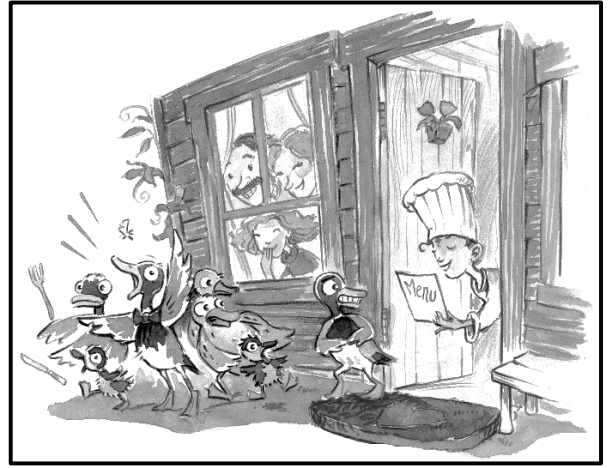
24 This time the entire family gathered at the window. There seemed to be some discussion, and then the boy in the red cap appeared at the door—only now he was wearing a chef’s hat. “Welcome, ducks,” he said. “We’ve had a change of menu and would like to invite you to stay.”
25 There was a flapping of wings and thunderous quacking.
26 “Oh, would you like to know what’s for dinner?” asked the boy. He smiled, cleared his throat, and read slowly from a piece of paper: “Roast duckling on a bed of quack grass, duck pudding, and a glass of sparkling cold duck soda.”
27 Suddenly, a stray feather zigzagged through the spring air and landed on Orville’s bill. His eyes grew large as mushroom tops, and he honked louder than a goose. “Um...like they said: NO DUCKS FOR DINNER!”
28 In two shakes of a quail’s tail, the horde of hungry ducks took to the sky. They arrived back at the pond just as a group of children and parents were leaving with empty bread bags. The ducks who had stayed behind lay satisfied in the afternoon sun.
29 Orville sighed and headed to the edge of the pond to look for slugs. That’s when he remembered another one of Mother’s sayings:
Be thankful for the things you have,
Whether feast or few.
It’s far better to swim in crumbs
Than to drown in duckling stew.
Which choice provides a summary of the passage?
What does the author mean by the phrase “felt a tingle in his tummy” in paragraph 1?
What did the ducks eat on days when they had to find their own food?
PART A: What does the word darted mean as it is used in paragraph 6?
PART B: Which phrase from paragraph 6 supports the answer to Part A?
Read the sentence from paragraph 27.
"His eyes grew large as mushroom tops, and he honked louder than a goose.”
What does the author mean by the phrase “his eyes grew large as mushroom tops” in the sentence?
PART A: How did Orville react to the family that visited the pond?
PART B: Which quotation from the passage supports the answer to Part A?
How did the use of the phrase “no ducks for dinner” change throughout the events of the passage?
Which two quotations support the inference that most people who came to the pond fed the ducks?
How would the passage be different if it were told from the first-person point of view of the main character?
How would the passage be different if it were written as a play?
1 George Washington Carver was always interested in plants. When he was a child, he was known as the “plant doctor.” He had a secret garden where he grew all kinds of plants. People would ask him for advice when they had sick plants. Sometimes he’d take their plants to his garden and nurse them back to health.
2 Later when he was teaching at Tuskegee Institute, he put his plant skills to good use. Many people in the South had been growing only cotton on their land. Cotton plants use most of the nutrients in the soil. Nutrients provide nourishment to plants. So the soil becomes “worn out” after a few years. Eventually, cotton will no longer grow on this land.
3 This was especially bad for poor African American farmers, who relied on selling cotton to support themselves. Carver was dedicated to helping those farmers, so he came up with a plan.
4 Carver knew that certain plants put nutrients back into the soil. One of those plants is the peanut! Peanuts are also a source of protein.
5 Carver thought that if those farmers planted peanuts, the plants would help restore their soil, provide food for their animals, and provide protein for their families — quite a plant! In 1896 peanuts were not even recognized as a crop in the United States, but Carver would help change that.
6 Carver told farmers to rotate their crops: plant cotton one year, then the next year plant peanuts and other soil restoring plants, like peas and sweet potatoes. It worked! The peanut plants grew and produced lots of peanuts. The plants added enough nutrients to the soil so cotton grew the next year. Now the farmers had lots of peanuts — too many for their families and animals — and no place to sell the extras. Again, Carver had a plan. Do you know what he did?
7 Carver invented all kinds of things made out of peanuts. He wrote down more than 300 uses for peanuts, including peanut milk, peanut paper, and peanut soap. Carver thought that if farmers started making things out of peanuts, they’d have to buy fewer things and would be more self-sufficient. If other people started making things out of peanuts, they would want to buy the extra peanuts so that the farmers would make more money. Although not many of Carver’s peanut products were ever mass-produced, he did help spread the word about peanuts.
8 Peanuts became more and more popular. By 1920, there were enough peanut farmers to form the United Peanut Association of America (UPAA). In 1921, the UPAA asked Carver to speak to the U.S. Congress about the many uses for peanuts. Soon the whole country had heard of George Washington Carver, the Peanut Man! By 1940, peanuts had become one of the top six crops in the U.S.
What does "dedicated" mean as it is used in paragraph 3 of "The Peanut Man"?
Which TWO details from the article provide evidence that Carver was dedicated to his work?
PART A: What is the main idea of the article?
PART B: Which detail from the article supports the answer to Part A?
What text structure is used in paragraph 2?
PART A: Which sentence best summarizes "The Peanut Man"?
PART B: Which TWO sentences from the article are important to include in a summary of "The Peanut Man"?
How does the author best support the idea that peanuts have become a major crop?
PART A: How did Carver become well-known across the country?
PART B: Which detail from the article supports the answer to Part A?