Hydrogen and oxygen react chemically to form water. How much water would form if 14.8 g of hydrogen reacted with 34.8 g of oxygen?
Balance the reaction.
__
Balance the reaction and indicate which type of chemical reaction (synthesis, decomposition, single displacement, double displacement) is being represented.
_
Reaction Type :
Balance the reaction and indicate which type of chemical reaction (synthesis, decomposition, single displacement, double displacement) is being represented.
_
Reaction type:
Balance the reaction and indicate which type of chemical reaction (synthesis, decomposition, single displacement, double displacement) is being represented.
_
Reaction type:
Balance the reaction and indicate which type of chemical reaction (synthesis, decomposition, single displacement, double displacement) is being represented. Show your work.
_
Reaction type:
In a chemical reaction
Using the chemical reaction, CH4 + 2O2 → CO2 + 2H2O if you count the atoms in the reactants, there are
In a chemical reaction, mass is conserved. This means that
If the reactants on the left side of a chemical equation are C3H8 + 5O2 the products in a balanced equation could be
If more reactants are used in a chemical reaction, more products will be produced. This is because
If two substances react and the temperature of the mixture increases, the reaction is
A chemical equation is shown below.
2H2O ➜ 2H2 + O2
Which of the following choices is/are the product(s) of this chemical reaction?
A chemical equation is shown below.
2H2O ➜ 2H2 + O2
Which of the following choices is the reactant of this chemical reaction?
Students have two identical beakers with a mass of 20 grams each. The students pour a different liquid reactant into each beaker. The total mass of the two beakers with the reactants is 50 grams. Next, the students combine Reactant 1 and Reactant 2 into one of the beakers. A chemical reaction produces a product.
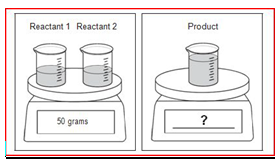
If all of the reactants are consumed and no gases are produced, what is the total mass of the product and one beaker?
When you burn a candle, all that remains is a small puddle of wax. The puddle of wax has less mass than the original candle. The rest of the original candle’s mass was
Use the law of conservation of mass to fill out the missing information in the table below.
Reaction | Reactants | Products | ||
1 | HgO | Hg | O2 | |
mass | 23.6 g | 13.0 g | ||
2 | CH4 | O2 | CO2 | H2O |
mass | 12.2 g | 14 g | 20.0 g | |
3 | Al(OH)3 | Al2O3 | H2O | |
mass | 21.8 g | 9.7 g | ||
A sample of copper powder is heated in an evaporating dish using a Bunsen burner. If the mass of the powder in the evaporating dish increases after heating, this indicates that
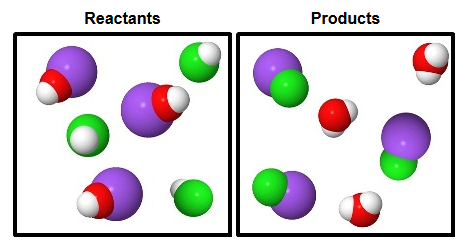
The images below are models that represent the reactants and products of a chemical reaction.

Based on the models, was mass conserved in this chemical reaction?
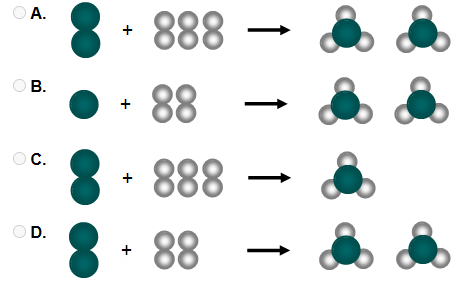
The chemical equation below shows the formation of ammonia from nitrogen and hydrogen gases.
N2 + H2 -----> NH3
However, the equation shown is not balanced. Which of the following particle diagrams shows the correct balanced form of the equation?