4 BIO - EOC - Ecosystems
star
star
star
star
star
Last updated 6 months ago
9 Nsɛmmisa
Each year, students in a biology class observe the monarch butterfly population in the field next to their school. The school’s field is a prairie habitat that contains milkweed plants. Monarch butterflies lay their eggs on milkweed because the hatched monarch caterpillars eat the leaves. Monarch butterfly populations have decreased to only a fraction of their former numbers over the last several decades.
This year, the class notices that some areas of the field are mowed several weeks before the monarchs start laying eggs. They wonder how humans impact the monarch population with mowing. They read articles on monarch conservation practices. Some experts claim that the monarch adult females prefer to lay their eggs on newer milkweed leaves to ensure the caterpillars that hatch will have a food supply for a longer time.
To investigate this claim, students conduct monarch egg counts in the two different areas of the field—mowed areas and control areas that are not mowed.
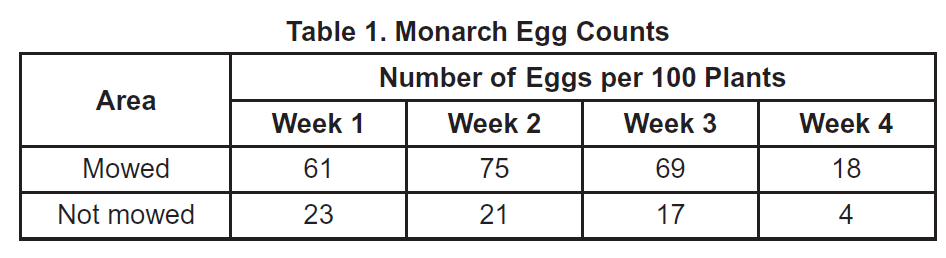
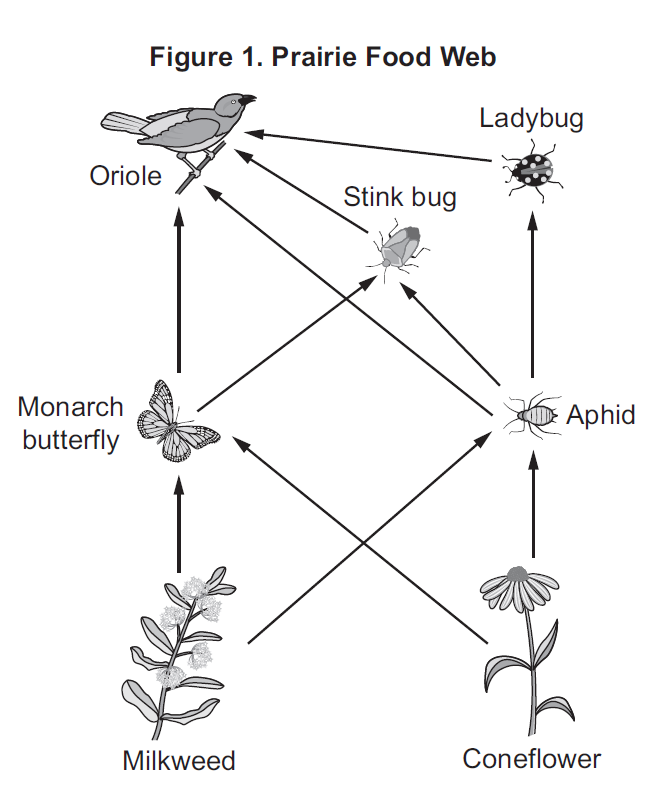
The students do some research and discover that new leaf growth on a milkweed plant several weeks after mowing is softer and easier for the monarch caterpillars to eat. They also learn that there are many predators for monarch eggs and young caterpillars. Stink bugs prey on eggs and caterpillars. Orioles and other birds prey on adult monarch butterflies. Figure 1 shows part of a food web for the prairie habitat of the monarchs.
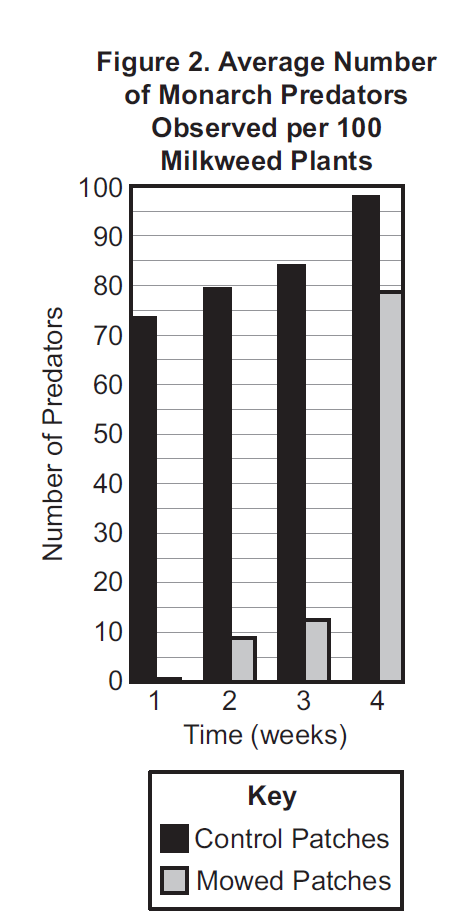
The class wonders if the mowing might also have an impact on the population sizes of predator insects that eat developing monarch caterpillars. Figure 2 shows the data collected on the numbers of predator insects in each area for four weeks after mowing.
The students analyze all of their data and work with school maintenance to create a mowing plan to increase monarch populations in their school’s field.
Indicate the benefits and limitations of using mowing as a solution to the monarch butterfly population decline.
increase of younger milkweed leaves
number of monarch eggs laid
labor and fuel costs of mowing
Benefit
Limitation
Which model best describes the relative amount of energy available to each organism that can be inferred from Figure 1?
The class discusses many possible solutions to the declining monarch population. One student suggests introducing a new species of insect to the field to eat the milkweed and promote new leaf growth. The teacher reminds the class that a new species could become invasive.
Which sentence best describes a possible consequence of introducing an invasive species in the prairie habitat of the monarch butterfly?
If there is a prolonged drought in the prairie, which events are most likely to occur?
Select all that apply.
The following question has two parts. First, answer Part A. Then, answer Part B.
Part A
Describe whether the stink bug population size will most likely increase or decrease one week and four weeks after the field is mowed.
Enter the answer in the box.
Part B
Explain how the population size relates to the carrying capacity of the ecosystem.
Enter the answer in the box.
Which claim is best supported by the evidence in the source?
Compare the impacts mowing has on the monarch ecosystem at the end of four weeks.
number of monarch eggs laid
abundance of new, soft milkweed leaves
number of predator insects in the field
Greater in Mowed Area
Greater in Non-Mowed (Control) Area
After reviewing their data and research, the students and school maintenance team decide to use mowing as a solution to the decline in the monarch population in the field. The students’ teacher reminds them that the biodiversity in the field might decrease as an unintended consequence of mowing.
Which solution would be most effective at increasing the monarch population and promoting biodiversity in the field?