7 BIO - EOC - Biological Evolution; Unity and Diversity 1
star
star
star
star
star
Last updated 6 months ago
8 Nsɛmmisa
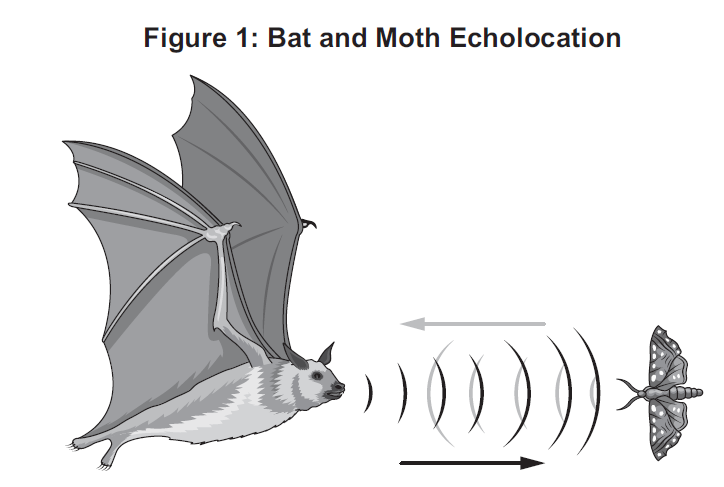
Bats navigate in darkness by emitting high-pitched, ultrasonic sounds that humans cannot hear. They create maps of their environments based on how the sound waves bounce back. This is called echolocation.
Bats also use echolocation to find food at night, such as moths. In response, some moths have developed mechanisms to avoid being eaten by bats. These moths have specialized tympanal organs that vibrate when hit with high-frequency sound waves, acting like simple eardrums. Moths can also generate their own ultrasonic sounds to confuse the bats’ echolocation.
Figure 1 shows a bat and a moth using echolocation.
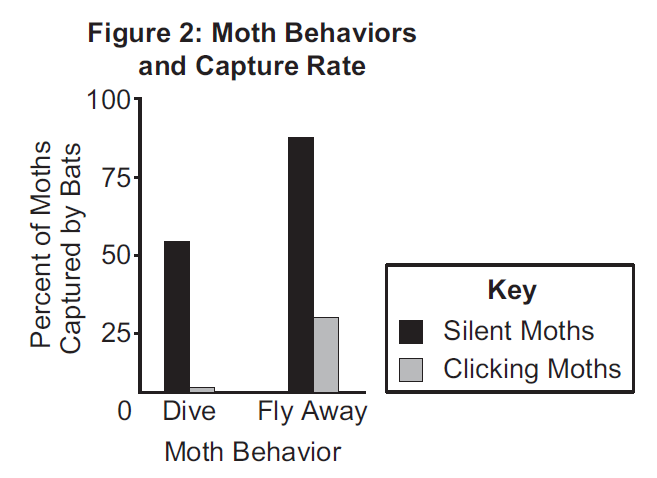
Moths vary in their behavior response to approaching bats. Some moths fly quickly away, and some display evasive flight patterns, like flying in loops and dives. Other moths release ultrasonic clicking noises that interfere with the bat’s echolocation. Figure 2 shows the effectiveness of these moth responses that help them avoid capture by bats.
Some bats have developed the ability to produce different echolocation frequencies to which moths cannot produce a counter-response. Certain species of bats also use echolocation to counter the sounds made by other bats.
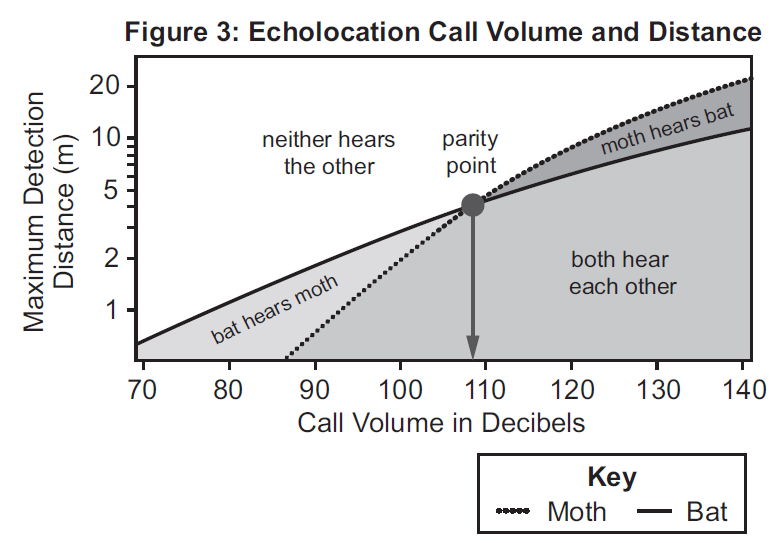
The effectiveness of echolocation depends upon the distance at which bats and moths can hear each other at different volumes, as shown in Figure 3.
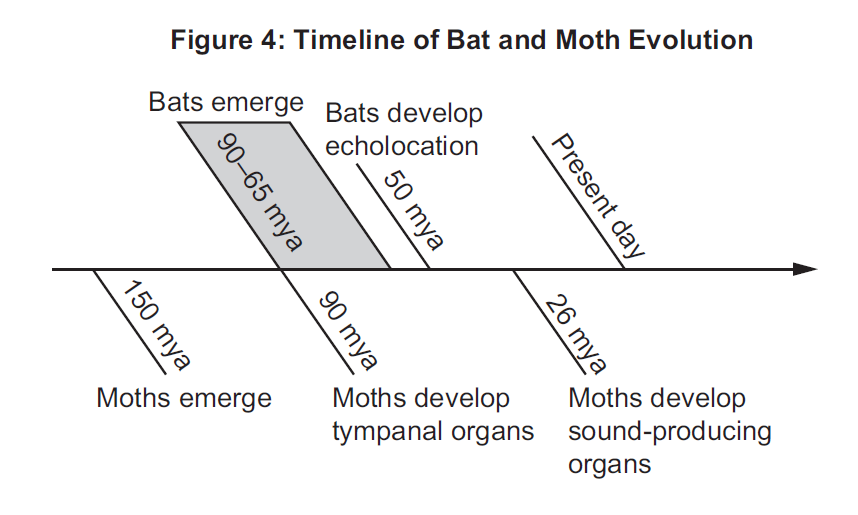
Scientists studied the history of the development of specialized organs in moths and bats. They determined that moths emerged 150 million years ago (mya) and bats emerged 65–90 mya, as shown in Figure 4.

Which statement best describes why tympanal organs in moths are an advantageous trait that would likely increase in a population over time?
Refer to Figure 2. Predict how each change would most likely impact the bat population size, assuming the total number of moths stays the same.
an increase in the percentage of moths producing clicking sounds
a decrease in the percentage of moths using diving motions
an increase in the percentage of moths that are silent
Increase Bat Population
Decrease Bat Population
Based on Figure 2, which combination of behaviors would most likely help a moth escape from a bat?
Bats collide with wind turbine blades during their migration seasons. In one effort to reduce bat collisions, devices that broadcast ultrasound waves to deter the bats were attached to the turbines. Researchers found that the bats did not have enough time to change their flight patterns before colliding with the turbine blades when they encountered the ultrasound waves broadcasted from the device.
How could this solution be improved?
Based on Figure 3, under which conditions would a bat have the most successful hunt?
Select all that apply.
The following question has two parts. First, answer Part A. Then, answer Part B.
Part A
A mutation allows a bat to detect a volume of 80 decibels at a distance of 1.5 meters.
Refer to Figure 3. Describe how this variation in hearing will most likely affect the bat. Complete each sentence by selecting the correct word or phrase.
This variation will the bat’s success in catching moths.
This action will the bat’s chances of survival.
Part B
Explain how the variation described in Part A could become more frequent in the population.
Some scientists have described bats and moths as being in an evolutionary race with each other.
Explain how moth adaptations may have evolved in response to the echolocation adaptation in bats.