Oxygen Bubbles in Aquatic Plants
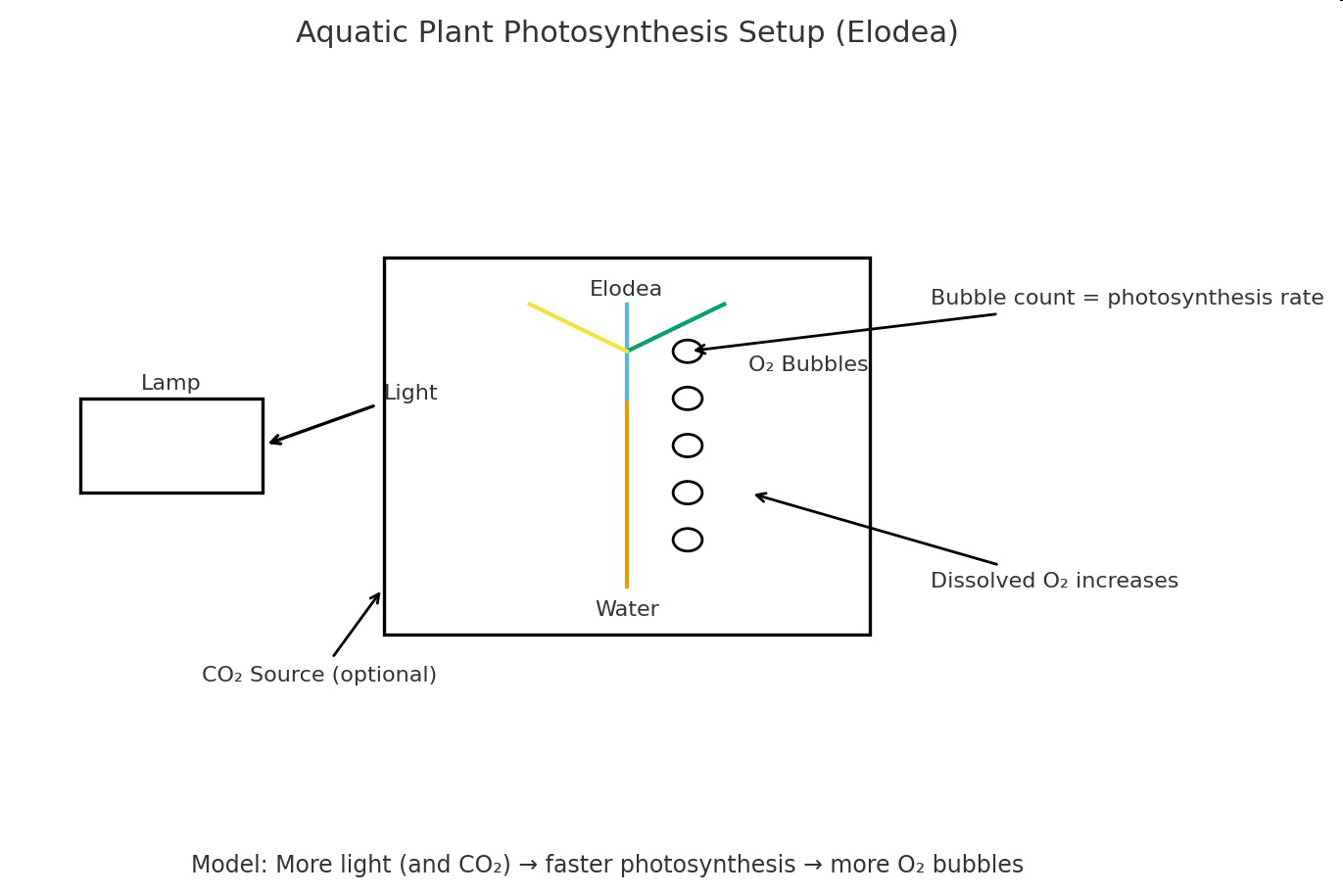
Photosynthesis is the process plants use to capture and store the Sun’s energy in chemical form. In aquatic plants like Elodea, light, carbon dioxide, and water are absorbed to produce glucose (a type of sugar) and oxygen. The oxygen escapes as bubbles from the plant’s surface - which can be counted to estimate the rate of photosynthesis.
The chemical reaction for photosynthesis can be written as:
$6\ \text{CO}_2 + 6\ \text{H}_2\text{O} + \text{light} \rightarrow \text{C}_6\text{H}_{12}\text{O}_6 + \text{O}_2$
When Elodea is placed near a bright light source, photosynthesis occurs faster, and the rate of oxygen bubble production increases. If the light source is dimmed or the plant is moved farther away, fewer bubbles form because the plant receives less light energy to power the process.
Adding extra $\text{CO}_2$ can also increase the rate, since carbon is one of the building blocks for glucose. These observations reveal how photosynthesis drives the cycling of matter and flow of energy: sunlight energy is captured and stored in glucose molecules, while oxygen is released into the environment for other organisms to use in respiration.
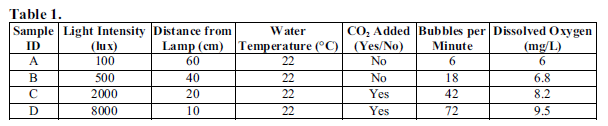
Graph of Information - Figure 1.
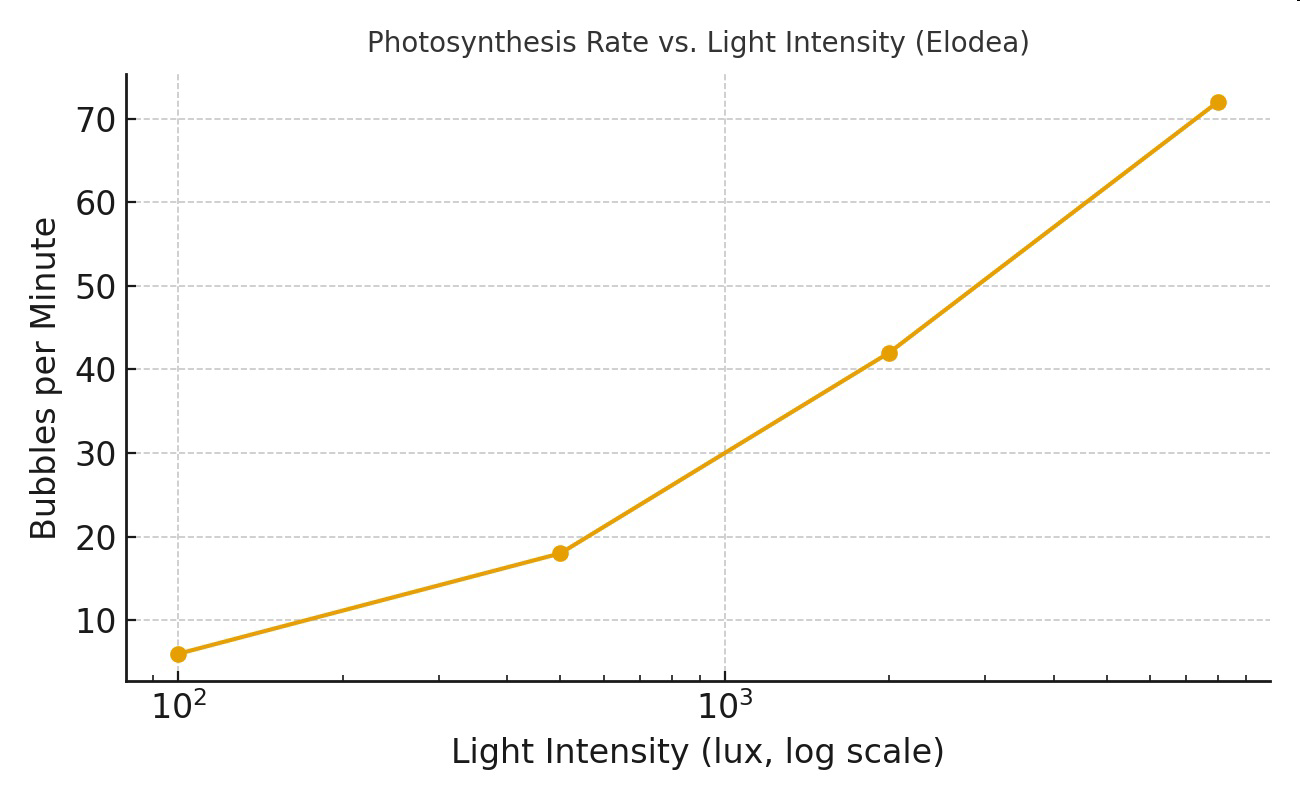
Figure 2.