Yeast and Sugar Experiment
Cells use food molecules for energy. Most cells perform aerobic respiration, which requires oxygen to fully break down glucose $C_6H_{12}O_6$ into $CO_2$, $H_2O$, and energy (ATP). But when oxygen is not available - such as in yeast or hard-working muscles - some cells perform anaerobic respiration, also called fermentation.
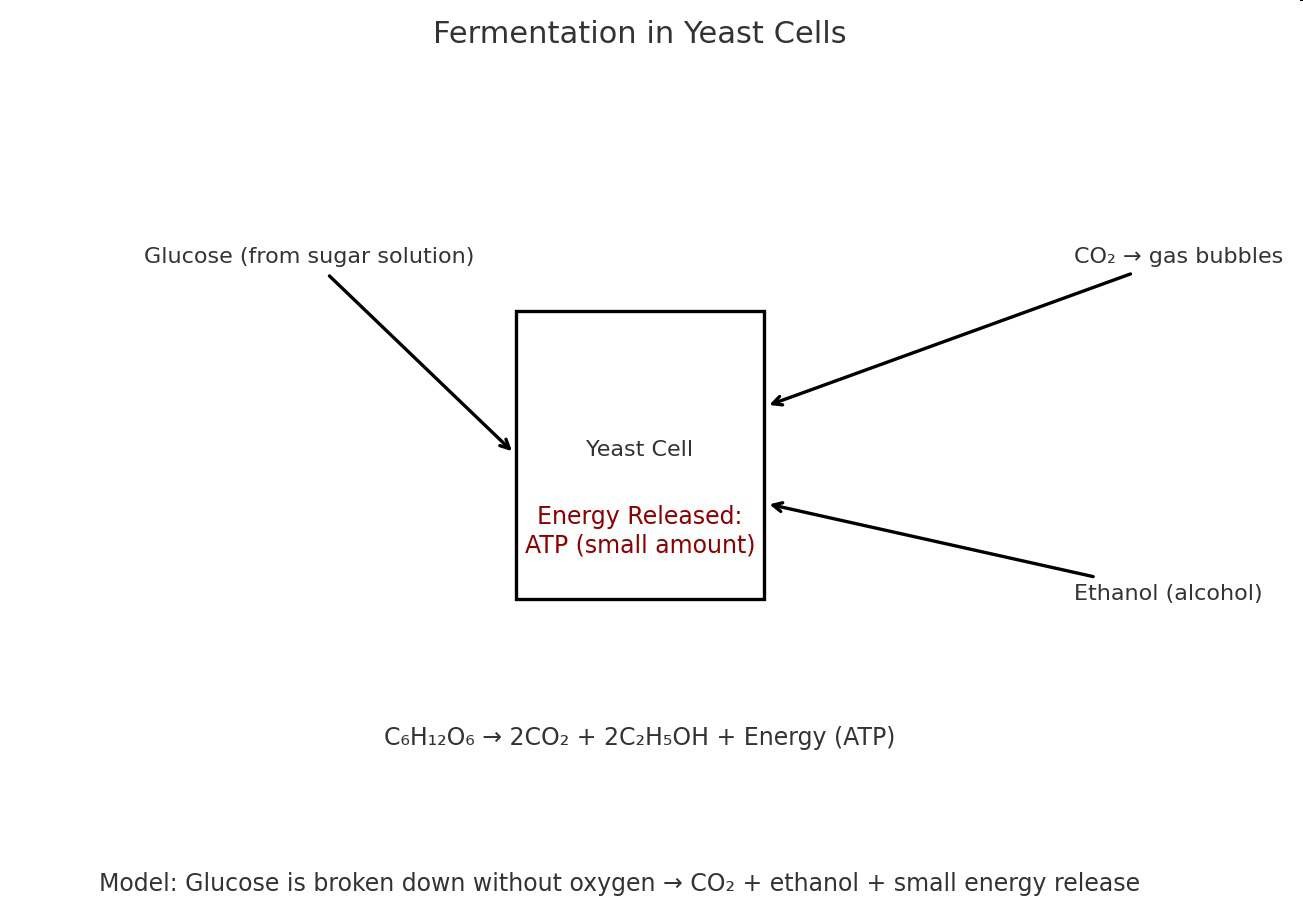
In yeast, fermentation breaks down glucose to produce alcohol (ethanol) and carbon dioxide, releasing a smaller amount of energy than aerobic respiration.
The chemical equation for alcoholic fermentation is:
$C_6H_{12}O_6 + 6O_2 \rightarrow 6CO_2 + 6H_2O + \text{Energy(ATP+Heat)}$
Although less efficient, fermentation still provides enough energy for yeast cells to survive and grow in low-oxygen environments. This process is what makes bread dough rise ($CO_2$ bubbles expand the dough) and what produces alcohol in beverages.
Through this phenomenon, students see that even without oxygen, matter is rearranged and energy flows through living systems - just at a reduced rate.
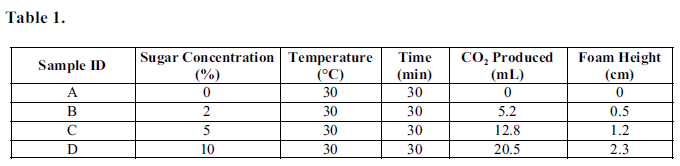
Graph of Information - Figure 1.
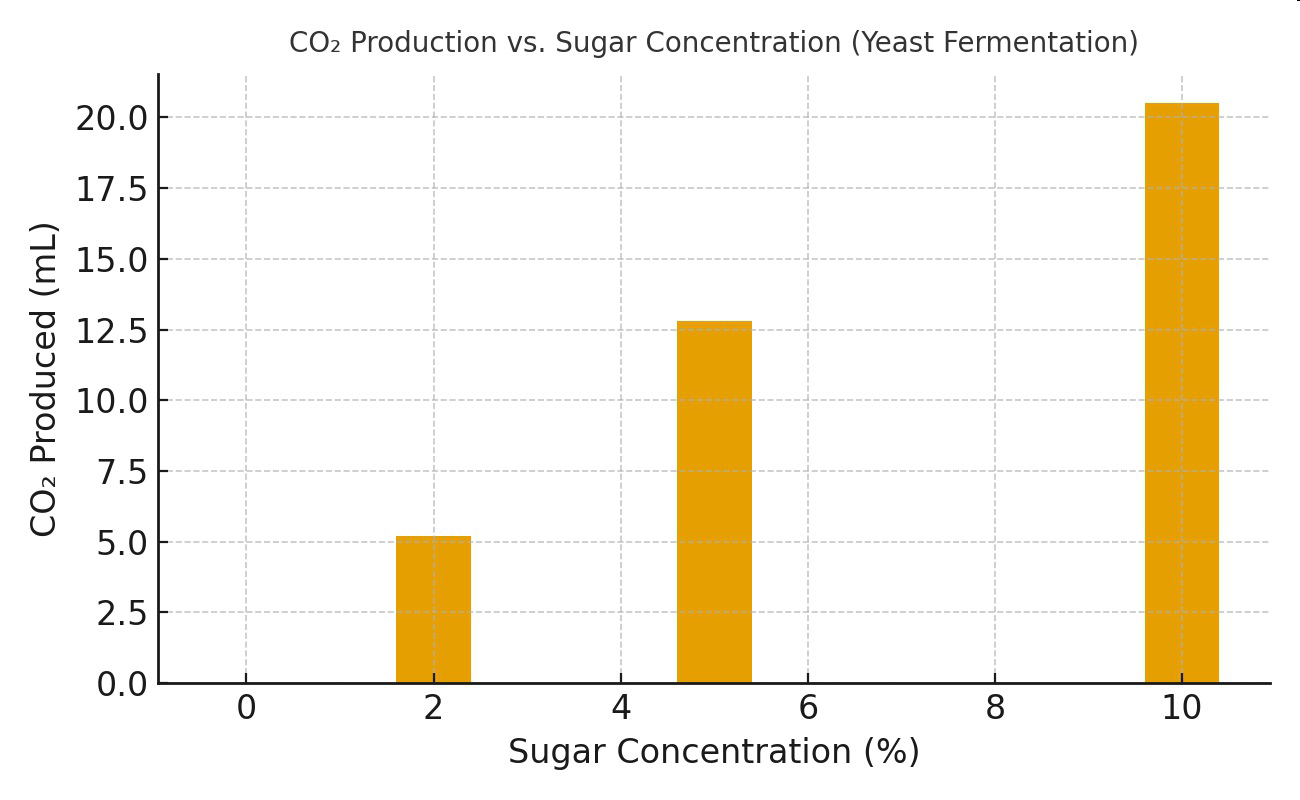
Figure 2.