Preskoči na glavni sadržaj
Prijava
Sign up for FREE
arrow_back
Biblioteka

Yeast in Bread Dough - MS - LS - Matter and Energy

star
star
star
star
star
Posljednje ažuriranje 6 months ago
6
Napomena autora:

Directions: Use the information provided and your knowledge of Life Science to answer the following questions. Show all work where necessary.

Directions: Use the information provided and your knowledge of Life Science to answer the following questions. Show all work where necessary.

0
Obavezno
2
DOK 1
MS-LS1-1
Obavezno
4
DOK 2
MS-LS1-1
Obavezno
6
DOK 3
MS-LS1-1
Obavezno
6
DOK 3
MS-LS1-2
Obavezno
2
DOK 1
MS-LS1-7
Obavezno
4
DOK 2
MS-LS1-1

Yeast in Bread Dough

When bakers mix flour, water, and yeast to make dough, the yeast comes alive. Yeast are single-celled fungi, meaning each individual yeast cell is a complete living organism. They are eukaryotic, so each cell contains a nucleus, cytoplasm, and cell membrane - just like the cells in plants and animals.

Yeast cells feed on simple sugars, breaking them down through a process called cellular respiration. When oxygen is available, they perform aerobic respiration to produce energy. When oxygen is limited - such as inside dough - they switch to anaerobic respiration, also known as fermentation. During fermentation, yeast produce carbon dioxide (CO$_2$) and ethanol (alcohol) as byproducts. The gas forms bubbles in the dough, causing it to expand, or “rise.”

Under a microscope, yeast appear as round or oval cells, often grouped in small clusters. Some yeast cells can be seen budding, a process where a small new cell grows from the side of a parent cell. This is how yeast reproduce asexually. Over time, many yeast cells can fill a culture or cause a loaf of bread to rise significantly.

By observing yeast activity and structure, students can collect evidence that yeast are living organisms made of cells that carry out essential life functions - growth, reproduction, and gas exchange - unlike nonliving particles such as flour or sugar grains.
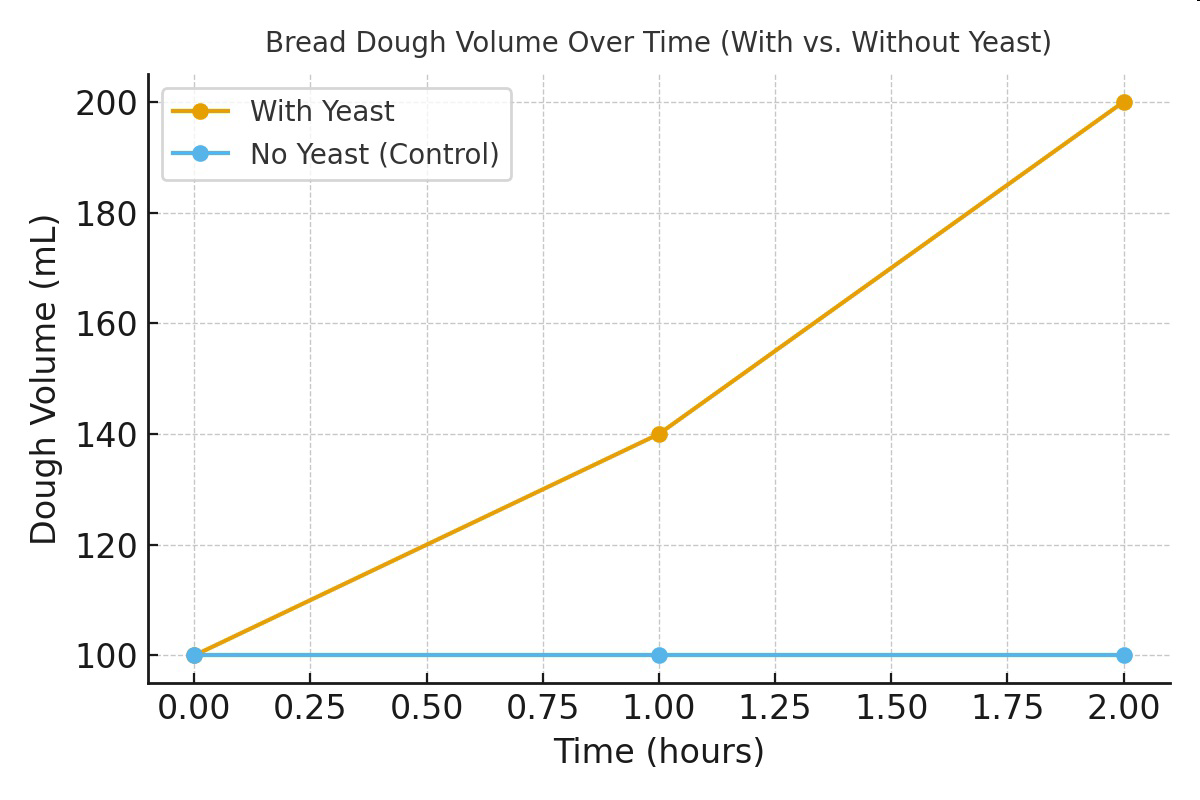
Graph of Information - Figure 1.
Pitanje 1
1.

Which observation best supports that yeast are living cells?

Pitanje 2
2.

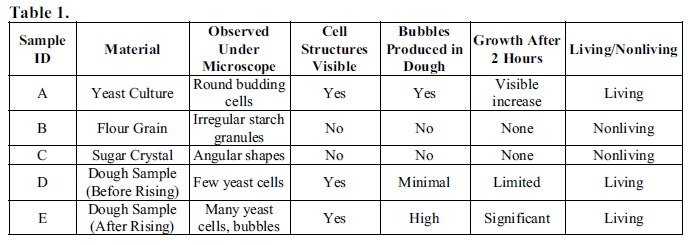
Using Table 1, compare the yeast culture (Sample A) with the flour grain (Sample B). Describe two differences that show which sample is living.

Pitanje 3
3.

Are yeast living cells?

Claim:

Evidence:

Reasoning:

Pitanje 4
4.

Explain how yeast activity inside dough provides evidence that cells carry out life functions such as gas exchange and growth.

Pitanje 5
5.

Which process is responsible for the bubbles that make bread dough rise?

Pitanje 6
6.

What evidence from Table 1 shows that yeast reproduce? Use specific examples from the table.