Antibiotic Resistance in Bacteria
When Alexander Fleming discovered penicillin in 1928, it was hailed as a miracle drug. By the 1940s, penicillin and other antibiotics were used worldwide to treat bacterial infections such as pneumonia and strep throat. However, by the 1950s doctors noticed a growing problem: the same drugs that once cured patients were becoming less effective. The cause was evolution through natural selection.
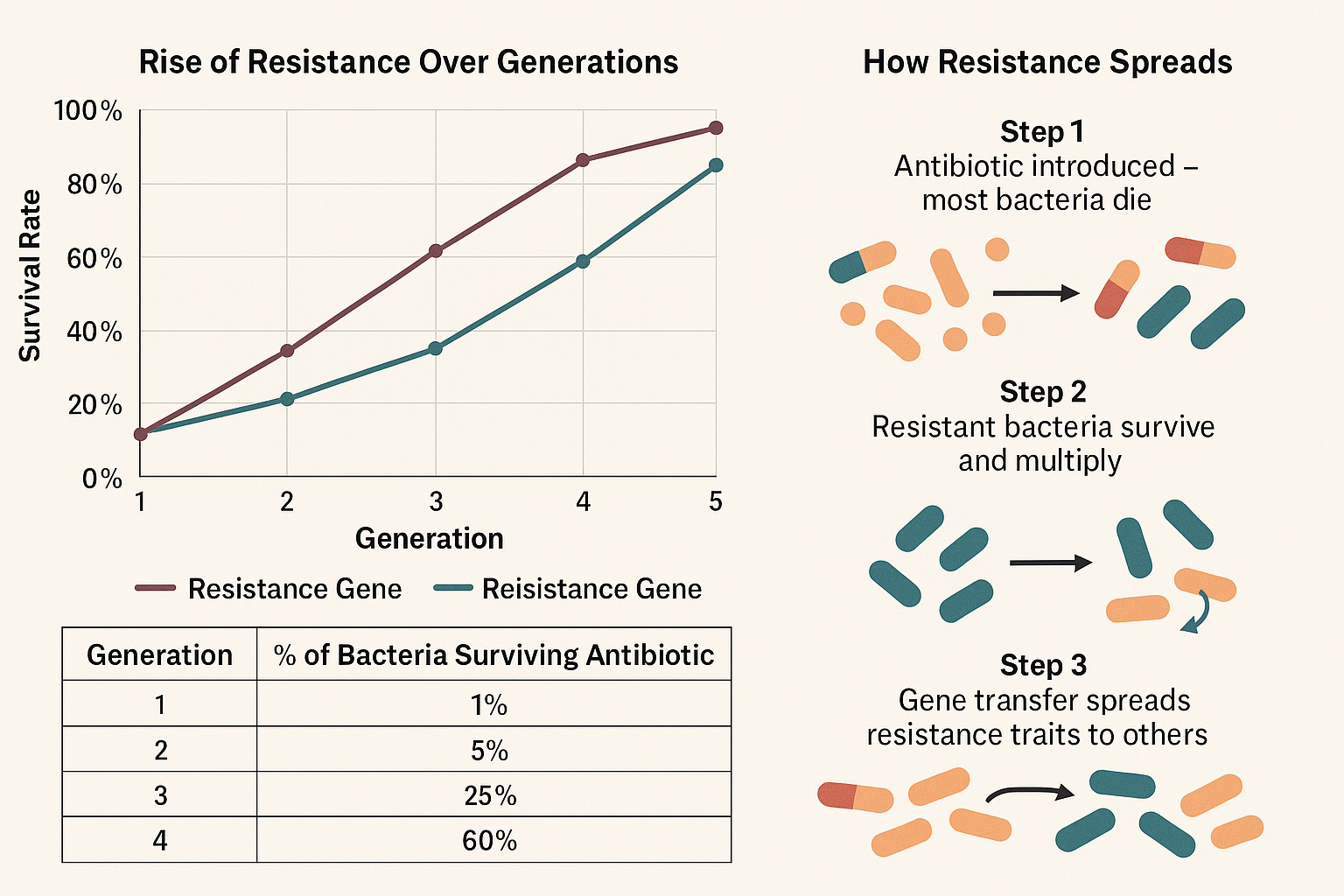
Within any population of bacteria, random mutations occur during DNA replication. Most mutations are neutral or harmful, but occasionally one gives the bacterium a trait that increases survival - for example, a protein that pumps the antibiotic out of the cell or an enzyme that breaks down the drug. When a patient takes an antibiotic, most bacteria die, but the few that possess resistance survive. Those survivors reproduce quickly, creating a new generation dominated by resistant cells. This process can happen within days, given the short bacterial life cycle.
Another factor accelerating resistance is overuse and misuse of antibiotics. Taking antibiotics when they’re not needed - such as for viral infections - exposes bacteria unnecessarily, giving them more opportunities to adapt. Incomplete doses also leave behind the strongest survivors. In hospitals, resistant strains like MRSA (Methicillin-Resistant Staphylococcus aureus) have evolved from ordinary bacteria into major health threats.
Modern genetic analysis has shown that bacteria can also share resistance genes through horizontal gene transfer, meaning even unrelated species can gain protection. This has led to “superbugs” that resist multiple antibiotics, forcing scientists to search for new treatments and strategies.
Antibiotic resistance demonstrates how natural selection works in real time:
genetic variation --> differential survival --> adaptation.
It reminds us that evolution isn’t just ancient history - it happens every day in our hospitals, farms, and homes.