Coral Reefs and Ocean Temperature
Coral reefs are among the most diverse ecosystems on Earth, but they are highly sensitive to temperature. Reef-building corals live in symbiosis with microscopic algae (zooxanthellae) that provide energy through photosynthesis. When water temperatures rise even 1–2$\degree C$ above normal for several weeks, corals become stressed and expel their algae — a process called bleaching. Without these algae, the coral loses its color and primary energy source.
Field studies during major El Niño events have shown that not all corals respond the same way. For example:
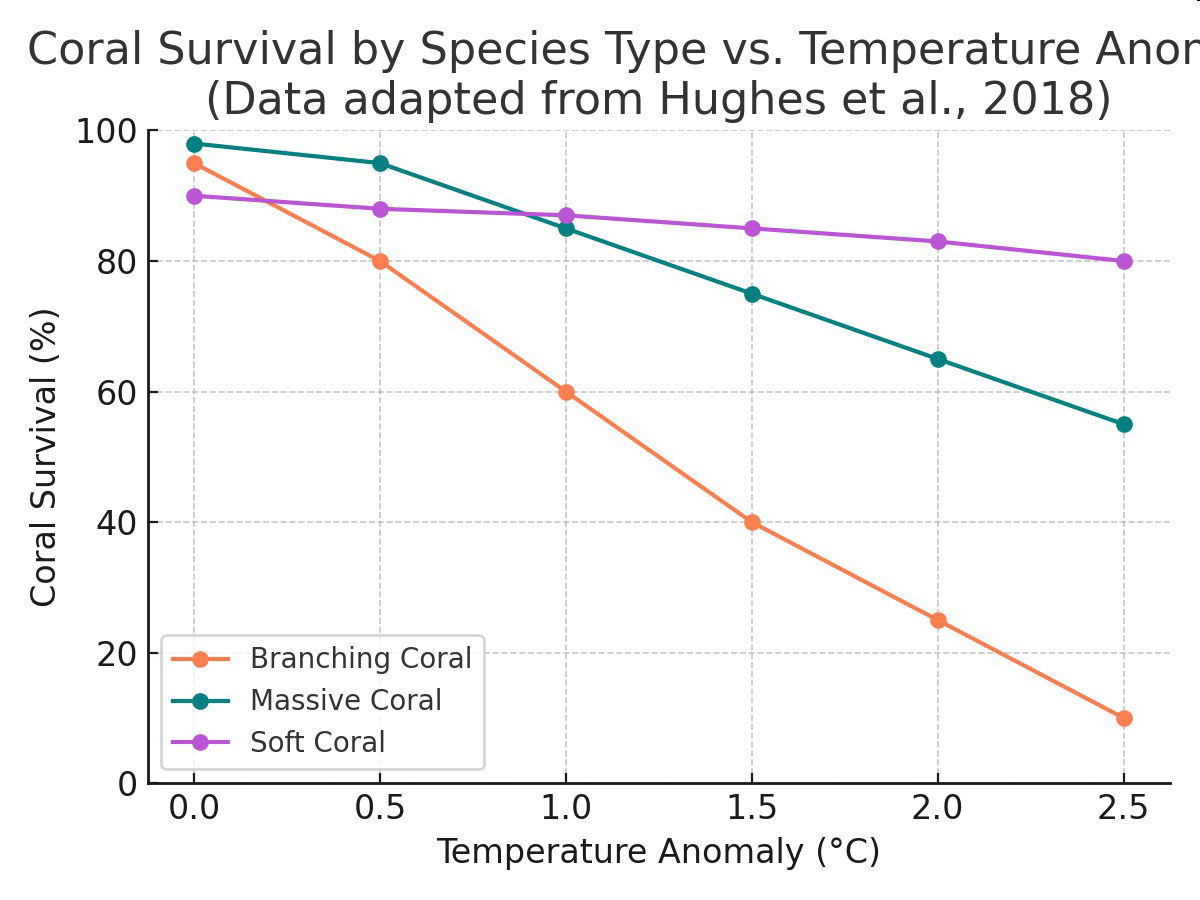
Massive corals (like brain corals) are more heat-tolerant and often recover after bleaching.
Branching corals (like staghorn and elkhorn) bleach quickly and have high mortality.
Soft corals and some algae-covered reef areas can even expand when other corals die.
Long-term data from NOAA Coral Reef Watch and the Great Barrier Reef Marine Park Authority show a direct relationship between sea surface temperature anomalies and bleaching severity. When temperatures remain ≥1$\degree C$ above average for 8 weeks, more than 70% of branching corals bleach, while only about 30% of massive corals do. Extended heat events (>10 weeks) can cause widespread coral death and reef collapse.
This pattern demonstrates that even within a single habitat, some organisms (massive corals) survive well, some (branching corals) survive less well, and some (bleaching-sensitive species) cannot survive prolonged heat. The same environmental change - rising temperature - produces different survival outcomes depending on each organism’s tolerance.
Table 1.
Temperature Anomaly ($\Delta ^\circ C$) | Bleaching Rate (%) | Branching Coral Survival (%) | Massive Coral Survival (%) | Soft Coral Survival (%) |
|---|
0 | 5 | 95 | 98 | 90 |
0.5 | 15 | 80 | 95 | 88 |
1 | 35 | 60 | 85 | 87 |
1.5 | 55 | 40 | 75 | 85 |
2 | 75 | 25 | 65 | 83 |
2.5 | 90 | 10 | 55 | 80 |
Graph of Information - Figure 1.
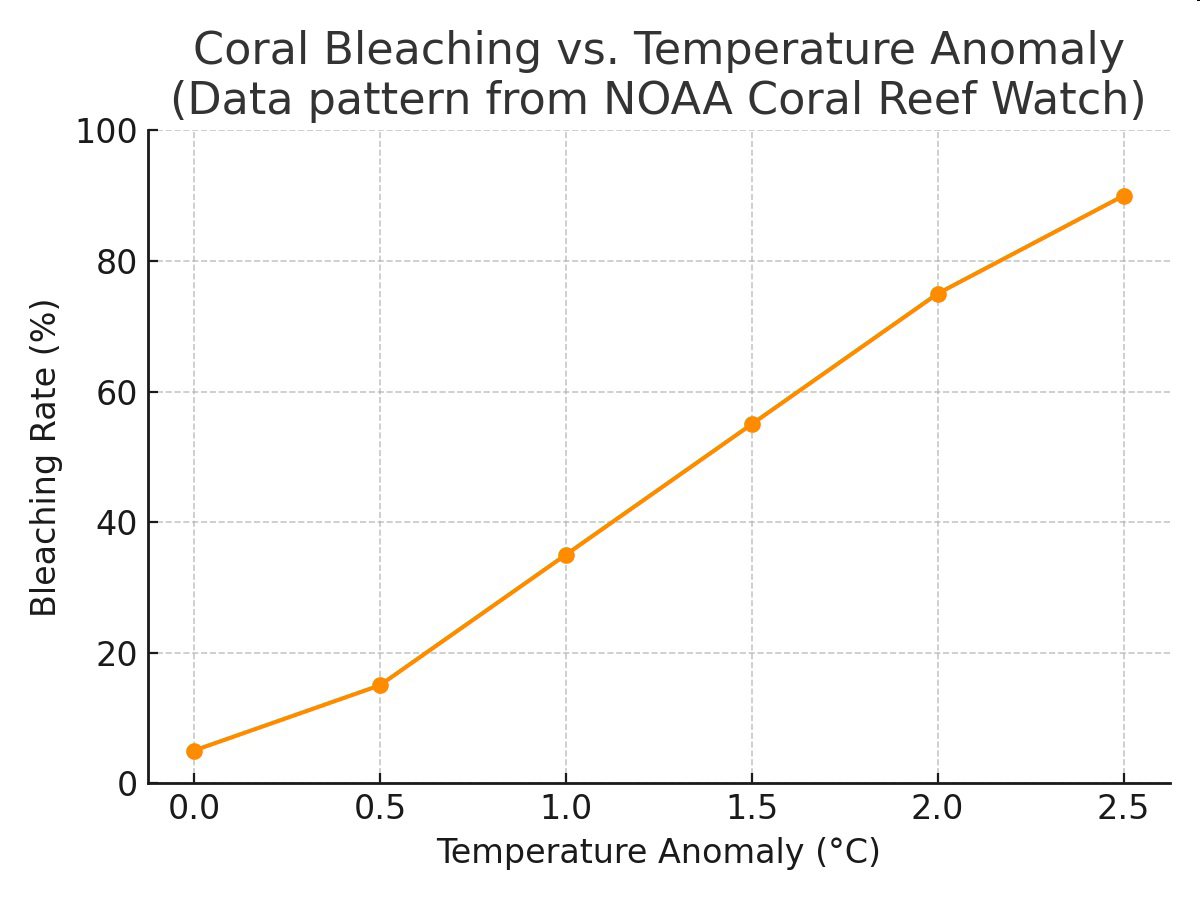
Graph of Information - Figure 2.