Elephant Tusklessness and Poaching Pressure
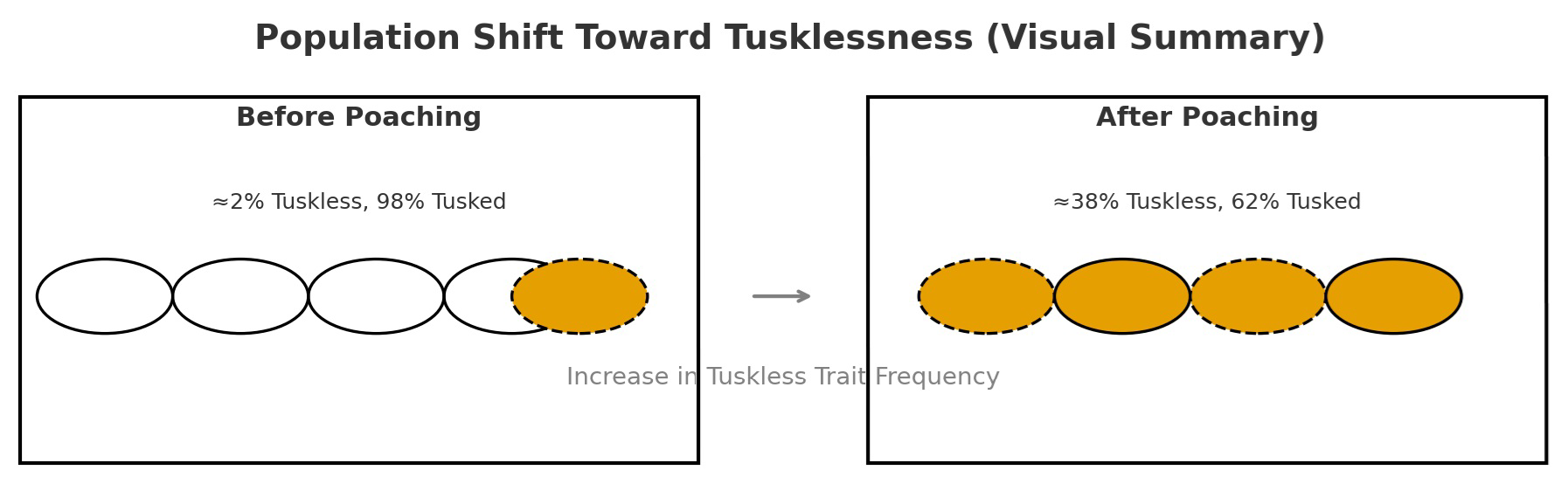
For thousands of years, elephants have used their tusks for digging, lifting, defense, and stripping bark from trees. Tusks are actually elongated incisor teeth, and the genes that control their growth can vary between individuals. Normally, tusked elephants make up most of a population. However, in areas where poaching for ivory has been intense, researchers have noticed a rapid increase in tuskless elephants - especially among females.
In Mozambique’s Gorongosa National Park, elephant populations were decimated during civil conflict in the late 20th century. Poachers targeted elephants with large tusks, removing most individuals that carried the tusk-producing gene. After the war ended, scientists discovered that more than one-third of surviving females were naturally tuskless, compared to fewer than 5% before the conflict.
This shift is an example of natural selection driven by human activity. The tuskless trait, which is controlled by a genetic mutation on the X chromosome, made females less likely to be hunted. As these tuskless individuals survived and reproduced, the frequency of the trait increased dramatically in the next generations.
Mathematical models and long-term field data confirm this trend. In populations with severe poaching, the percentage of tuskless elephants can double within a few decades. However, the change has ecological consequences - tuskless elephants dig fewer water holes, strip less bark, and alter their habitats differently from their tusked relatives.
This case provides a striking demonstration of how human pressures can act as a powerful selective force. Genetic variation within the population allowed some individuals to survive and reproduce under new conditions. Over time, this led to an observable evolutionary shift - a clear, real-time example of natural selection in action.
Table 1.
Change in Tuskless Frequency and Survival (1970 - 2020)
Year | Tuskless Females (%) | Tusked Females (%) | Tuskless Survival (%) | Tusked Survival (%) |
|---|
1970 | 2 | 98 | 90 | 91 |
1980 | 4 | 96 | 92 | 80 |
1990 | 18 | 82 | 88 | 60 |
2000 | 28 | 72 | 85 | 55 |
2010 | 33 | 67 | 83 | 58 |
2020 | 38 | 62 | 82 | 57 |
Graph of Information - Figure 1.
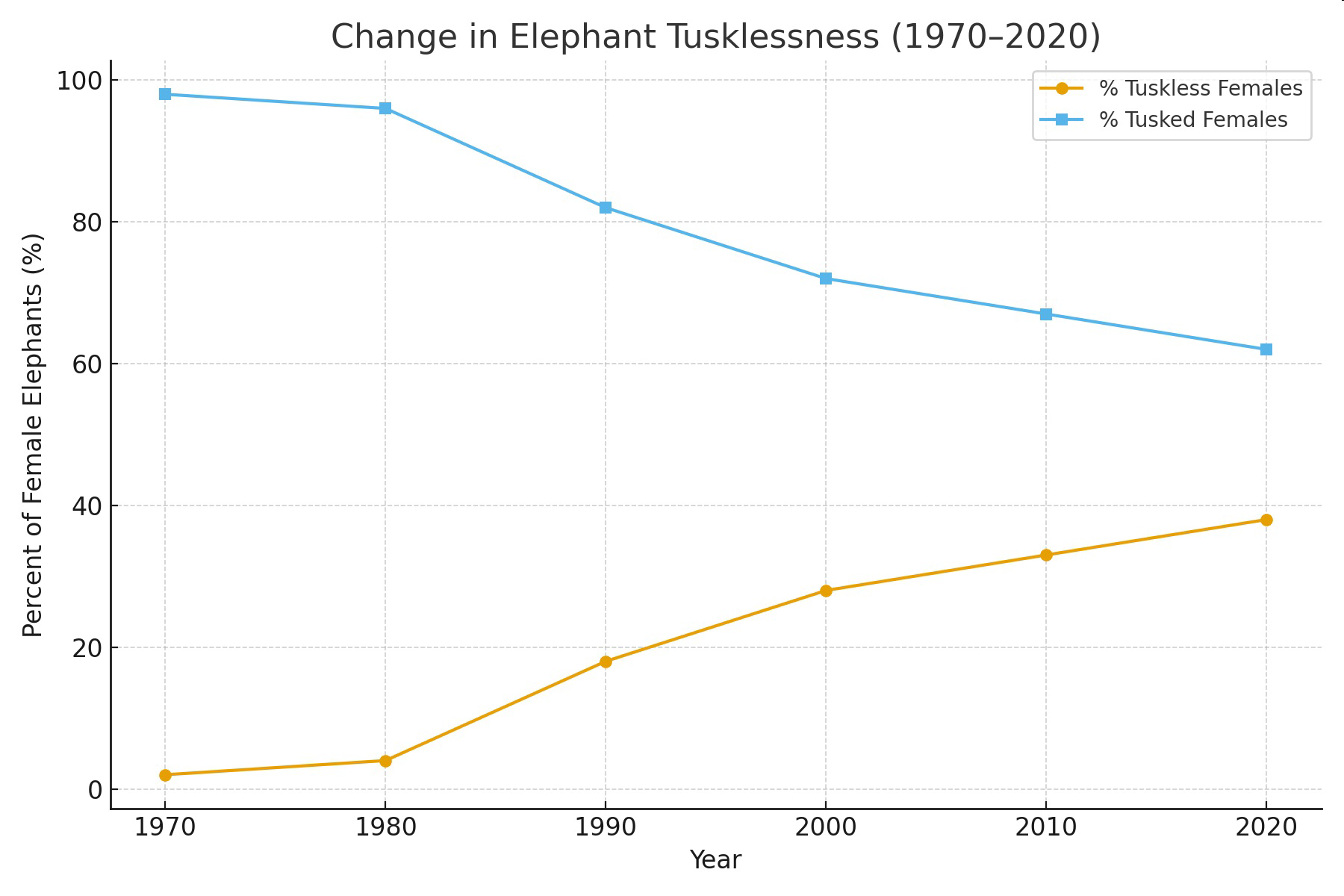
Table 2.
Modeled Change in Tuskless Gene Frequency Over Generations
Generation | Tusked Allele Frequency | Tuskless Allele Frequency |
|---|
1 | 0.97 | 0.03 |
2 | 0.92 | 0.08 |
3 | 0.83 | 0.17 |
4 | 0.75 | 0.25 |
5 | 0.68 | 0.32 |
6 | 0.60 | 0.40 |
Graph of Information - Figure 2.
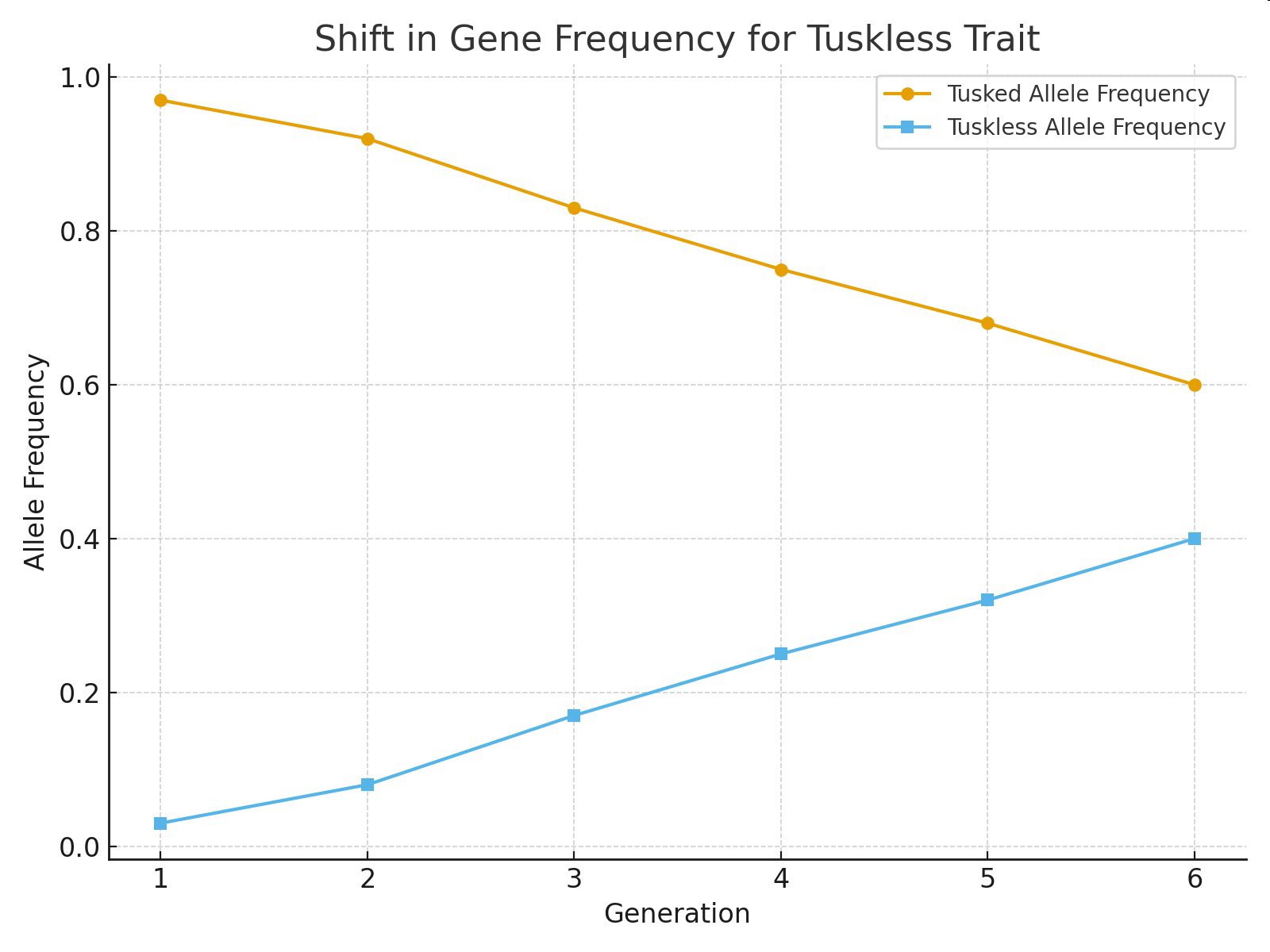
Figure 3.
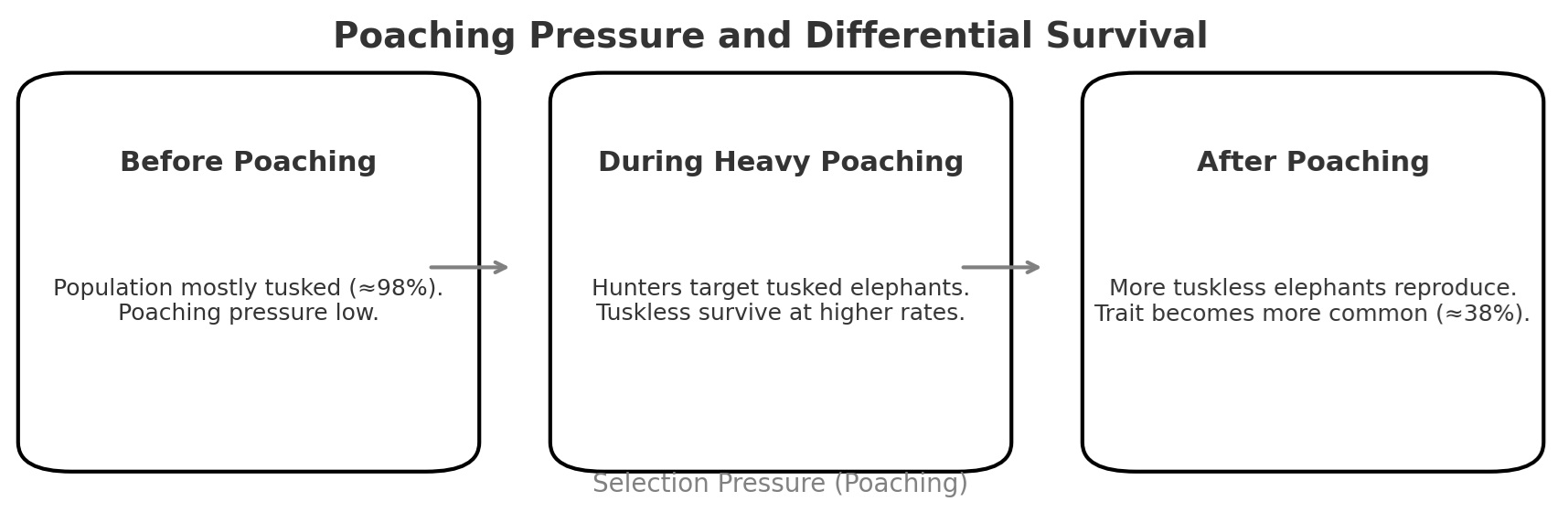
Figure 4.