Ɛhia
1
Ɛhia
1
Ɛhia
1
Ɛhia
1
Ɛhia
1
Ɛhia
1
Spelling and capitalization COUNTS. Please type your answers to the questions as they are spelled on the reference image. Be sure to submit this test by the end of your class period.
Revolutionary War
Civil War
True or false. September 11, 2003 quickly becomes the deadliest terrorist attack on American soil in only two hours.
What did President Bush declare shortly after these attacks?
What type of source is a diary from a miner in the 1800s?
Is a magazine article about mining in the Old West primary or secondary?
What source type is a photograph from the 1941 Pearl Harbor attack?
Is an encyclopedia entry about the Vietnam War primary or secondary?
What type of source is a World War I uniform worn by a great-grandfather?
Is a historical map of China from ancient times primary or secondary?
What country is 1
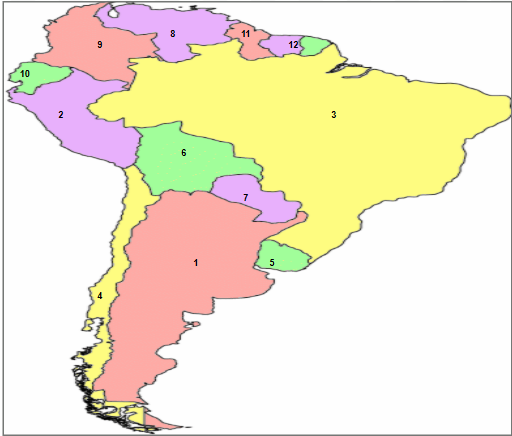
What country is 3
What country is 8
What does it mean to be malnourished
What is extreme poverty
Where did they film the documentary Living on One
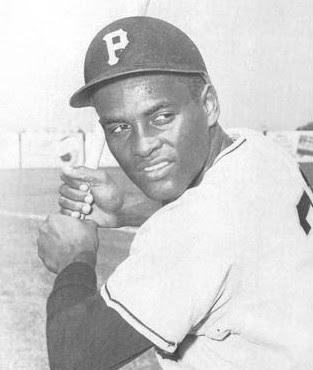
Roberto was born in Barrio San Antón, Carolina, Puerto Rico, to Melchor Clemente and Luisa Walker. He was the youngest of seven children. During Clemente’s childhood, his father worked as a foreman for sugarcane crops located in the municipality, located in the northeastern part of the island. Because the family’s resources were limited, Clemente and his brothers worked alongside his father in the fields, loading and unloading trucks. As a youth, Clemente was a track and field star and Olympic hopeful before deciding to turn his attention to baseball.
Clemente had first shown interest in baseball early in life and often played against neighboring barrios. He attended Julio Vizcarrondo Coronado High School in Carolina. During his first year in high school, he was recruited by Roberto Marín to play softball with the Sello Rojo team after he was seen playing baseball in Barrio San Antón. He was with the team two years as a shortstop. Clemente joined Puerto Rico’s amateur league when he was 16 years old, playing for the Ferdinand Juncos team, which represented the municipality of Juncos.
Career
Roberto Clemente was a right fielder. His Major League debut was with the Pittsburgh Pirates. He was an All-Star for 13 seasons, playing in 15 All-Star Games. He was the National League (NL) Most Valuable Player (MVP) in 1966, the NL batting leader in 1961, 1964, 1965, and 1967, and a Gold Glove Award winner for 12 consecutive seasons from 1961 through 1972. His batting average was over .300 for 13 seasons, and he had 3,000 hits during his major league career. He also was a two-time World Series champion.
Clemente was the first Latin American and Caribbean player to win a World Series as a starting position player (1960), to receive an NL MVP Award (1966), and to receive a World Series MVP Award (1971).
Clemente did a lot of charity work, especially in Latin American countries. He headed relief efforts in Puerto Rico after a massive earthquake hit Nicaragua in late December 1972. When Clemente received reports that the Nicaraguan army had stolen the relief supplies meant for the Nicaraguan people, he decided to accompany the next delivery. Shortly after takeoff from the San Juan airport on December 31, 1972, the plane crashed into the ocean, killing Clemente. Each year the MLB gives the Roberto Clemente Award. This award is for the player who best follows Clemente’s example with charity work. In 1973, Clemente was awarded the Congressional Gold Medal and the first Presidential Citizens Medal. On August 17, 1984 the United States Postal Service issued a postage stamp honoring Clemente. This was the day before what would have been his 50th birthday.
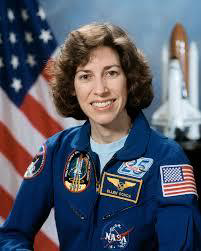
Ellen Ochoa was born on 10th May 1958 in Los Angeles, California. Her parents were Joseph and Rosanne Ochoa. Her grandparents were from Sonora, Mexico, where they later moved to Arizona. It was in Arizona where her father was born. Her parents divorced before she could finish high school, and she lived with her mother and brothers.
Ochoa attended Grossmont High School, located in El Cajon, where she graduated in 1975. She later attended San Diego State University, where she graduated with a Bachelor of Science in physics in 1981. During this time, she was living with her mother. She later pursued a masters’ and doctorate from Stanford University, where she graduated in 1981 and 1985, respectively, in electrical engineering.
Ochoa's first work was as a researcher at NASA Ames Research Center, where she researched optical developments and made discoveries. Her optical research was used by scientists in space exploration, especially in detecting patterns while in space.
She also helped discover how sound can be removed from images, an application widely used in space exploration today. Due to her research, her works have been written in journals and scientific papers. She has also been awarded in the field of optics due to her discoveries.
Ochoa became an astronaut in 1991, and some of her works included checking flight robotics, software, and hardware. In 1993, she became the first Hispanic woman to space on a nine-day exploration exercise. The main aim of the journey to space was to study the earth's ozone layer and how it was being affected due to climate change.
In 2007, after retiring as an astronaut, she became the deputy director of Johnson Space Centre before becoming director from 2012 to 2018. As of 2021, she heads the National Service Board as its chair. Due to her achievements in space exploration, schools have been named after her in Texas, California, and Washington DC. She was also inducted into the National Academy of Investors. Ochoa has also received many medals, including the NASA Exceptional Service Medal, which she was given in 1997, and an Outstanding Leadership Medal in 1995.
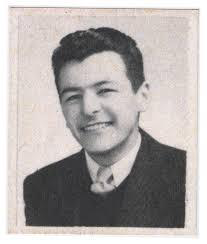
Ralph Lazo, a Mexican-American who grew up in the racially diverse Temple Street neighborhood of Los Angeles. Born in 1924, Ralph’s America consisted of many different colors, languages and beliefs. His mother died young and his father spent a lot of time on the road for work, so Ralph often ate dinner at the homes of his Japanese-American friends and passed time playing basketball on the Filipino church team.
When Ralph was 17, attending Belmont High School in Los Angeles, the Japanese attack on Pearl Harbor on December 7, 1941, quickly drew the U.S. into WWII and clearly demarcated its “enemy.” With war hysteria at its height, U.S. President Franklin D. Roosevelt evoked national security to authorize the internment of people with Japanese heritage in “War Relocation Camps.” Ralph watched posters go up in his community’s churches with instructions for internment, as friends he had grown up with were forced to leave against their will. “These people hadn’t done anything that I hadn’t done except go to Japanese language school,” Ralph stated.
In total, over 110,000 people of Japanese heritage were interned, 62% of them were American citizens. To many Americans, Japanese internment was a justifiable wartime measure for protecting the home front. But to Ralph, internment was an unacceptable act of discrimination against his innocent, law-abiding neighbors. As he helped long-time friends pack up their homes and sell their belongings for next to nothing, Ralph only grew more incensed at the injustice.
In May 1942, he told his father he was going to summer camp and slipped aboard a train headed to Manzanar internment camp in California’s Owens Valley, one of ten war relocation centers. The camp’s cramped living quarters were surrounded by barbed wire and guard towers topped with blinding searchlights. Uniformed military police patrolled the area. Cots and straw-filled mattresses furnished tiny rooms overflowing with large groups, and the communal latrines had no partitions for privacy. Temperatures in the summer soared to 110 degrees, while prisoners shivered below freezing within walls that swept across the barren landscape.
Here Ralph lived among the Japanese like one of them, his heritage never once inquired about by government authorities because of his brown skin. He sent a few letters home before his father realized where he was and gave him permission to stay. Ralph stayed in the internment camp for two years in solidarity with his friends—prisoner by choice, acting from his conscience. Ralph remained the only such person, non-Japanese who voluntarily relocated to Manzanar. His internment there was only discovered when he was drafted into the U.S. Army in August 1944.
How many colonies were there?
What did the British make the colonists pay for that they were not happy about?
Where did the war start?
Which country did the American colonies fight for independence from?
Who became the first President of the United States
What document declared America's independence?
Which country did the American colonies fight against?
What year did the Revolutionary War begin?
What was the main goal of the Confederacy?
Who was the president during the Civil War?
Which event triggered the start of the Civil War?
What was a primary cause of the Civil War?
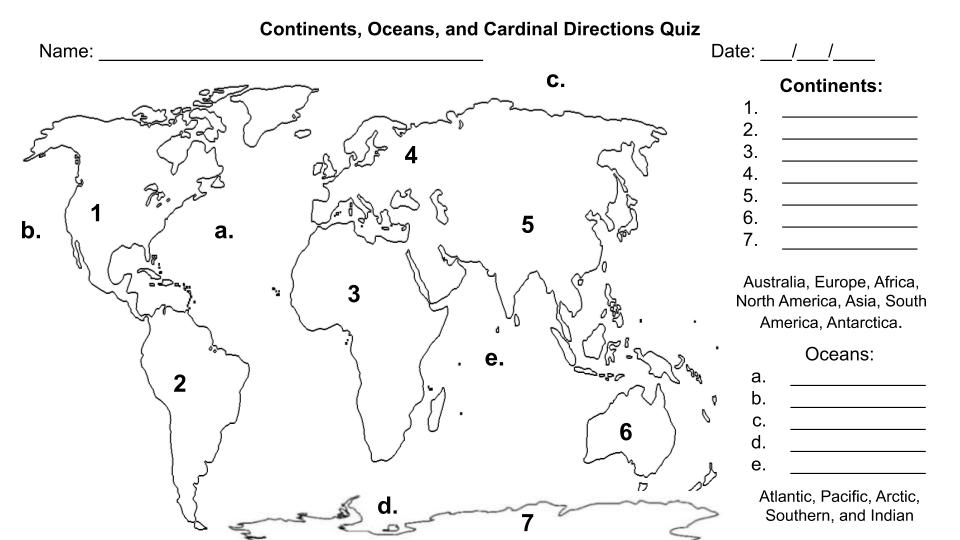
Which continent is labeled as 'a'?
What countries make up North America
Which continent is at position '3'?
What is the southernmost continent?
Which is the largest continent on Earth?
Which ocean is located between Africa and Australia?
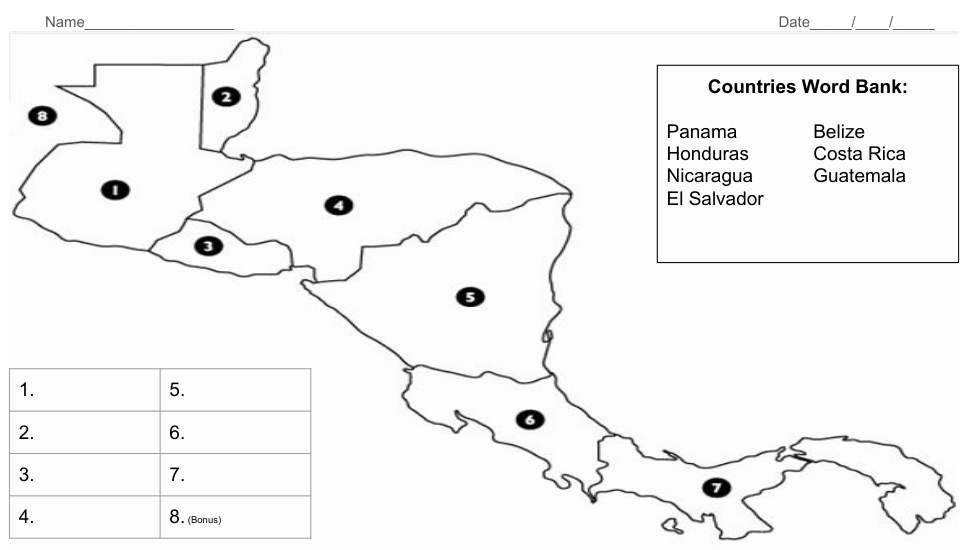
Which country is numbered 1 on the map?
Which country is located at position 4?
What country do you find in position 7?
Which country is at position 6?
What position did Clemente play in Major League Baseball?
What tragic event ended Clemente's life?
What significant contribution did Clemente make after an earthquake in Nicaragua?
What was one of Ochoa's early jobs?
In what year did Ellen Ochoa go to space for the first time?
What does Ochoa's research help detect in space?
What position did Ochoa hold at Johnson Space Center after she retired as an astronaut?
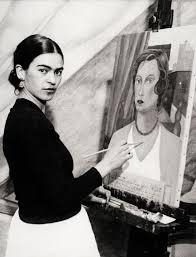
Frida Kahlo grew up in a house called La Casa Azul, in Mexico, with her parents and six sisters. That house is now the Frida Kahlo museum. As a child, Frida loved to draw. At age 6, she caught a disease called polio which damaged her right leg and caused her to walk with a limp for the rest of her life.
Initially studying medicine, Kahlo changed her career path following a serious accident. On September 17, 1925, at the age of 18, Frida Kahlo was riding in a bus that collided with a trolley car. As a result of the accident she suffered severe injuries: a broken spinal column, a broken collarbone ribs and pelvis, eleven fractures in her right leg, a crushed and dislocated right foot, and a dislocated shoulder. Also, an iron handrail pierced her abdomen and her uterus. The accident left her in a great deal of pain, and she spent three months recovering in a full body cast. Although she recovered from her injuries and eventually was able to walk again, she was in extreme pain for the rest of her life. As part of her recovery, Kahlo underwent thirty-five operations but she kept painting. Her mother had a special easel made for her so she could paint in bed, and her father lent her his box of oil paints and some brushes. Frida said, “I paint my own reality. The only thing I know is that I paint because I need to, and I paint whatever passes through my head without any other consideration”.
Frida often painted portraits of herself. She wanted to show people about her suffering, her inability to have children, and also the people in her life. She created one hundred and forty three paintings, and of these, fifty-five are self-portraits. Frida was proud of her Mexican heritage. She was inspired by traditional Mexican art which is wonderfully colorful, bright, patterned and full of life. It is full of hearts, flowers, dancing, music, and texture. She often featured animals in her self-portraits, such as monkeys, parrots, a hairless dog, and a deer. Her “Self Portrait with Monkey” (1938) shows Frida standing in front of trees and leaves wearing a traditional Mexican blouse and necklace, along with an elaborate hairstyle that also reflects her heritage.
Frida’s work has inspired artists to reveal their emotions, inner-turmoil, fantasies, and view-points, no matter how extreme. She is also viewed as the people’s artist because she endured a great struggle and she fought through it. Frida was a strong woman who overcame her predicament and did what she loved despite severe pain and hardship. Today, people visit her home in Mexico to see where her great art was created and to appreciate what a single person can accomplish against all the odds.
What did Frida Kahlo use to express her reality?
How many self-portraits did Frida create?
What type of art influenced Frida Kahlo's work?
What did Frida endure throughout her life?
What prompted Ralph to go to the Manzanar internment camp?
How did Ralph view Japanese internment?
What year did the Pearl Harbor attack occur?