Log in
Sign up for FREE
arrow_back
Library

Copy of Article Analysis: Powerful Women (1/26/2026)

star
star
star
star
star
Last updated 4 months ago
19 questions
Required
1
8.5.C
Required
1
8.5.C
8.9.C
1
8.5.E
8.5.G
1
8.5.E
8.5.G
1
8.5.E
8.5.G
Question 1
1.

Before you read: (pick 1 below and answer)
  • What is power?
  • How have women traditionally been viewed in terms of power?
  • What are some examples of powerful women throughout history?

1. Full page Version: https://docs.google.com/document/d/1p0cXUb50SFXGbUNrpVsSdBUCxUWn5ayC/edit?usp=sharing&ouid=112718053608407082764&rtpof=true&sd=true

2. AUDIO: https://somup.com/cTlFYORsry
Question 2
2.

Previewing a Text

When reading a nonfiction text about historical figures, strong readers scan the text before they begin reading. They look at text features to gather information about the topic. Each piece of information helps them think about what they will be reading before they begin.

How to Preview a Text

Begin by reading the title of the article and searching for clues about the main idea. Ask yourself what you already know about the topic.

Then, survey the text for other text features. For example, read any headings and subheadings you find.

When you have previewed the entire article, read the first sentence or even the first paragraph. Then, try assembling the information you have gleaned from your preview into a statement detailing what you expect to learn. After you finish reading, be sure to check your accuracy.

1
Question 3
3.

8.8.D.i
Required
1
8.9.A
Required
1
8.5.F
8.5.G
Required
1
8.6.C
Required
1
8.5.F
8.5.G
Required
1
8.5.G
8.6.C
Required
1
8.5.G
8.8.D.iii
8.9.A
Required
1
8.5.G
Required
1
8.10.C
8.8.D.iii
Required
1
8.6.D
Required
1
8.5.G
8.8.D.i
Required
1
8.9.A
Required
1
8.6.C
Required
1
8.5.G
8.8.D.i

Alike/Unalike


The following questions will ask you to make connections between the powerful women in this article.
Question 17
17.

Question 18
18.

Question 19
19.

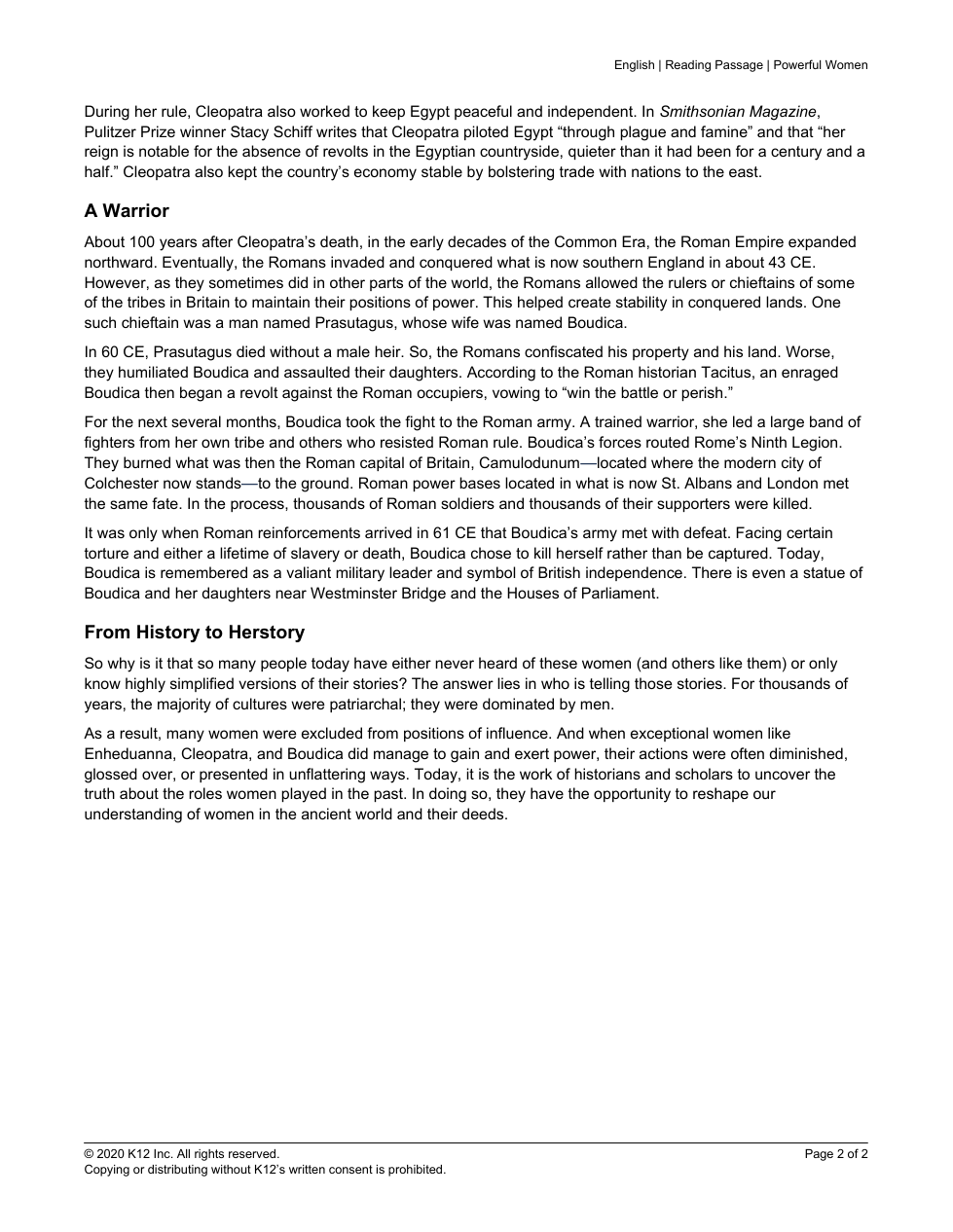
What is the central idea/thesis used in the introductory section of the article?
Question 4
4.

Question 5
5.

Question 6
6.

Question 7
7.

Question 8
8.

Question 9
9.

Question 10
10.

Question 11
11.

Question 12
12.

Question 13
13.

Question 14
14.

Question 15
15.

Question 16
16.

How does Enheduanna’s power differ most from the power held by Cleopatra and Boudica?
A. Enheduanna’s influence was mainly religious rather than military or political.
B. Enheduanna ruled for a shorter period of time.
C. Enheduanna used violence to maintain control.
D. Enheduanna led a rebellion against a foreign empire
Which statements accurately compare Cleopatra and Boudica? Select two answers.
A. Both women fought against Roman control
B. Both women led armies during times of conflict
C. Cleopatra allied with Rome, while Boudica rebelled against it
D. Both women gained power mainly through religious leadership
What central idea do the similarities and differences among Enheduanna, Cleopatra, and Boudica help the author convey?
A. Women only gained power when they were related to powerful men or allied themselves with the forces of powerful men.
B. Women’s power in ancient times was limited and unimportant, and this is why history doesn't record many instances of their power.
C. Powerful women in the ancient world held different kinds of influence depending on their roles and circumstances.
D. Military power was the most important form of power in the ancient world, and even women used that to gain influence.
Why does the author introduce the article by mentioning Antigone?
A. To teach readers detailed information about a powerful female character in a famous Greek play
B. To show that well known stories about strong women are usually only fictional
C. To use an example of a brave fictional woman to lead into a discussion of real powerful women in history
D. To explain why ancient Greek literature is an important development in our world history
According to the article, why is Cleopatra one of the most remembered women in history?
A. She was a woman who used her physical beauty to influence the likes of Roman leaders Julius Caesar and Marc Antony.
B. She ruled during a time of conflict but failed to keep Egypt independent.
C. She demonstrated intelligence, political skill, and leadership that kept Egypt stable.
D. She expanded Egypt’s territory through military conquest.
Which sentence from the text best supports the answer to the previous question (#5)?
A. “In popular movies and books, she’s often depicted as a seductress…”
B. “She spoke at least six languages.”
C. “She commissioned artists to depict her in traditionally Egyptian ways.”
D. “Cleopatra piloted Egypt ‘through plague and famine.’”
According to the text, why was Boudica a powerful figure in history?
A. She successfully ruled Britain after the Romans withdrew.
B. She led a large, organized rebellion that challenged Roman authority.
C. She negotiated peace between Roman leaders and British tribes.
D. She defended Roman interests in Britain.
Which detail from the article best shows Boudica’s power as a military leader?
A. “The Romans allowed the rulers of some tribes to maintain their positions of power.”
B. “Boudica chose to kill herself rather than be captured.”
C. “Her forces routed Rome’s Ninth Legion.”
D. “There is even a statue of Boudica and her daughters near Westminster Bridge.”
What is one reason why the author includes the information about Enheduanna?
A. to explain how one powerful woman was born a princess but later gained power as a warrior
B. to show how one powerful woman gained influence as both a political leader and religious figure
C. to demonstrate that everyday women could have power and influence where they lived
D. to provide an example of a woman who became powerful solely through her poetic abilities
As which of these is Enheduanna of Ur remembered?
(Select all that apply)
A. poet
B. high priestess
C. leader who defeated Persian king Cyrus
D. queen
How are the sections of the article organized to help develop the reader’s understanding?
A. After the introduction, each of the next three sections illustrates details about which ancient women were the most powerful according to the types of power they held. The final section highlights the idea that historians have only begun to uncover truths about the roles women have played in history.
B. After the introduction, each of the next three sections illustrates women who used their influence to move themselves into higher positions of power. The final section highlights how some powerful ancient women preferred to have more direct control over others.
C. After the introduction, the next two sections focus on how powerful women have taken on roles as warriors and leaders of military endeavors. The final two sections demonstrate that powerful women might have had more influence in the literary and religious spheres.
D. After the introduction, the next two sections focus on how women gained power by using their beauty to influence leaders of other empires. The final two sections demonstrate that ordinary women are typically left out of the history books despite making a big impact in their communities.
Which key point is MOST important to include in a summary of the article?
A. Many ancient stories about women, such as Antigone, are works of fiction created for entertainment.
B. Cleopatra was more intelligent and politically skilled than many people realize today.
C. Historians today rely mostly on myths and legends to learn about women from the ancient world.
B. Women in the ancient world held real power and influence as religious leaders, rulers, and warriors, even though their achievements were often overlooked.
According to the article, why do people either not know about Enheduanna, Cleopatra, and Boudica or only know simplified versions of their stories?
A. Their accomplishments were not important enough to be written down.
B. For thousands of years, the majority of cultures were dominated by men.
C. Historians do not seek out information on figures from ancient Sumeria, Egypt, or Britain.
D. They did not want their deeds to be recorded and remembered by others.
What is the author’s main purpose in writing this article?
A. To argue that ancient civilizations were more advanced than modern ones
B. To entertain readers with dramatic stories from the ancient world
C. To explain how women’s power was limited in ancient societies
D. To highlight real women whose leadership has often been overlooked or misrepresented
Which statement from the article best supports the author’s purpose?
A. “Priestesses acted as religious leaders in certain cultures.”
B. “Cleopatra spoke their language, which many rulers in her family line did not.”
C. “Their actions were often diminished, glossed over, or presented in unflattering ways.”
D. “There is even a statue of Boudica and her daughters near Westminster Bridge.”
What is the main idea of the article as a whole?
A. Women in ancient societies were rarely allowed to hold leadership roles.
B. Powerful women existed in the ancient world, but history has often minimized their contributions.
C. Ancient civilizations depended on strong military leaders to survive.
D. Fictional stories often exaggerate the abilities of women.