Yeast Cell Growth and Division
Yeast are unicellular organisms that reproduce by budding, a process where a new cell forms from the surface of an existing one. Each yeast cell performs all life functions - it takes in nutrients, grows, reproduces, and responds to its environment - even though it is made of only one cell.
Scientists use yeast as a model to study how single cells grow and divide. When yeast are given sugar and warmth, they multiply rapidly through cell division, which can be observed under a microscope or by measuring the increase in cell density in a culture.
Researchers at the Massachusetts Institute of Technology Microbial Systems Lab tracked yeast population growth over several hours, counting cells with a hemocytometer.
Table 1.
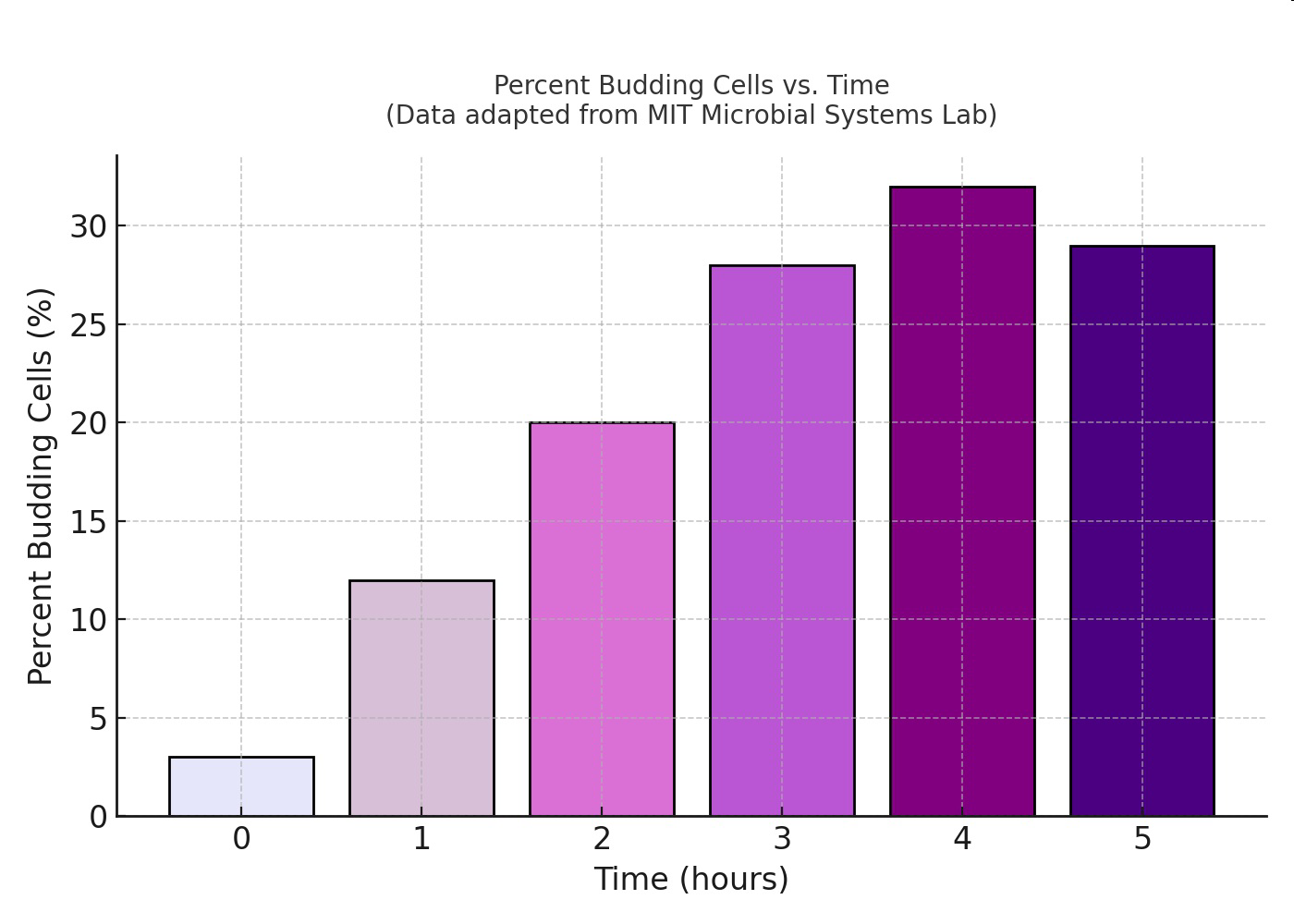
Time (hours) | Average Cell Count (cells/mL x $10^6$) | Percent Budding Cells (%) |
|---|
0 | 1.2 | 3 |
1 | 2.5 | 12 |
2 | 5 | 20 |
3 | 9.8 | 28 |
4 | 18.5 | 32 |
5 | 24 | 29 |
The increase in both cell count and percent of budding cells over time shows that yeast are made of individual, self-replicating cells. Each cell performs the functions necessary for life. Because yeast can live and reproduce independently as one cell, they provide direct evidence that living things can be made of just a single cell.
Graph of Information - Figure 1.
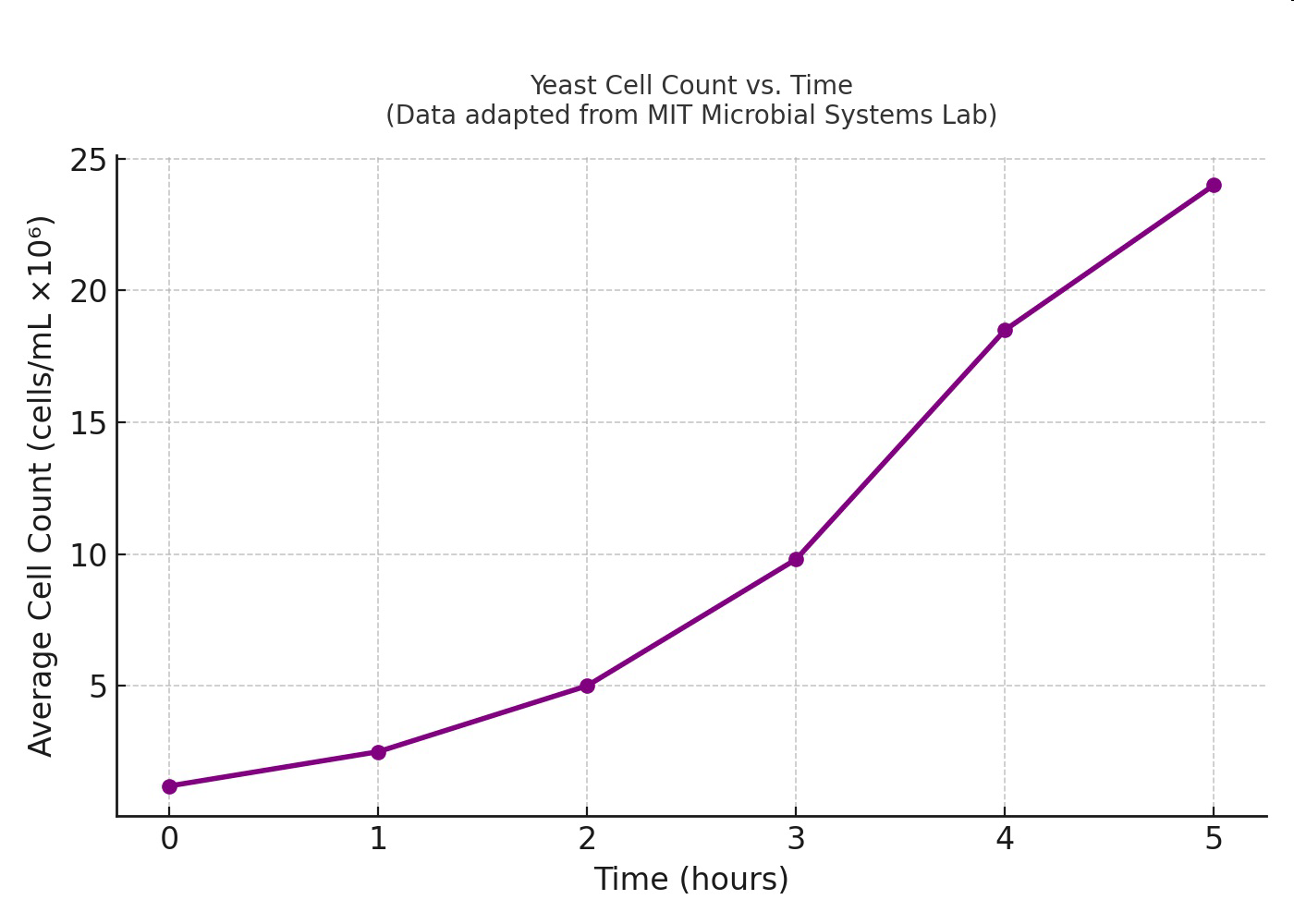
Graph of Information - Figure 2.