Have you heard of Katherine G. Johnson? If you haven’t heard of her, it may be because she’s one of the “hidden figures” behind NASA’s work to send people into space. But she’s definitely worth knowing about! She achieved countless breakthroughs throughout her impressive career in math and science.
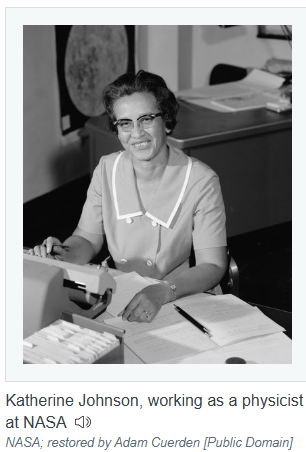
Johnson was born on August 26, 1918. At the young age of 13, she already showed an incredible talent for math. She was way ahead of her classmates and graduated with highest honors from West Virginia State College. She began teaching at a Black public school in Virginia.
As a Black woman growing up in the South, Katherine G. Johnson faced a lot of discrimination. When Johnson was growing up, many schools in the South were segregated. This meant that Black and white students attended separate schools. She was one of three Black students to integrate into the all-white graduate schools in West Virginia. She enrolled in the graduate math program, but stopped her studies to start a family. She went back to teaching, not realizing that her career path would shift drastically.
In 1952, a relative told her about an open job in the all-Black West Area Computing section at the National Advisory Committee for Aeronautics’ (NACA’s) Langley laboratory. This laboratory was responsible for working on new flight technology, including space travel. NACA would later become part of NASA (National Aeronautics and Space Administration). She got the job and spent four years analyzing data about a plane crash while learning the ins and outs of the mathematics of flying. Johnson and the other Black women working at NASA faced discrimination there. They worked in a separate department from their white female coworkers, and both groups of women were kept out of the main, all-male NASA workspaces. They had to fight extra hard to make their ideas and voices heard at NASA.
In 1957, the Soviet Union launched a satellite called Sputnik 1 into Earth's orbit. This was the first satellite to be sent into space. The Space Race was on! The United States began funding NASA to compete with the Soviet Union. The United States wanted to be the first country to have a successful human space flight. Katherine G. Johnson contributed greatly to this effort. She wrote research papers that laid out many of the mathematical equations necessary for space travel.
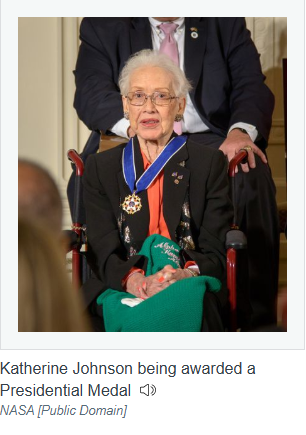
Katherine G. Johnson is probably most known for her work on the orbital mission of John Glenn. He was set to be the first American to orbit around the Earth. But he did not trust all of the electronic machines that would control the path of his spaceship. These machines would sometimes malfunction. Glenn asked the engineers for Katherine G. Johnson’s help. He trusted her to check every single mathematical equation. She checked the numbers, and Glenn’s mission was a success! Now, there is a movie called Hidden Figures that tells the true story of how she and two other brilliant African American women made sure this mission was a triumph.
33 years of work and many research papers later, Johnson retired in 1986. She said, “I loved going to work every single day.” At the age of 97, she was awarded the Presidential Medal of Freedom for her important work at NASA.
For many Americans, Martin Luther King Jr. Day isn’t just a "day off" from school or work. They will make it a "day on" and participate in community service projects in honor of Martin Luther King Jr. Day.

Library of Congress
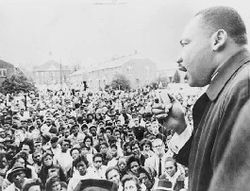
The Rev. Dr. Martin Luther King addresses a group of followers.
King (1929-1968) was a famous civil rights leader. When King was growing up, the South was segregated, or separated by race. Black people did not have the same rights as white people. Under the law, they were not allowed to attend the same schools as white people and had to sit in the back seats of buses. Black people also had to use separate restrooms and drinking fountains.
When King was older, he worked to change those unjust laws. During the 1950s and 1960s, he gave speeches and organized peaceful marches and protests. Beginning in 1955, King led the famous Montgomery bus boycott. For 381 days, African Americans boycotted, or refused to use, public buses in the Alabama city. A year later, the U.S. Supreme Court ruled that segregation on buses was illegal.
King gained national attention from the boycott and, in 1963, delivered his famous "I Have a Dream" speech. He told a crowd of more than 200,000 people in Washington, D.C., that his dream was for all people to be treated fairly and equally under the law. As a result of his work, civil rights laws were passed. Those laws protect the rights of all Americans.
Many people celebrate King’s legacy on Martin Luther King Jr. Day with parades and other events. The legacy of a leader is something that person has accomplished that would benefit future generations. For King, that meant making the world a better place. Thousands more honor King by cleaning parks, volunteering at homeless shelters, and participating in other community service projects.
"Everybody can be great because everybody can serve," King once said. By taking part in community service projects, Americans are able to keep this leader’s dream alive.
January 15, 1929: Born in Atlanta, Georgia
August 28, 1963: Delivers his "I Have a Dream" speech in Washington, D.C.
December 10, 1964: Becomes the youngest person to receive the Nobel Peace Prize
April 4, 1968: Is assassinated in Memphis, Tennessee
January 20, 1986: Martin Luther King Jr. Day first observed as a national holiday

Jay Bernstein Public Relations [Public domain]
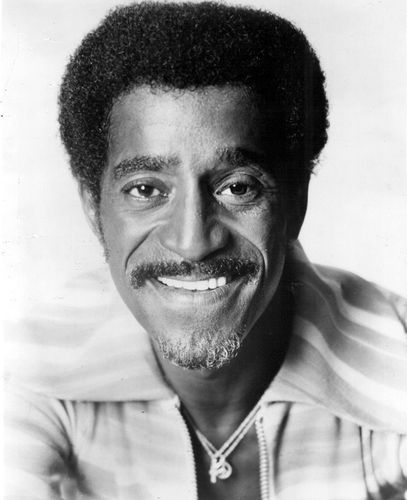
Sammy Davis Jr.
Have you heard of a man named Sammy Davis Jr.? Sammy Davis Jr. overcame racism and bigotry to become one of the biggest entertainers in the world! Many people consider Sammy Davis Jr. to be one of the most legendary performers of the 20th century.
Davis was born on December 8, 1925 in New York City. At a young age, he went on the road with his father and uncle, who were entertainers. Sammy Davis Jr. learned to tap dance and started performing with them. He learned to play multiple instruments and became a skilled singer, dancer and comedian. His talent was unmatched by many. He quickly became the star of the show!
In 1943, Davis’s budding entertainment career was interrupted. He was drafted into the Army to fight in World War II. While in the Army, he experienced prejudice and even physical abuse from his fellow soldiers. He realized one way to protect himself from this form of hatred was to entertain. By being an entertainer in the army, he felt somewhat safer.
After the war ended, Davis picked up his performing career. He performed at nightclubs and started recording his own records. In 1947, his career reached new heights when he opened for Frank Sinatra, a well-known entertainer. They would remain close friends throughout their lives.

Dell Publishing [Public domain]
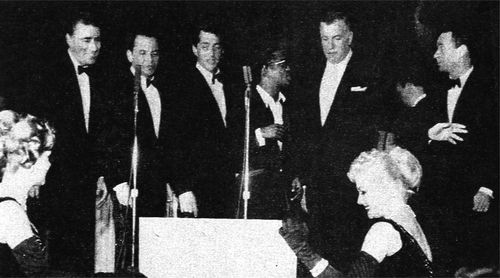
The Rat Pack with Sammy Davis Jr.
Sammy Davis Jr. was a star who had successful records and appeared in multiple television shows and films. He was also an important member of the Rat Pack, a group of famous entertainers which included Sinatra. Davis even took his talents to the stage and performed on Broadway in Mr. Wonderful and Golden Boy. But despite all this, Davis still experienced constant racial discrimination. Rather than quietly deal with it, he was outspoken about discrimination and acted on his beliefs. During the 1960s, he participated in the March on Washington and spoke out against racial prejudice. He refused to perform at segregated nightclubs. Many people saw his refusal to perform in these venues as the reason that Miami and Las Vegas nightclubs became desegregated. He also challenged biases by marrying Swedish actress May Britt, who was white. At the time, interracial marriage was illegal in 31 states. His legacy includes speaking out against racial prejudice and working hard to achieve his goals in the face of racism.
Davis continued sharing his many talents past the ‘60s. In 1972, he produced his most successful hit record, “The Candy Man.” It was number 1 on the Billboard Hot 100. Before his death in 1990, he went on a final tour with Frank Sinatra and Liza Minelli, two legends in their own right. His legacy continues to live on through his many records, films, and biographies.
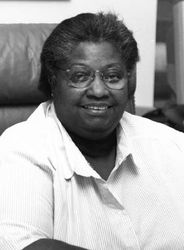
Alexa Canady, the first African American woman neurosurgeon in the United States
Have you ever wanted to become a doctor? If so, you may want to follow Alexa Canady’s path. Alexa Canady was the first female African American neurosurgeon in the United States!
Canady was born on November 7, 1950. At a young age, her parents taught her the importance of hard work and perseverance. This life lesson stayed with her throughout her schooling and career.
Canady went to the University of Michigan and studied zoology. During her junior year of college, she did a summer program that inspired her to become a doctor of some kind. After college, she went to medical school. After graduating from medical school, Canady had some trouble getting an internship. But eventually, she ended up as a surgery intern at Yale-New Haven Hospital. After her internship, she went on to do her residency in Minnesota. Residency is a part of a doctor’s training, where the doctors-in-training learn on the job. Canady quickly became one of the top residents of her class! Then, she moved on to be a proper neurosurgeon, with a focus on helping sick kids.
Neurosurgery is a kind of surgery that is performed on the nervous system, which includes the brain and the spinal cord. Neurosurgeons must be extremely skilled and talented to succeed in this difficult profession. Alexa Canady rose to every challenge. Many of her patients were under the age of 10. They had serious brain injuries or diseases. Throughout her over 20-year career, Canady saved thousands of young lives.
Canady's approach to medicine was to focus on the patients. She wanted to create a strong relationship with her patients so they felt that they could speak freely about their pain and other concerns. She built trust with her patients. This skill of hers did not go unnoticed. In 1987, she became the director of neurosurgery at the Children’s Hospital of Michigan. With her guidance, people viewed her department as one of the best in the country. Although she did experience discrimination during her time as a neurosurgeon, she continued to push past the barriers in the medical profession. She has said, “The greatest challenge I faced in becoming a neurosurgeon was believing it was possible.” Her hard work and dedication paid off.
Alexa Canady received many awards for her work in neurology. She was inducted into the Michigan Women’s Hall of Fame in 1989. And in 1993, she received the American Medical Women's Association President's Award. Even in retirement, Canady works part-time at a hospital, helping other children in need.
What subject did Katherine G. Johnson show an incredible talent for from an early age?
The text describes a sequence of events in Johnson’s career and life. How did Johnson’s career change in 1952?
Read the following sentences from the text.
“The United States wanted to be the first country to have a successful human space flight. Katherine G. Johnson contributed greatly to this effort. She wrote research papers that laid out many of the mathematical equations necessary for space travel.”
What can you conclude about Johnson based on this information?
Read the author’s description of John Glenn’s mission and Johnson’s role in it in the second to last paragraph. How might the author describe Johnson’s role in Glenn’s mission?
What is the main idea of this text?
What major achievement is Katherine G. Johnson known for?
What notable recognition did Johnson receive at age 97?
According to the text, when did Martin Luther King Jr. give speeches and organize peaceful marches and protests?
What does the author provide in the section titled “A Civil Rights Hero: Martin Luther King Jr.”?
Read these sentences from the text.
When King was older, he worked to change those unjust laws. During the 1950s and 1960s, he gave speeches and organized peaceful marches and protests. Beginning in 1955, King led the famous Montgomery bus boycott. For 381 days, African Americans boycotted, or refused to use, public buses in the Alabama city. A year later, the U.S. Supreme Court ruled that segregation on buses was illegal.
What can you conclude based on this information?
Based on the text, what was probably true about Martin Luther King Jr.?
What is this text mainly about?
Read these sentences from the text.
Many people celebrate King’s legacy on Martin Luther King Jr. Day with parades and other events. The legacy of a leader is something that person has accomplished that would benefit future generations. For King, that meant making the world a better place.
As used in these sentences, what does the word “generations” mean?
Choose the answer that best completes the sentence.
_________ the South was segregated, Black people did not have the same rights as white people.
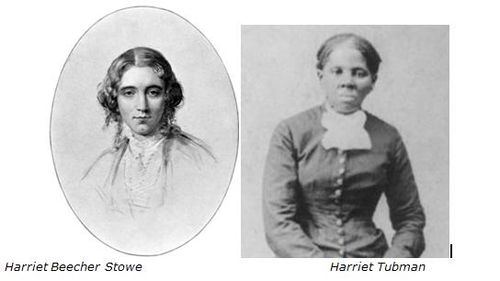
Many people fought against slavery in the United States. They were called abolitionists because they wanted to abolish (get rid of) slavery. Two of the best-known abolitionists were both named Harriet: Harriet Beecher Stowe and Harriet Tubman.
Harriet Beecher Stowe was the sixth of 11 children born to a minister and his wife. She was just five years old when her mother died. At age 13, she started going to a school founded by her sister, where she learned to be a teacher and started writing. She wrote her first book at age 22.
In 1852, her novel Uncle Tom’s Cabin was published. It quickly became a bestseller. Indeed, it was the most popular book in America. Although the book was fiction, it was based on the lives of real people. The novel tells the story of several slaves, but its main character is Tom, a man with a wife and children. Tom is separated from his family and sold to one plantation owner after another. The last of his owners is a cruel man named Simon Legree. Legree orders Tom to beat the other slaves on his plantation. Tom refuses, so Legree beats Tom. Legree orders his hired hands, called overseers, to kill Tom. While Tom dies, several of the other characters in the book escape from slavery by traveling north to Canada via what was called the Underground Railroad. The Underground Railroad was not an actual railroad, but a network of people who helped shelter and guide slaves to their freedom.
Stowe’s novel moved many readers and inspired them to speak out against slavery. Many plays were performed based on the novel’s characters. But her book angered people in the South, and historians believe it helped lead the Southern states to break away from the North a decade later, which marked the beginning of the Civil War. Uncle Tom’s Cabin was so influential that when President Abraham Lincoln met Stowe in 1862, he is supposed to have said: “So you’re the little woman who wrote the book that started this great war.”
Like Harriet Beecher Stowe, Harriet Tubman was one of 11 children. Both of Harriet Tubman’s parents were slaves on a plantation in Maryland. Tubman began working at six years old, rented out by her “master” as a weaver. As a teenager, she began working in the fields of the plantation. She suffered many beatings at the hands of the plantation’s overseers, which caused permanent damage. Learning that the plantation owner planned to sell her and her brothers, she decided to escape. Guided only by the North Star in the sky, she made her way to Pennsylvania, frequently on foot.
But Tubman was not content simply to live in freedom. She became active in the Underground Railroad Harriet Beecher Stowe had written about.
Just one year after her own escape, she returned to the South to rescue her sister and her sister’s two children. Then she returned once again for one of her brothers. Sometime later, she returned yet again to rescue her parents. It was not just her family she helped to become free. She wanted to help other slaves to escape. She returned to the South 19 times. The exact number of slaves that Tubman led to freedom is unknown; a 19th century biography stated that she rescued 300 slaves, while modern historians estimate the total was closer to 70.
During the Civil War, Tubman worked for the Union Army as a nurse and a cook. She also became a spy. In one daring mission, she learned the position of the Confederate Army along the Combahee River in South Carolina and traveled on a gunboat with hundreds of Union Army soldiers as they freed about 750 slaves.
Both Harriets lived fruitful lives long past the Civil War. Harriet Beecher Stowe continued to write, publishing more than 30 books. In her 80s, Harriet Tubman opened a nursing home in her adopted hometown of Auburn, NY for older African Americans. Both spoke out for women’s rights. But Harriet Tubman and Harriet Beecher Stowe are now recognized for their different but important roles in ending slavery in the United States of America.
What is an abolitionist?
How does the author compare Harriet Tubman and Harriet Beecher Stowe?
Harriet Tubman’s work to improve the lives of African-Americans continued after the Civil War. What evidence from the passage supports this conclusion?
Read the following sentences:
“[Harriet Tubman] also became a spy. In one daring mission, she learned the position of the Confederate Army along the Combahee River in South Carolina and traveled on a gunboat with hundreds of Union Army soldiers as they freed about 750 slaves.”
Based on this information, what can you conclude about Harriet Tubman?
What is this passage mostly about?
Read the following sentences:
“But her book angered people in the South, and historians believe it helped lead the Southern states to break away from the North a decade later, which marked the beginning of the Civil War. Uncle Tom’s Cabin was so influential that when President Abraham Lincoln met Stowe in 1862, he is supposed to have said: ‘So you’re the little woman who wrote the book that started this great war.’”
As used in this sentence, what does the word “influential” mean?
Choose the answer that best completes the sentence below.
Harriet Tubman and Harriet Beecher Stowe had many things in common; ___________, they were both abolitionists, they both fought for women’s rights, and they were both one of eleven children.
What did Sammy Davis Jr. do at a young age?
What caused Sammy Davis Jr. to pause his entertainment career in 1943?
Sammy Davis Jr. had a successful career as an entertainer. What evidence from the text supports this conclusion?
Sammy Davis Jr. used his popularity as an entertainer to fight against racism. What evidence from the text supports this conclusion?
What is the main idea of this text?
Read the following sentences.
“Rather than quietly deal with it, he was outspoken about discrimination and acted on his beliefs. During the 1960s, he participated in the March on Washington and spoke out against racial prejudice. He refused to perform at segregated nightclubs...He also challenged biases by marrying Swedish actress May Britt, who was white. At the time, interracial marriage was illegal in 31 states.”
As used in these sentences, what does the word “biases” most closely mean?
Choose the answer that best completes the sentence below.
Sammy Davis Jr. had a positive impact on racial equality in the U.S. __________ he was outspoken about the discrimination he experienced and took action.
What kind of doctor was Alexa Canady?
In the third paragraph, the author describes Canady’s journey to becoming a neurosurgeon. What were the steps in Canady’s process of becoming a neurosurgeon?
Read these sentences from the text.
“Canady's approach to medicine was to focus on the patients. She wanted to create a strong relationship with her patients so they felt that they could speak freely about their pain and other concerns. She built trust with her patients.”
Based on this information, what can you conclude about how Canady would act as a doctor?
Read these sentences from the text.
“With her guidance, people viewed her department as one of the best in the country. Although she did experience discrimination during her time as a neurosurgeon, she continued to push past the barriers in the medical profession.”
How might the author describe Canady as a person, based on this information?
What is the main idea of this text?
What was a major focus of Canady's medical practice?
What did Canady receive in 1993 for her work?