Burning Steel Wool
Real-World Phenomenon
A piece of steel wool can be burned (heated strongly) and afterward it looks darker and more brittle. When it is weighed before and after burning, the mass often increases. This seems confusing because mass is supposed to be conserved in chemical reactions. Scientists use models of atoms and evidence about the system to explain why this happens.
Diagram 1.
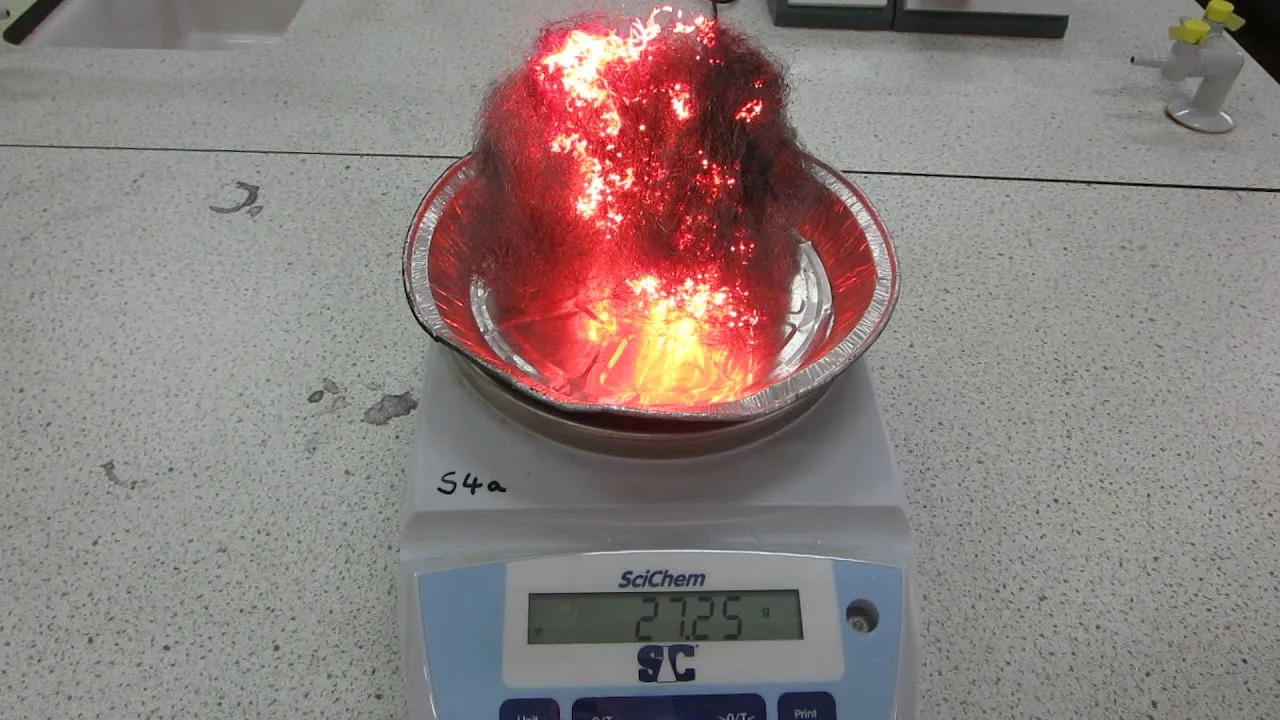
Source: https://thewonderofscience.com/phenomenon/2018/7/8/burning-steel-wool
In a chemical reaction, atoms are not created or destroyed. Instead, atoms rearrange to form new substances. Because the total number of atoms stays the same, the total mass is conserved. However, whether the measured mass appears to change depends on what is included in the system being measured.
Steel wool is mostly iron. When steel wool burns, iron atoms react with oxygen atoms from the air. The product is iron oxide, a new substance. In this reaction, oxygen from the air becomes part of the solid material. That means the solid can gain mass because atoms that were originally in the air are now included in the solid after the reaction.
If the steel wool is weighed alone before burning and then weighed alone after burning, the mass often increases. That does not break the law of conservation of mass. It happens because the system is not closed. Oxygen atoms entered the steel wool from the surrounding air, adding mass to the solid.
A model of atoms helps explain this. Before the reaction, the steel wool contains iron atoms and the air contains oxygen atoms. After the reaction, the iron atoms and oxygen atoms are bonded together in iron oxide. The atoms are rearranged, but the total number of atoms involved in the reaction is the same before and after. The difference is that oxygen atoms moved from the air into the solid product.
To show mass conservation clearly, scientists can measure the mass of a closed system where oxygen cannot enter or leave. In a closed system, the total mass before and after the reaction stays the same.
Diagram 2.
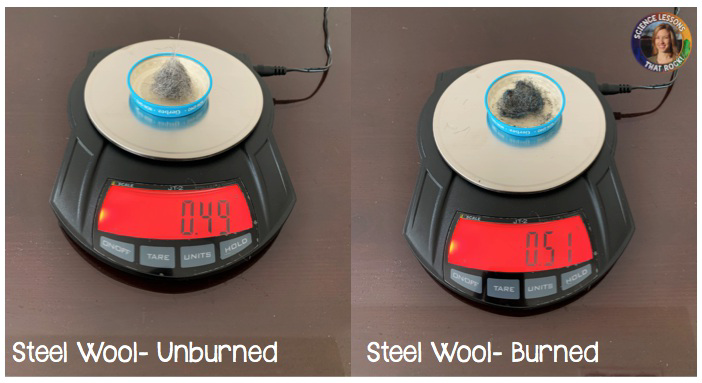
Source: https://sciencelessonsthatrock.com/conservation-of-mass-experiments-html/
Table 1.
Trial | Mass Before Burning (g) | Observation Before | Mass After Burning (g) | Observation After |
|---|
Trial 1 | 2 | Shiny gray, fluffy | 2.28 | Dark gray/black, brittle |
Trial 2 | 2.05 | Shiny gray, fluffy | 2.32 | Dark gray/black, brittle |
Trial 3 | 1.98 | Shiny gray, fluffy | 2.25 | Dark gray/black, brittle |
Trial 4 | 2.02 | Shiny gray, fluffy | 2.3 | Dark gray/black, brittle |
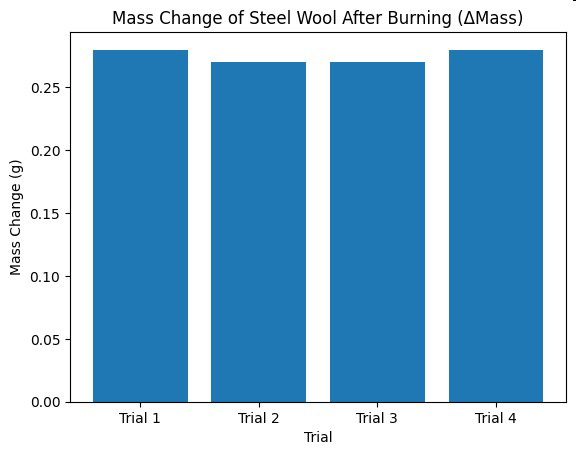
Graph of Information - Figure 1.
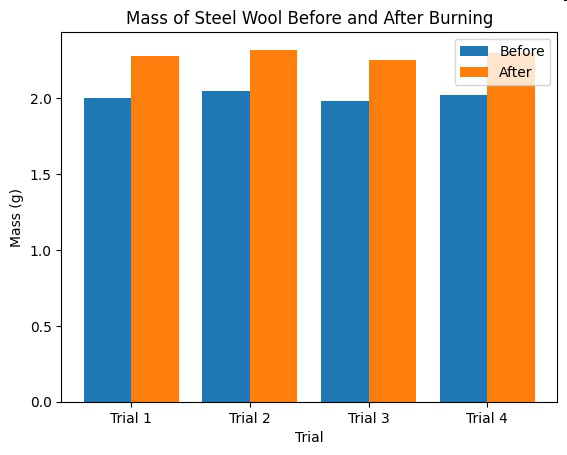
Graph of Information - Figure 2.