Designing a Hand Warmer
Real-World Phenomenon
Reusable and disposable hand warmers are used in cold weather to keep hands warm. When activated, the temperature of the hand warmer increases without using electricity. This happens because a chemical or physical process inside the device releases thermal energy. Engineers design these devices to reach a safe temperature and stay warm for a useful amount of time.
Some devices are designed to release thermal energy when materials interact. This release of thermal energy causes the temperature of the device to increase. Processes that release thermal energy are called exothermic.
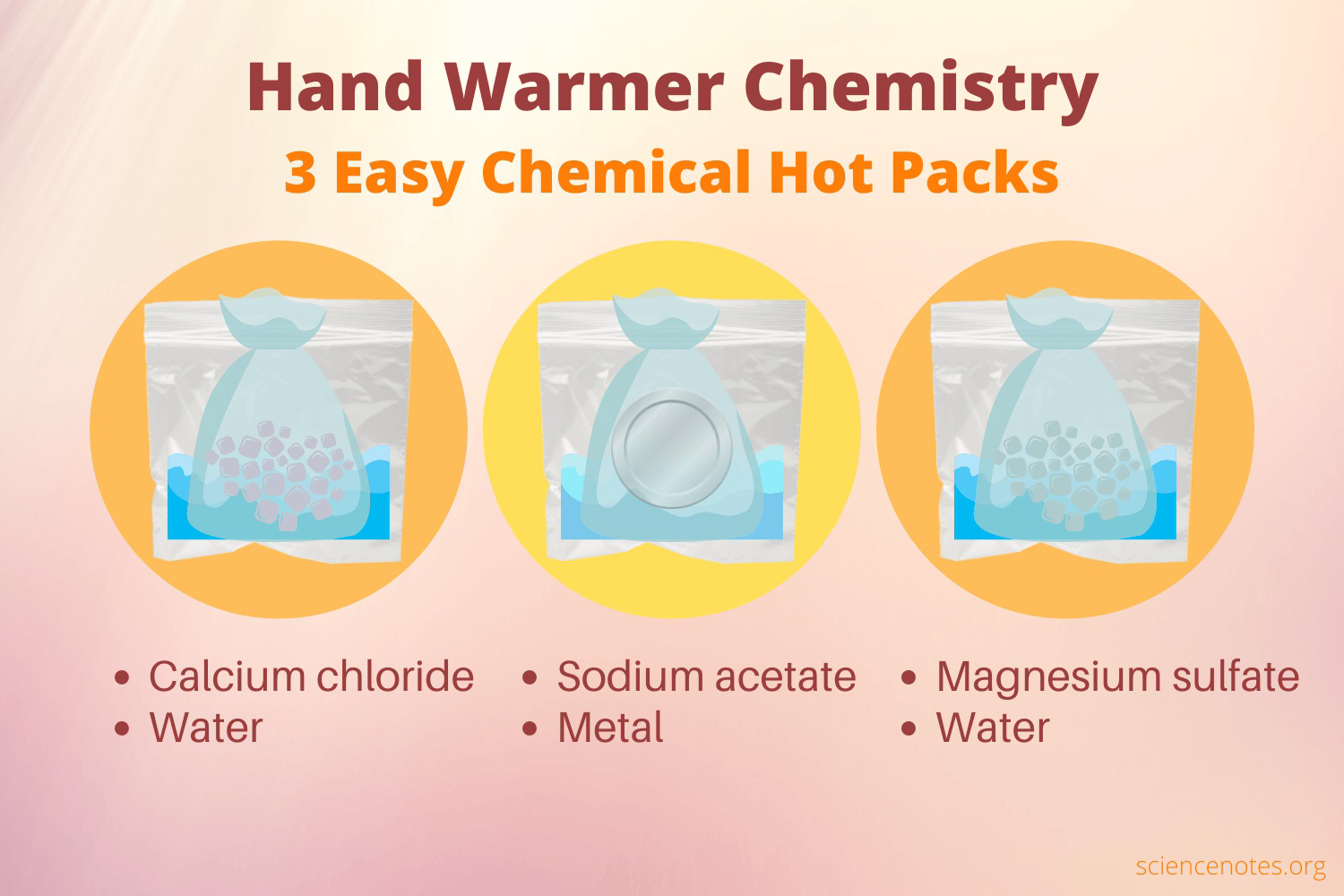
Hand warmers are examples of devices that use exothermic processes. In some hand warmers, a chemical reaction occurs when materials mix or are exposed to air. In other reusable hand warmers, a physical process called crystallization releases energy as particles form a solid structure. In both cases, thermal energy is transferred from the materials inside the warmer to the surrounding environment, including a person’s hands.
Diagram 1.
Source:
https://sciencenotes.org/hand-warmer-chemistry-easy-chemical-hot-packs/
Engineers must carefully design hand warmers so they are effective and safe. If the warmer releases too much thermal energy too quickly, it could become dangerously hot. If it releases too little energy, it may not be useful. Engineers test prototypes by measuring temperature changes over time and recording how long the device stays warm.
The engineering design process involves building a prototype, testing it, and then modifying the design based on the data collected. Design changes might include adjusting the amount of reacting material, changing the container size, or adding insulation to slow heat loss.
By analyzing temperature data and using models of particle motion, students can explain how the hand warmer releases thermal energy and how design changes improve its performance.
Table 1. Initial Design
Time (minutes) | Temperature (°C) |
|---|
0 | 20 |
2 | 26.5 |
5 | 33 |
8 | 36.5 |
10 | 38 |
15 | 36 |
20 | 33.5 |
25 | 30 |
30 | 27 |
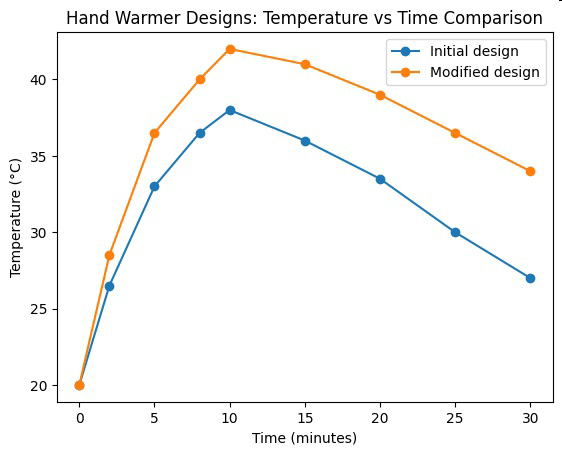
Graph of Information - Figure 1.
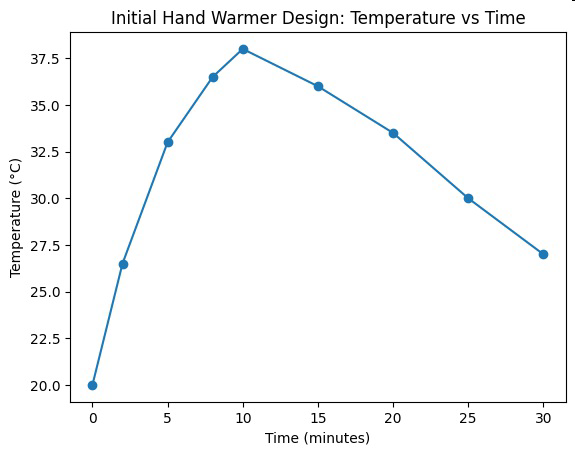
Table 2. Modified Design
Time (minutes) | Temperature (oC) |
|---|
0 | 20 |
2 | 28.5 |
5 | 36.5 |
8 | 40 |
10 | 42 |
15 | 41 |
20 | 39 |
25 | 36.5 |
30 | 34 |
Graph of Information - Figure 2.