Designing an Instant Cold Pack
Real-World Phenomenon
Instant cold packs are often used for sports injuries to reduce swelling. When the pack is squeezed, the temperature drops quickly without being placed in a freezer. This happens because a physical process inside the pack absorbs thermal energy from its surroundings. Engineers design and test these packs to control how cold they get and how long they stay cold.
Some devices are designed to change temperature when materials interact. These temperature changes can happen because of physical or chemical processes. In some cases, a substance absorbs thermal energy from its surroundings, causing the temperature to decrease. This type of process is called endothermic.
Instant cold packs use an endothermic physical process. Inside the pack are two materials kept separate until the pack is activated. When the materials mix, a solid dissolves in water. Dissolving requires energy to separate particles, and that energy is taken from the surrounding materials, including the pack and the air around it. As a result, the temperature of the pack drops.
Diagram 1.
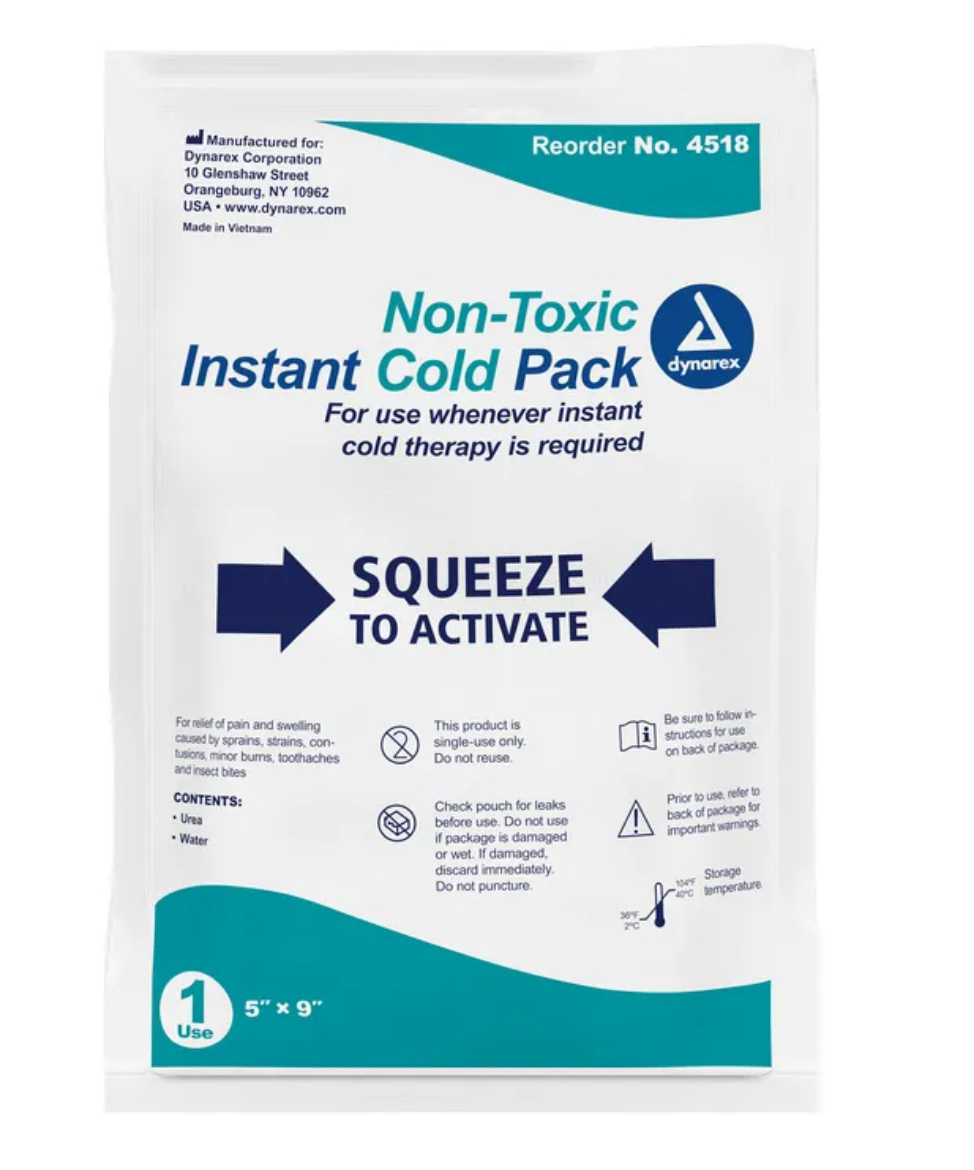
Source: https://www.bmhsi.com/instant-cold-packs
Engineers design cold packs carefully. If the pack gets too cold, it could be unsafe. If it does not get cold enough, it may not be useful. Engineers test their designs by measuring temperature changes over time. They may change the amount of solid used, the volume of water, or the insulation of the container to improve performance.
Designing a cold pack is an example of an engineering design process. First, a problem is identified: create a device that absorbs thermal energy. Then, a prototype is built and tested. Data are collected on how much the temperature changes and how long the effect lasts. Based on the data, the design can be modified to improve safety, effectiveness, or efficiency.
By analyzing temperature data and using models of particle motion, students can explain how their cold pack design absorbs thermal energy and how design changes affect performance.
Table 1. Initial Design
Time (minutes) | Temperature (oC) |
|---|
0 | 22 |
1 | 18.5 |
2 | 16.2 |
3 | 14.6 |
4 | 13.4 |
5 | 12 |
7 | 12.8 |
10 | 14.3 |
12 | 15.6 |
15 | 17 |
Graph of Information - Figure 1.
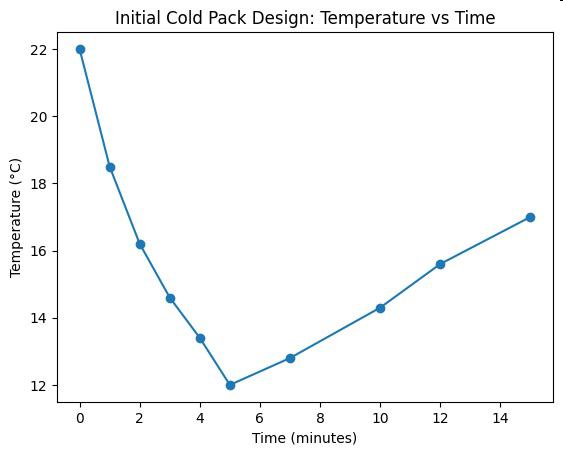
Table 2. Modified Design
Time (minutes) | Temperature (oC) |
|---|
0 | 22 |
1 | 17.2 |
2 | 13.8 |
3 | 11.4 |
4 | 10.1 |
5 | 9 |
7 | 9.4 |
10 | 10.8 |
12 | 11.8 |
15 | 13 |