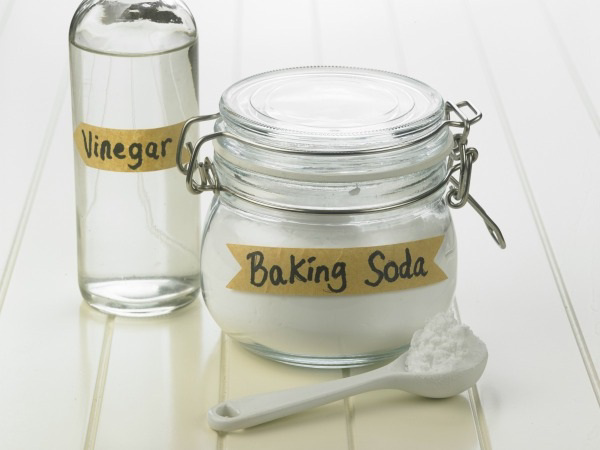
Vinegar and Baking Soda
Diagram 1.
Source: https://www.thriftyfun.com/Cleaning-With-Baking-Soda-and-Vinegar.html
Real-World Phenomenon
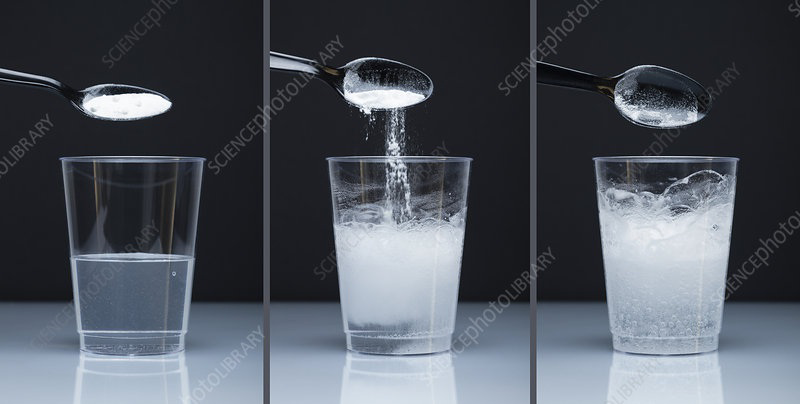
When baking soda is added to vinegar, the mixture begins to bubble and fizz. Gas is released, the temperature changes, and the substances no longer look the same as they did before mixing. Scientists collect data before and after the substances interact to determine whether a chemical reaction has occurred.
When substances interact, they may undergo either a physical change or a chemical reaction. In a physical change, the substances may change form, such as dissolving or melting, but no new substances are created. In a chemical reaction, new substances form with different properties than the original substances.
Vinegar is a liquid solution that contains acetic acid, while baking soda is a solid substance called sodium bicarbonate. Before they interact, each substance has its own properties, including mass, temperature, and appearance. When baking soda is added to vinegar, bubbles form immediately. These bubbles are a gas released during the interaction.
The production of gas is an important piece of evidence when determining whether a chemical reaction has occurred. In this case, the gas released is carbon dioxide. The formation of a gas that was not present before suggests that a new substance has been created.
Diagram 2.
Source: https://www.sciencephoto.com/media/7797111/view/vinegar-reacting-with-baking-soda
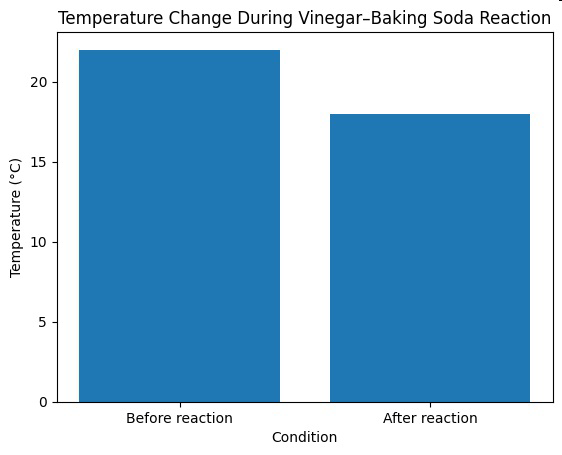
Other properties can also change during the interaction. The temperature of the mixture may decrease as energy is absorbed during the reaction. If the reaction takes place in an open container, some mass may appear to be lost as gas escapes into the air. These changes can be measured and compared before and after the substances interact.
By analyzing data on properties such as mass, temperature, and gas production, scientists can determine whether a chemical reaction has occurred. When new substances form and properties change in ways that cannot be reversed easily, the evidence supports the conclusion that a chemical reaction has taken place.
Table 1.
Substance | Mass (g) | Temperature (oC) |
|---|
Vinegar | 100 | 22 |
Baking soda | 10 | 22 |
Graph of Information - Figure 1.
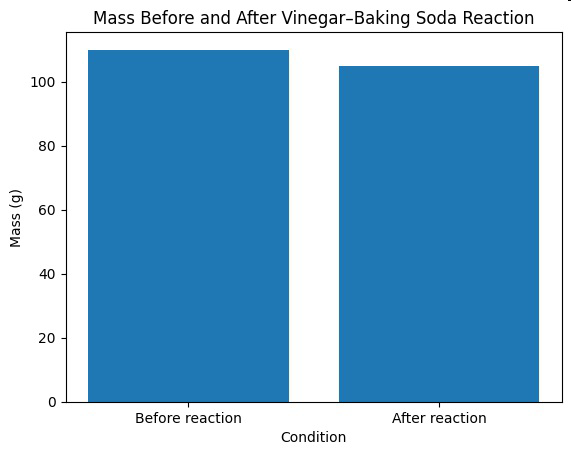
Table 2.
Mixture Condition | Mass (g) | Temperature (oC) | Gas Observed |
|---|
After reaction | 105 | 18 | Yes |
Graph of Information - Figure 2.