Vinegar and Baking Soda in a Closed System
Real-World Phenomenon
When vinegar and baking soda react in an open container, bubbles form and gas escapes. However, when the same reaction happens inside a sealed bag or closed container, the bag inflates but the total mass of the system stays the same. Scientists use models of atoms and measurements of mass to explain why mass is conserved during the reaction.
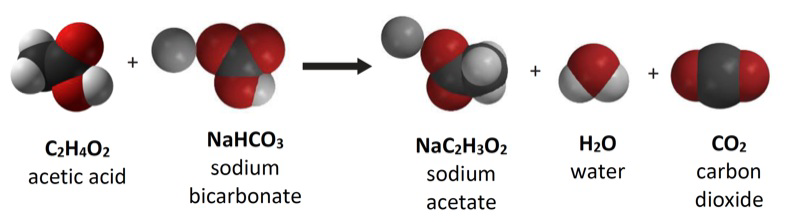
Diagram 1.
Source: https://www.acs.org/middleschoolchemistry/lessonplans/chapter6/lesson2.html
In a chemical reaction, substances interact and form new substances. Even though the materials may look different after the reaction, the total number of atoms does not change. Atoms are not created or destroyed. Instead, they rearrange to form new molecules. This idea is known as the law of conservation of mass.
Vinegar and baking soda undergo a chemical reaction that produces carbon dioxide gas, water, and a dissolved substance. In an open container, the gas escapes into the air, making it appear as though some mass is lost. However, this does not mean mass has disappeared. The gas is simply no longer part of the measured system.
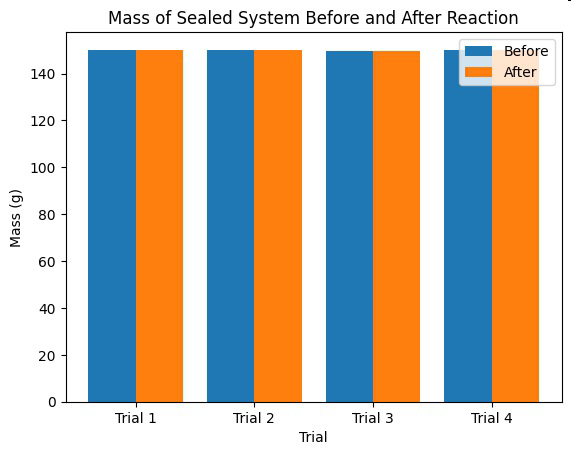
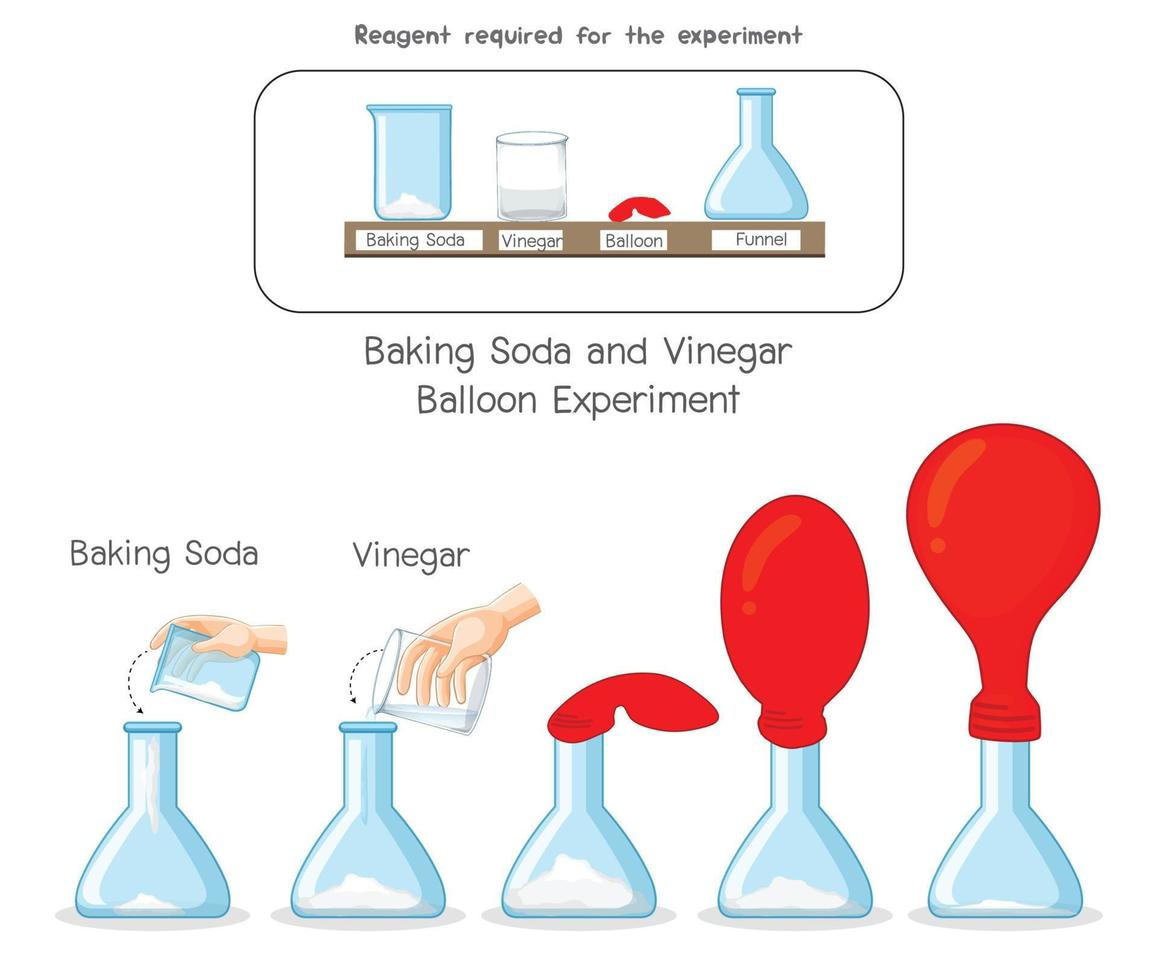
When the reaction takes place in a closed system, such as a sealed bag, the gas cannot escape. The bag may expand as gas fills it, but all atoms remain inside the system. If the total mass of the closed system is measured before and after the reaction, it stays the same.
Diagram 2.
Source:
https://www.vecteezy.com/vector-art/21669329-baking-soda-and-vinegar-balloon-science-experiment
Scientists use particle models to explain this result. Before the reaction, atoms are arranged in vinegar and baking soda molecules. During the reaction, those atoms rearrange to form new molecules, including carbon dioxide. The number of each type of atom before the reaction is equal to the number after the reaction.
By combining mass measurements with atomic models, scientists can explain why mass is conserved even when substances change. The evidence supports the conclusion that chemical reactions rearrange atoms but do not change the total number of atoms in the system.
Table 1.
Trial | Mass Before Reaction (g) | Mass After Reaction (g) |
|---|
Trial 1 | 150 | 150 |
Trial 2 | 150.2 | 150.2 |
Trial 3 | 149.8 | 149.8 |
Trial 4 | 150.1 | 150.1 |
Graph of Information - Figure 1.