Designing a Self-Heating Cup
Diagram 1.
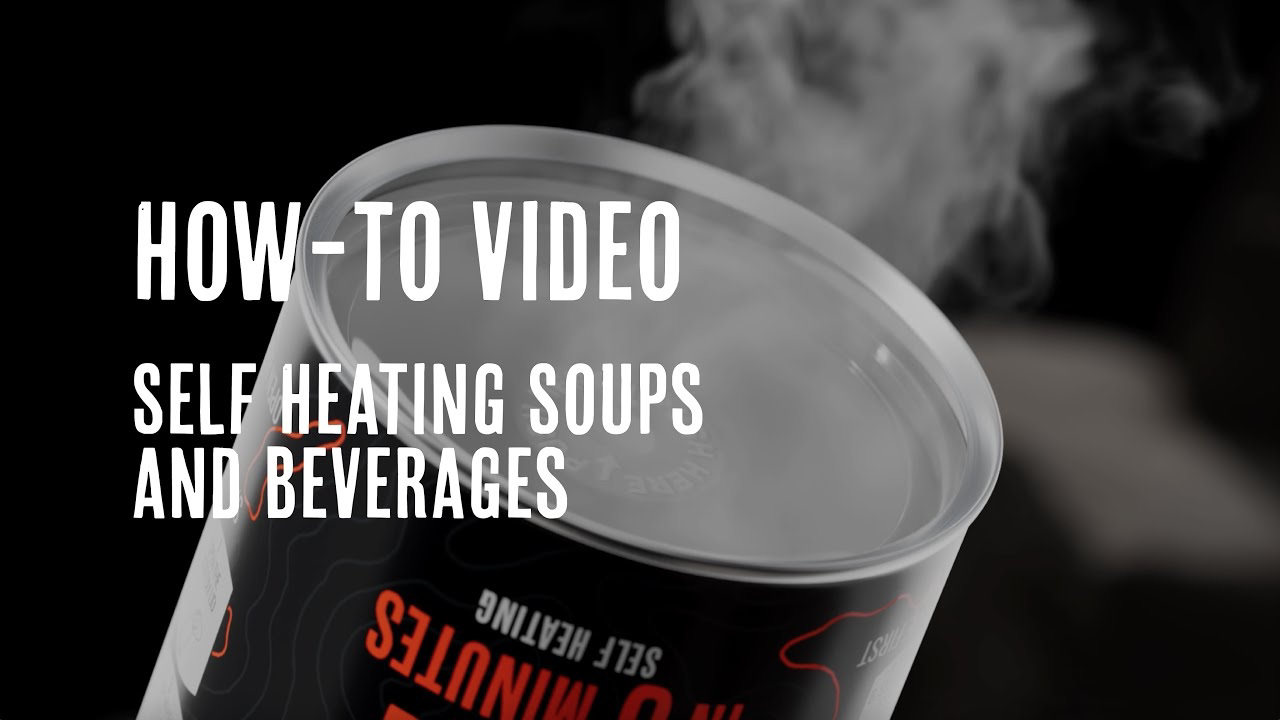
Source: https://www.youtube.com/watch?v=1bRMu5wT6mw
Real-World Phenomenon
Some camping meals and emergency food containers can heat themselves without electricity. When activated, the container warms the food inside. This happens because a chemical process inside the device releases thermal energy, which is transferred to the liquid or food. Engineers design these devices to control how fast and how much heat is released.
Devices that heat without electricity rely on chemical or physical processes that release thermal energy. When this energy is released, it can be transferred to nearby materials, causing their temperature to increase. These processes are called exothermic.
In a self-heating cup, two materials are kept separate until the device is activated. When they mix, an exothermic process begins and releases thermal energy. This energy does not heat the food directly by contact with a flame. Instead, energy is transferred through the container walls into the liquid inside the cup.
Engineers must design self-heating cups carefully. The device must release enough thermal energy to warm the liquid to a useful temperature but not so much that it becomes unsafe. The design must also control how quickly the energy is released. If the reaction happens too fast, much of the energy may be lost to the air instead of heating the liquid.
Testing the design involves measuring the temperature of the liquid over time. Engineers compare different designs by changing factors such as the amount of reacting material, the thickness of the container walls, or the insulation around the heating chamber. Based on temperature data, engineers modify the design to improve performance.
This design process follows a cycle of planning, testing, and improving. By analyzing temperature data and using models of energy transfer, students can explain how their self-heating cup transfers thermal energy and how design changes affect the final temperature of the liquid.
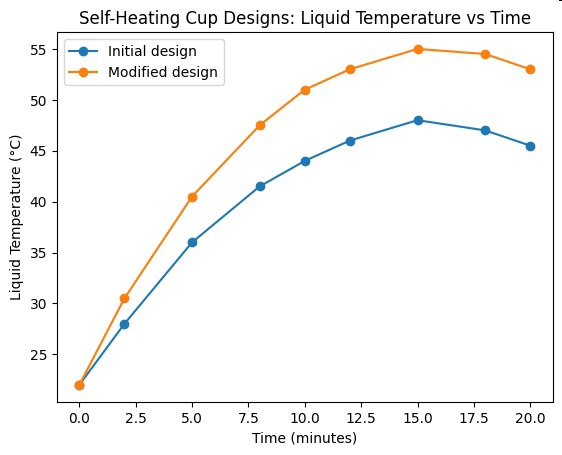
Table 1. Initial Design
Time (minutes) | Liquid Temperature (°C) |
|---|
0 | 22 |
2 | 28 |
5 | 36 |
8 | 41.5 |
10 | 44 |
12 | 46 |
15 | 48 |
18 | 47 |
20 | 45.5 |
Graph of Information - Figure 1.
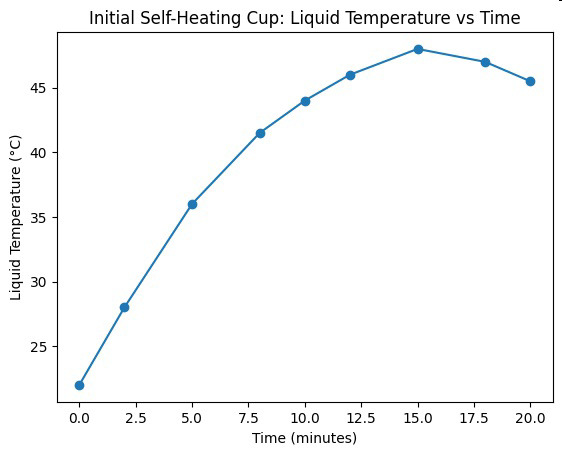
Table 2. Modified Design
Time (minutes) | Liquid Temperature (°C) |
|---|
0 | 22 |
2 | 30.5 |
5 | 40.5 |
8 | 47.5 |
10 | 51 |
12 | 53 |
15 | 55 |
18 | 54.5 |
20 | 53 |
Graph of Information - Figure 2.