Twa kɔ nsɛm atitiriw so
Log in
Sign up for FREE
arrow_back
Laabri

Week 3.7: Exciting Sports

star
star
star
star
star
Last updated about 2 hours ago
37 Nsɛmmisa
The History of Surfing in Hawaii
The Amazing Acrobatics of Sepak Takraw
Learning to Skateboard
Brazil Today: Futebol - Brazil's Sport
The Sport of Kabaddi

Click submit when finished with all questions and check your answers. You may not be able to make corrections at this time.

1
1
1
1
1
1
1
Asemmisa {{asɛmmisaAhyɛnsode}}
7.

Choose the answer that best completes the sentence below.

In its earlier days, surfing was well respected in Hawaii.allowed for more cultures to play it together and caused the sport to gain popularity.

1
1
1
1
1
1
1
1
Asemmisa {{asɛmmisaAhyɛnsode}}
23.

Choose the answer that best completes the sentence.

Ella keeps practicing her new trick; soccer is so popular in Brazil, many of the best players are treated as national heroes.

The Sport of Kabaddi

Kabaddi is a team sport that requires quick thinking, strength, and the ability to hold your breath! People of all ages play and enjoy kabaddi. All you need is friends to play with and a large court. Today, kabaddi is one of the most popular sports in India.

To play kabaddi, two teams of seven players alternate between playing offense and defense. To start a round, the attacking team (offense) sends out one player to be the “raider.” The raider’s job is to cross the court and enter the defending team’s territory. They must score points by touching as many of the defending players as possible. The raider must then escape past the line in the middle of the court and return to their own territory. To make things tougher, the raider has 30 seconds to score. And, as they are trying to tag players, the raider must continually chant “kabaddi” out loud in a single breath! If the raider loses their breath and stops chanting “kabaddi”, they are out. Once a raider touches a player, the defending team tries to tackle the raider before the raider passes the midline. If the defending team tackles the raider and the raider loses their breath, the defending team gets a point. The two teams take turns defending and raiding. At the end of 40 minutes, the team with the most points wins. There are three different styles of kabaddi, but they all have these rules in common.

Kabaddi has a rich, long history in Indian culture. It is believed that kabaddi began in India and has been around for thousands of years. One major source of evidence for this is The Mahabharata. The Mahabharata is an epic poem that was written over 2,000 years ago in ancient India. It mentions a military operation that resembles the sport of kabaddi. It describes a warrior named Arjuna, who mastered kabaddi skills with the help of the Hindu god Krishna. He would climb over walls to attack his enemies and escape unharmed. Throughout history, Indian princes would often play kabaddi to demonstrate their strength and skill. The game continued to develop over the years in India. In many parts of India and South Asia, kabaddi was played in schools for physical exercise. It was and still is a very popular game in India’s rural areas, since it does not require any special equipment.

The basic rules of kabaddi were formalized in India in 1923. India introduced the sport to the world during the 1936 Berlin Olympics at a demonstration before the games officially began. Many people enjoyed watching the sport and wanted to learn. In 1972, the Amateur Kabaddi Federation of India was founded. Today, this organization wants to make kabaddi an official Olympic sport to continue sharing this exciting sport worldwide.

Millions of people from as many as 65 countries play kabaddi in various forms. This fun, fast game continues to be extremely popular in Asia and beyond.

1
1
1
1
1
1
1

The History of Surfing in Hawaii

Surfing has existed in many forms for several centuries in places like West Africa and Peru. But the origins of the most popular form of modern surfing originated in Ancient Polynesia. Cave paintings from the 12th century show Polynesians riding waves. The first Polynesians arrived in the Hawaiian Islands in the 4th century. They brought with them their deep knowledge of the ocean as well as the sport of surfing. Surfing has been a major part of Polynesian and Hawaiian culture for thousands of years.

In Hawaii, surfing has always been more than a sport. In its earliest days in the islands, it was a cultural and spiritual activity. Hawaiians called surfing he’e nalu, which means “wave sliding.” They followed an ancient code of rules and laws called Kapu. The Kapu system controlled religion, politics, lifestyle, and surfing customs. For example, before selecting a tree to carve to create a surfboard, Hawaiians would give offerings to the gods. They prayed to the kahuna, or expert priest, to give them good waves. Hawaiians even gave thanks after surviving a rough wipeout in the ocean. All of these traditions were a well-established part of Hawaiian surfing culture.

Hawaiian men, women, and children of all ages and social classes surfed. Back then, Hawaiian society was split into two main social classes: the royal and the common class. Only members of the royal class could surf in certain areas with the best waves. Chieftains, the highest members of the royal class, displayed their courage, skill, and power by surfing in big waves. They rode on olo boards, which could be as long as 24 feet and were made of heavy wood. Other Hawaiians rode alaia or paipo boards. These boards were much shorter and lighter, making them easier to ride. Although the social classes in Hawaii were strictly divided, some people in the common class gained respect from the royal class by demonstrating their surfing skills. Over hundreds of years, surfing continued to flourish as an important part of Hawaiian life.

In the late 1700s and early 1800s, white settlers began arriving in Hawaii. The first written account of surfing happened in 1778. British explorer Captain James Cook wrote that the surfer he watched seemed to feel “the most supreme pleasure, while he was driven on, so fast and so smoothly, by the sea.” However, not all explorers and other white settlers felt the same way about surfing. Missionaries arrived on the islands of Hawaii. They thought surfing was sinful and tried to ban it. They also brought diseases to the islands. By 1800, the Hawaiian population had declined by 48% since Cook had arrived in Hawaii. By 1840, the population had declined by 84%. During this time, surfing almost disappeared. However, a few dedicated Hawaiian surfers persevered and continued to keep the sport alive.
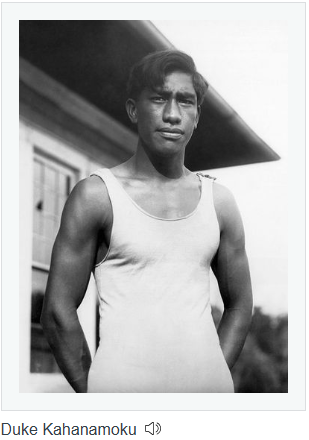
Duke Kahanamoku and George Freeth, two Hawaiian surfers, helped spread surfing to the rest of the world. In 1907, Freeth gave surfing demonstrations in Southern California. People were amazed at his skill. In 1914, Duke Kahanamoku went to Australia and popularized surfing there. Soon, many people started traveling to Hawaii to learn how to surf. New, lighter boards were created that made surfing more accessible. It became an international sport.

Today, there are about 35 million surfers worldwide. In 2016, the Olympic Committee decided to make surfing an Olympic sport for future Olympic Games. Surfing continues to be a popular sport in Hawaii and the rest of the world.
Asemmisa {{asɛmmisaAhyɛnsode}}
1.

Who introduced surfing to the Hawaiian Islands?

Asemmisa {{asɛmmisaAhyɛnsode}}
2.

How does the text describe the Kapu custom for creating a surfboard?

Asemmisa {{asɛmmisaAhyɛnsode}}
3.

Read the following sentences.

"Missionaries arrived on the islands of Hawaii. They thought surfing was sinful and tried to ban it. They also brought diseases to the islands. By 1800, the Hawaiian population had declined by 48% since Cook had arrived in Hawaii. By 1840, the population had declined by 84%. During this time, surfing almost disappeared."

What conclusion can you draw based on this evidence?

Asemmisa {{asɛmmisaAhyɛnsode}}
4.

How did Duke Kahanamoku and George Freeth spread Hawaiian culture to the rest of the world?

Asemmisa {{asɛmmisaAhyɛnsode}}
5.

What is the main idea of this text?

Asemmisa {{asɛmmisaAhyɛnsode}}
6.

Read the following sentences.

“In 1914, Duke Kahanamoku went to Australia and popularized surfing there. Soon, many people started traveling to Hawaii to learn how to surf. New, lighter boards were created that made surfing more accessible. It became an international sport.”

As used in this sentence, what does the word “accessible” most closely mean?

Asemmisa {{asɛmmisaAhyɛnsode}}
8.

What helped spread surfing around the world in the 20th century?

The Amazing Acrobatics of Sepak Takraw

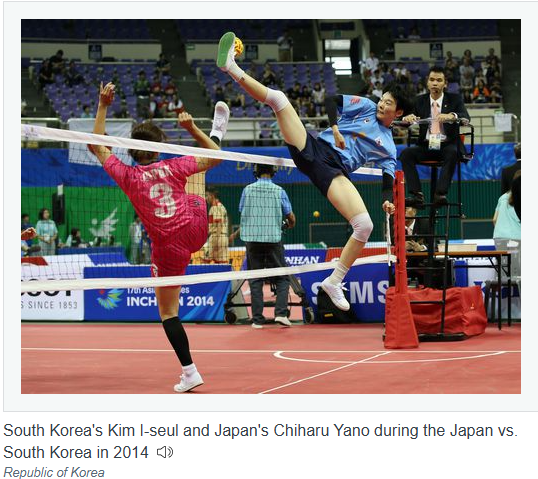
Sepak takraw is a very popular sport in Southeast Asia. It requires athleticism, flexibility, and teamwork. In this sport, three teammates work together to hit a ball across a net using only their feet, knees, chest and head. The ball is not allowed to touch the players’ arms or hands. Players use their flexibility to twist, jump, and kick with grace and power. The goal of the game is for one team to score more points than the other team. Players score points when they cause their opponents to fault. Faults occur when players make errors like hitting the ball out of bounds or missing the ball. Each team can only hit the ball three times in a row before the other team must hit it.

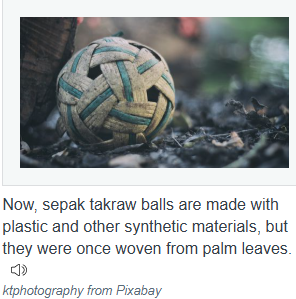
Sepak takraw has been around in different forms for a very long time. Since the 15th century, different versions of sepak takraw have been played across many Asian countries. One version most likely came from a Chinese military program. As part of this program, soldiers would kick a ball and try to keep it in the air with their feet. At the time, the ball was made from animal hide and chicken feathers. This version of sepak takraw was less of a sport, and more of an exercise for soldiers to stretch their legs and practice their agility. Throughout Asia, people played other versions of sepak takraw for centuries with their own rules. In fact, the game has different names in different places. In Thailand, it is called “takraw,” and in Laos it is “kataw.” In Malaysia, it is called “sepak raga.” One distinct version of the game is found in Myanmar and is called “chinlone.” In this version, teams do not compete against each other, but perform together in a playing circle. The goal of the game is to keep the ball in the air in graceful and entertaining ways.

The more modern, simplified version of sepak takraw was made official almost 200 years ago in Thailand, then called Siam. In 1829, the Siam Sports Association created the first official rules of the game. The organization added the net between the teams and hosted the first public tournament. Within just a few years, sepak takraw was played in most Thai schools. The game became very popular. It was even played to celebrate the kingdom’s first constitution in 1933!

Even with this popularity, sepak takraw did not have standardized rules across Asia until the 1960s. The Asian Sepak Takraw Federation created the first set of formalized rules across Asia. The game took on the official name of sepak takraw. For many years, Thailand and Malaysia have dominated sepak takraw tournaments. And over the years, this sport has gained international popularity. Many people in Asia are calling for sepak takraw to become an official Olympic sport. Making sepak takraw an Olympic sport would broaden its audience even more.

Sepak takraw is an entertaining, fast-paced sport with a long and varied history. Spectators love to watch players do gravity-defying kicks and use their whole body to keep the ball up in the air. Have you seen or played in a sepak takraw game?

Asemmisa {{asɛmmisaAhyɛnsode}}
9.

What is sepak takraw?

Asemmisa {{asɛmmisaAhyɛnsode}}
10.

How does the sepak takraw sport compare to the version soldiers would practice in the Chinese military?

Asemmisa {{asɛmmisaAhyɛnsode}}
11.

Sepak takraw is an important part of Thai culture. What evidence from the text supports this conclusion?

Asemmisa {{asɛmmisaAhyɛnsode}}
12.

The Olympics is a competition of many sports that athletes from all around the world participate in. How would making sepak takraw an Olympic sport broaden its audience?

Asemmisa {{asɛmmisaAhyɛnsode}}
13.

What is the main idea of this text?

Asemmisa {{asɛmmisaAhyɛnsode}}
14.

Read the following sentences from the text.

“Sepak takraw has been around in different forms for a very long time. Since the 15th century, different versions of sepak takraw have been played across many Asian countries. One version most likely came from a Chinese military program….One distinct version of the game is found in Myanmar and is called ‘chinlone.’”

As used in this excerpt, what does the word “version” most closely mean?

Asemmisa {{asɛmmisaAhyɛnsode}}
16.

What parts of the body can players use in sepak takraw?

Learning to Skateboard

The sound of the skateboard up and down the hallway is driving Ella insane. She sits at her desk, trying to read a book. All she hears is: scraaaape, scraaaape, thud!

She pokes her head out of her bedroom door.

“Mom said not to skateboard in the house!” she yells at her brother.

“It’s Saturday afternoon, Nerd! Take a break!”

Ella slams her bedroom door. How dare he! Then, she opens the bedroom door again and watches quietly. It does seem like fun, actually.

“Hey,” she calls after him. “Let me try.”

“No way, Nerd! Not after you just yelled at me to stop.”

Ugh! Ella slams the door again and goes back to her desk. She hears Joseph pick up the board and run down the stairs. Outside, his friends are all waiting for him. They all have their skateboards.

Maybe I spend too much time indoors, Ella thinks.

Closing the book on her desk, she puts on a jacket and follows her brother outside. He’s skating up and down the block now, showing off for all his friends.

She walks up behind him, waving her hands. He sees her, but pretends not to.

“Hey, Joseph! Hey!”

“Get lost,” he says.

“Can I skate with you?”

“I said get lost,” he says. “Girls can’t skate.”

All his friends start laughing. “Girls can’t skate,” they repeat, sneering.

Ella feels tears well up in her eyes, but she won’t let the boys see her cry. Girls can’t skate? Maybe that’s because you won’t even let me try!

She’s about halfway up the block when she hears a voice call out after her.

“Hey Ella! Wait up!”

It’s one of Joseph’s friends. He looks sheepish and a bit frightened.

She spins around angrily. “What do you want from me?”

“I…I… just thought…”

“You just thought that girls can’t skate, so you wanted to come and make fun of me?”

The boy looks at the ground. “No, I just thought maybe you’d like to try out my board a little bit. I can show you how to use it.”

Ella wonders if maybe it’s a trick, but the boy seems so sincere. He holds out the board to her, and she takes it.

“My name is Jake,” he says. “Let me show you how to ride.”

“What about my brother?” she asks.

They both turn to look for Joseph. At the end of the street, he grabs one end of his board and flips around in the air. He’s busy impressing his friends.

“Come on,” Jake says, “He can’t notice anyone but himself right now.”

Jake takes her by the hand and leads her to a small patch of concrete next to the lawn.

“This way if you fall, you’ll fall on the grass,” he says.

“I’m afraid to fall,” Ella says.

“You can’t learn if you’re afraid to fall,” Jake says.

“But what if I hurt myself?”

Jake hands her a helmet. It’s covered with stickers from all his favorite skate punk bands.

“But if you do fall, this way, you won’t end up in the hospital with a concussion.”

He shows her how to stand on the board, how to place her feet in a comfortable position, and how to shove off with one foot.

Ella stands on the board and feels herself wobble back and forth. It looks so easy when Jake does it. She isn’t sure what to do with her hands and waves them around wildly in the air. Suddenly, she feels the earth move from her feet to her head.

WOAAAH! Her head hits the grass with a clunk.

“Good thing you had that helmet on,” Jake says. Ella is lying on the ground.

She looks at her arm and gasps. Her elbow is bleeding a little.

“Hey, we’d better stop now. You’re hurt!” Jake says.

“I can take it,” Ella tells him. “I can’t learn if I’m afraid to fall, right?”

They keep practicing until it starts to get dark. They both have so much fun, they completely lose track of time.

“Oh no! I missed dinner!” Jake says, finally noticing the time.

“Oh no!” Ella says. “Well, I guess you’d better take your board and go home.” She is trying to disguise the hurt in her voice, but she cannot.

“You were better at hiding your pain when you fell on your elbow, Ella.”

Ella laughs. “Yeah,” she says, looking down at her feet. “I guess I’m kind of sad about it ending.”

“Tell you what, Ella. Why don’t you keep the board for a week?”

“Really? Do you mean it?”

“Absolutely. I mean it!” Jake says. “I…uh.” Jake stutters and gives her a big hug. She hates to admit it, but the hug feels really nice.

“I promise to give it back in good condition!”

“Hey, maybe it’s just an excuse to see you again,” he says.

The next day, Ella wakes up early and takes the board outside. She practices everything Jake taught her and only falls a few times. The scrape on her elbow is already almost completely healed.

When Saturday comes around again, she wakes up extra early. She wants to have as much time as possible with the board. She’s even taught herself a new trick, one she learned herself by watching a video online. It’s called an Ollie.

She does it 10 times and falls. She does it 10 more times and almost completes it. After 10 more tries, she is finally successful.

When Jake comes around the corner, she’s jumping in the air, the board flying right along with her. She sees Jake smile and start to applaud, and she’s down in the grass again. THUD!

“That was amazing!” Jake says.

“Yeah, well, you didn’t see me fall about 50 times before I actually did it!” she says.

In the distance, they hear someone calling Jake’s name. It’s her brother. He comes skating around the corner along with the rest of his friends.

“Jake, we’ve been looking for you everywhere!” he says. And then he sees his sister lying in the grass.

“I told you!” he says, holding his sides and doubling over. “I told you girls can’t skate!”

“I can!” Ella yells. “I’ll prove it to you!”

Ella gets up and starts to do the trick, but Jake runs over and stops her.

“You don’t owe anybody an explanation,” he says.

“Are you crazy?” Ella asks him. Joseph and his friends are walking away now, still laughing and saying she can’t skate.

“You and I both know you can do it, and we know how hard you’ve been working. No matter what you do, they’ll find a way to make fun of you.”

“I guess you’re right,” Ella says. She puts the board down and executes a perfect Ollie.

“I saw that,” Jake says. “You’re capable of a lot of great things.”

At that exact moment, Ella loses her balance and goes tumbling to the ground. Jake reaches into the grass to take her hand.

“It’s a good thing I’m not afraid to fall,” Ella says. “Or I’d never know I had good friends there to help me back up again.”

They hug each other for what seems like a very long time.

“Same time next week?” Jake asks.

“I’ll see you then,” Ella says. She heads home knowing she has a lot more practice ahead of her, but that’s okay.

Asemmisa {{asɛmmisaAhyɛnsode}}
17.

Who learns how to skateboard in this story?

Asemmisa {{asɛmmisaAhyɛnsode}}
18.

What is a conflict in the story?

Asemmisa {{asɛmmisaAhyɛnsode}}
19.

Read these sentences from the story.

“At that exact moment, Ella loses her balance and goes tumbling to the ground. Jake reaches into the grass to take her hand.
‘It’s a good thing I’m not afraid to fall...’ Ella says. ‘Or I’d never know I had good friends there to help me back up again.’

They hug each other for what seems like a very long time.”

What can be concluded from these sentences?

Asemmisa {{asɛmmisaAhyɛnsode}}
20.

How does Jake feel about Ella?

Asemmisa {{asɛmmisaAhyɛnsode}}
21.

What is a theme of this story?

Asemmisa {{asɛmmisaAhyɛnsode}}
22.


Read the following sentences from the story:

“The sound of the skateboard up and down the hallway is driving Ella insane. She sits at her desk, trying to read a book. All she hears is: scraaaape, scraaaape, thud!”

Why does the author write “scraaaape, scraaaape, thud”?

Asemmisa {{asɛmmisaAhyɛnsode}}
24.

Based on the text, how many World Cup titles did Pelé win?

Asemmisa {{asɛmmisaAhyɛnsode}}
25.

Why does the author discuss Pelé?

Asemmisa {{asɛmmisaAhyɛnsode}}
26.

Read these sentences from the text.

When [Pelé] was 15, he tried out for a professional club. A former World Cup player had brought him to the tryout. The man said, “This boy will be the greatest soccer player in the world.” He was right.

Based on this information, what can you conclude about Pelé?

Asemmisa {{asɛmmisaAhyɛnsode}}
27.

Based on the text, why is Pelé famous outside of Brazil?

Asemmisa {{asɛmmisaAhyɛnsode}}
28.

What is the main idea of this text?

Asemmisa {{asɛmmisaAhyɛnsode}}
29.

Read these sentences from the text.

Many people also know that Brazil has won the World Cup title many times. The World Cup is the most prestigious international soccer event.

As used in the text, what does the word "prestigious" mean?

Asemmisa {{asɛmmisaAhyɛnsode}}
31.

In what country is kabaddi a popular sport?

Asemmisa {{asɛmmisaAhyɛnsode}}
32.

What happens after a raider in kabaddi enters the defending team’s territory?

Asemmisa {{asɛmmisaAhyɛnsode}}
33.

Read the following sentences from the text.

“The raider’s job is to cross the court and enter the defending team’s territory. They must score points by touching as many of the defending players as possible…And, as they are trying to tag players, the raider must continually chant ‘kabaddi’ out loud in a single breath! If the raider loses their breath and stops chanting ‘kabaddi’, they are out.”

What can you conclude about the raider based on this information?

Asemmisa {{asɛmmisaAhyɛnsode}}
34.

The author says that the first mention of kabaddi comes from an ancient poem, the Mahabharata. How has the sport of kabaddi changed over the years from the time of the Mahabharata to now?

Asemmisa {{asɛmmisaAhyɛnsode}}
35.

What is the main idea of this text?

Asemmisa {{asɛmmisaAhyɛnsode}}
36.

What is one reason kabaddi is popular in rural areas?

Asemmisa {{asɛmmisaAhyɛnsode}}
37.

Every word has other words that have similar meanings or even the exact same meaning (these are called synonyms). Find the synonym to this vocabulary word: demonstrate