Warriors of New Zealand
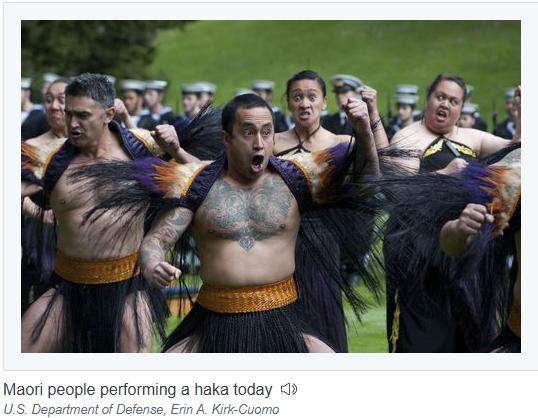
The New Zealand national rugby union team, known as the All Blacks, has one of the most interesting traditions in the sports world. Before every international match, the team does a chant called a haka. A haka is a traditional Maori dance. The Maori are the indigenous people of New Zealand. For centuries, a type of haka was done as a war chant to signal a battle between Maori tribes. Today, haka are performed mainly at cultural events or celebrations. But for the All Blacks rugby team, the haka remains a powerful battle cry.
The All Blacks team gathers in the center of the field, in front of the opposing team. They do a series of specific and exact movements. They stomp their feet. They use their hands to pound their arms and legs in unison. The leader of the chant shouts out the traditional lines: “Ka mate, ka mate!” (“I die, I die!” ) The team shouts back in response: “Ka ora, ka ora!” (“I live, I live!” ) The chant and the stomps are meant to get the All Blacks energized and prepared for the game. They are also meant to strike fear into the other team. When they are finished, the crowd goes wild with cheers. They know the challenge has just been put forth. And then, the rugby game begins. To a person who is not familiar with Maori customs, it may seem unusual to begin a rugby match in this way. Yet the haka is just one piece of the Maori tradition and culture.
The Art of the Maori
Maori art has long been valued for its unique designs. The Maori have always believed that art is sacred. Many of them have tattoos. Tattoos were seen as an important rite of passage and a powerful symbol in the move from childhood to adulthood. Since the head was thought to be the most sacred part of the body, the most popular tattoo was the face tattoo. Each tattoo used a different series of curves and shapes. No two patterns were the same. The tattoos were a symbol of social rank and power. Those who had no tattoos were thought to have very little power.
Much of traditional Maori art includes carvings. Many carvings are of human forms made out of wood. They are believed to be the honored ancestors of a tribe. Some carvings have sea monsters on them, and tell a myth or a legend. Many houses have symbolic carvings on them. In some instances, the entire house is one huge carving. The house represents the body of the ancestor, and is named after that person.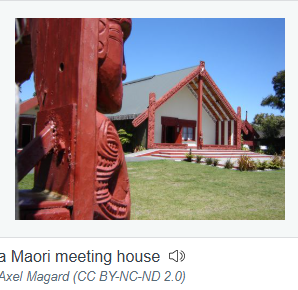
The woven art of the Maori carries with it great spiritual value. It often has deep and specific meanings. Some woven pieces show the value of learning. Some show the Maori connection to nature. The act of weaving itself carries a strong feeling of unity, as the tightness of the fibers often symbolizes the closeness of family ties.
The art of the Maori shows the values and beliefs they hold. From tattoos, to weavings, to carvings, to dance, these traditions are all important parts of a culture that has existed for centuries in New Zealand.
The Maori Through History
The islands of New Zealand are located in the southwest Pacific Ocean, some 1,200 miles southeast of Australia. The north and south islands are dotted with active volcanoes and cut through by swift rivers. Today they are home to more sheep than people. But it has been the home of the Maori people ever since their ancestors landed there in canoes during the 1200s.
Scientists believe the people who became the Maori set out to sea from islands to the west and north of what is now called New Zealand. The native people of the Pacific were excellent sea travelers. They used the flight patterns of seasonal birds by day and the stars by night to sail to islands thousands of miles away. They used simple but large canoes. The canoes were operated both by paddle and by sail. Their hulls were decorated with symbols that were believed to be very powerful. Some of their battle canoes are thought to be the largest ever made in the world.
When these early people settled in New Zealand, they had to learn how to live in this unfamiliar land. There was a lot more land than the tropical islands from which they came. The weather was also colder. They needed to make heavier clothing and stronger huts to deal with the colder temperatures. They needed to prepare for the earthquakes that hit this part of the world on a regular basis. They also needed to come up with a new way to grow the tropical vegetable and fruit plants they had brought with them. Some of the plants grew well in the colder environment, but others did not.
As the Maori population grew, so did the need for resources. Different tribes formed, and a series of wars broke out among them. Most of the wars were over property and hunting rights. The Maori came to be known as some of the fiercest warriors in history.
It was during these times of war that the war-type haka was used. Rival Maori groups would meet on the battlefield. Then each group would do the haka to show how powerful and brave they were. The men would walk back and forth. They would pound their spears into the ground and chant in rhythm. They would roll their eyes and shout insults. They would stick out their tongues. Sometimes the dance worked. The other group would decide not to fight such strong warriors. But more often than not, the haka led to a battle.
The huge distance between the islands of New Zealand and the next closest land mass kept the Maori culture apart from the world for hundreds of years. It wasn't until 1642 that a ship in search of land rich in minerals made its way to the far south Pacific. The people on the ship were the first Europeans that the Maori encountered. Some Maori went out on canoes to get closer to the Europeans, and some of the Europeans traveled in a smaller ship toward the canoes. There were some misunderstandings. Some actions that were meant to be friendly were understood as threats by mistake. This led to the death of some European sailors.
Europeans didn’t come to New Zealand again until a little more than 120 years later. These Europeans were mainly looking to hunt for whales and seals. Most relations between the Maori and these Europeans were friendly. However, many of the Maori ended up enduring a lot of suffering in the form of illness. The Europeans had brought a number of diseases with them that the Maori had not encountered before. The Maori had no way to prepare for or fight against the germs, and large numbers of Maori died.
The European ships brought something else with them that would change the way of life for the Maori: guns. The Europeans used a specific type of gun called a musket. The Maori people had never seen a musket. The musket allowed fighting to be done at long distances. Certain Maori tribes began to trade food and supplies for guns and gunpowder. As a result, some tribes had guns while others did not. This divided the villages and changed the balance of power among the tribes. Beginning in 1807, the Maori fought one another with muskets. Conflicts from the 1810s to the early 1830s became known as the Musket Wars. While no one is sure how many people died in these conflicts, some believe about 20,000 people lost their lives.
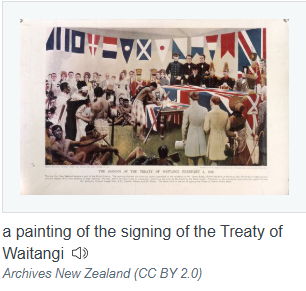
Several years after the Musket Wars, the Maori became linked with one particular European nation, the British Empire. In fact, this wasn’t the first time that the islands had a connection with the British. The British explorer James Cook came to the islands in 1769. He claimed the islands for his country. But it wouldn’t be until 1840 when the British Empire’s Queen Victoria made a treaty, or agreement, with the Maori. At that moment, the Maori were brought into the British Empire. Many Maori chiefs signed the treaty. Although over 500 chiefs signed, not every chief signed or had the chance to sign. Ever since the treaty’s signing, the very meaning of the treaty has been a source of debate.
Throughout the 1840s and early 1850s, non-Maori people in New Zealand demanded a form of democracy. They got their wish in 1852 with the New Zealand Constitution Act, but the Maori didn’t have representation in the government. Then, in 1867, the Maori were given some representation in the government: four seats. Only Maori people could vote for representatives to fill these four seats. The number of Maori seats has increased to seven seats today, but the total number of seats in the government also has increased greatly.
Preserving the Culture
For many years after the Maori became connected with Britain, Maori people were encouraged to learn about the ways of different people all around the world. Some parts of this effort, like connecting with other cultures, were good. But much of the Maori culture was in danger of being lost. In recent years, there has been a series of movements to preserve Maori culture. Many schools in the Maori areas now teach the original language and the ways of their ancestors along with classes in science, global studies, and modern technology.
Today, the Maori culture is celebrated throughout New Zealand. Maori people serve in elected positions, star in international films and shows, and play on the national sports teams. The All Blacks rugby team's haka dance might very well be the best example of this celebration of Maori culture. Maori warriors performed the haka dance in wars and conflicts centuries before, but the haka dance today keeps alive the spirit, soul, and pride of the Maori.