Formation of Water from Hydrogen and Oxygen
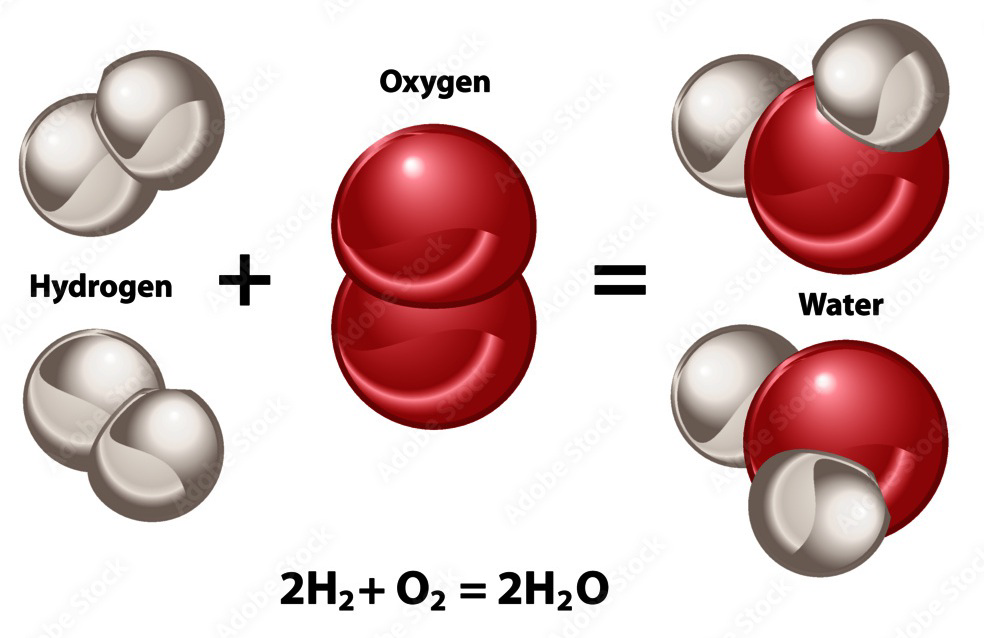
Diagram 1.
Source: https://stock.adobe.com/de/images/chemical-reaction-model-of-creating-new-compounds/
Real-World Phenomenon
Water can be produced when hydrogen gas reacts with oxygen gas. Even though the substances change into something new (water), scientists can show that the total number of atoms stays the same by using a model that counts atoms before and after the reaction. When atoms are conserved, mass is conserved too.
In a chemical reaction, substances change because atoms rearrange into new molecules. The key idea is that atoms are not created or destroyed during the reaction. This means the total number of each type of atom stays the same before and after the reaction. Because atoms have mass, conserving atoms also explains why mass is conserved.
A clear way to show this is by modeling the reaction that forms water. Hydrogen gas is made of hydrogen molecules (H$_2$). Oxygen gas is made of oxygen molecules (O$_2$). Water molecules are H$_2$O, meaning each water molecule contains two hydrogen atoms and one oxygen atom.
If we try to make water, we need to make sure the number of atoms is balanced. For example, one oxygen molecule contains two oxygen atoms. That means we can form two water molecules (because each water molecule needs one oxygen atom). To make two water molecules, we also need four hydrogen atoms, which come from two hydrogen molecules. The balanced model is:
$2\text{H}_2 + \text{O}_2 \rightarrow 2\text{H}_2\text{O}$
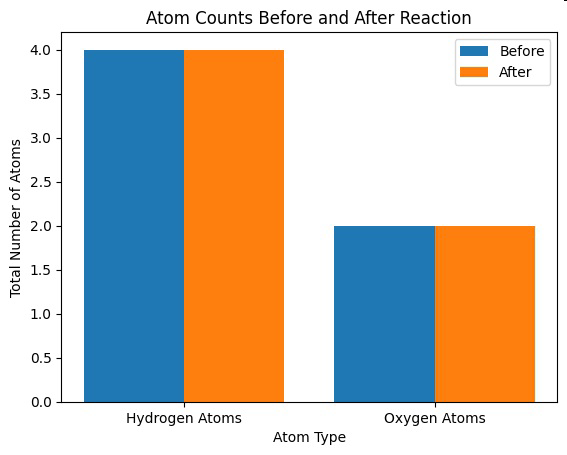
This model shows that before the reaction there are 4 hydrogen atoms and 2 oxygen atoms, and after the reaction there are still 4 hydrogen atoms and 2 oxygen atoms, just rearranged into water molecules. Because the atoms are conserved, the total mass is conserved.
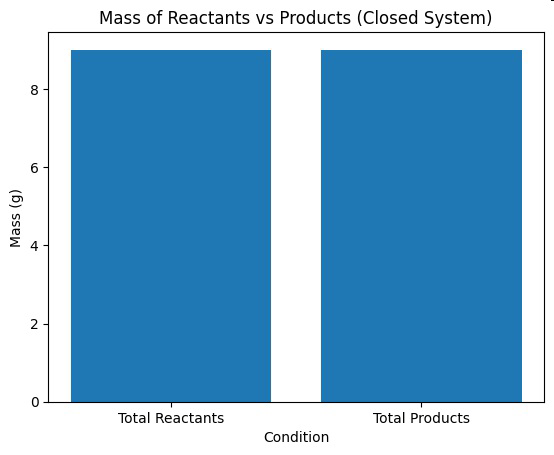
Scientists can also connect models to data. If the masses of hydrogen and oxygen are measured before the reaction and the mass of water is measured after, the totals match (in a closed system). Using both atom-count models and mass data provides strong evidence for conservation of mass in chemical reactions.
Table 1.
Substance | Number of Molecules | Hydrogen Atoms (total) | Oxygen Atoms (total) | Mass (g) |
|---|
Hydrogen (H$_2$) | 2 | 4 | 0 | 2 |
Oxygen (O$_2$) | 1 | 0 | 2 | 16 |
Water (H$_2$O) | 2 | 4 | 2 | 18 |
Graph of Information - Figure 1.
Graph of Information - Figure 2.