Rusting Iron
Real-World Phenomenon
A new iron nail is shiny and smooth. After being left outside in rain or placed in water, the nail can turn reddish-brown and rough. Over time, it may become weaker and flaky. Scientists use data on properties before and after the iron interacts with oxygen and water to determine whether rusting is a chemical reaction.
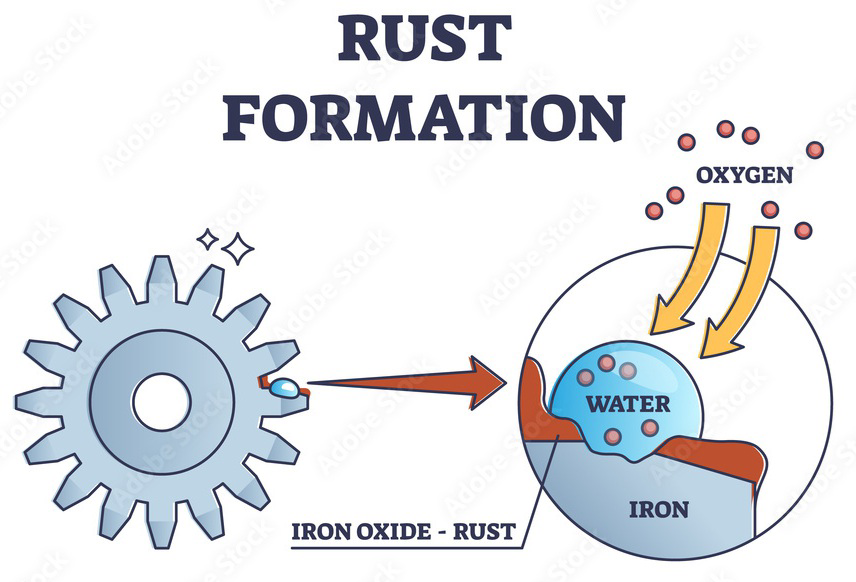
Diagram 1.
Source:
https://animalia-life.club/qa/pictures/rusting-of-iron-chemical-reaction
When substances interact, they may undergo a physical change or a chemical reaction. In a physical change, the substance may change form, but the same substance is still present. In a chemical reaction, new substances form and the properties change in ways that are not easily reversed.
Rusting happens when iron reacts with oxygen, often in the presence of water. The iron atoms combine with oxygen to form iron oxide, which is a new substance with different properties than iron. This change does not happen instantly. It occurs over time as the interaction continues.
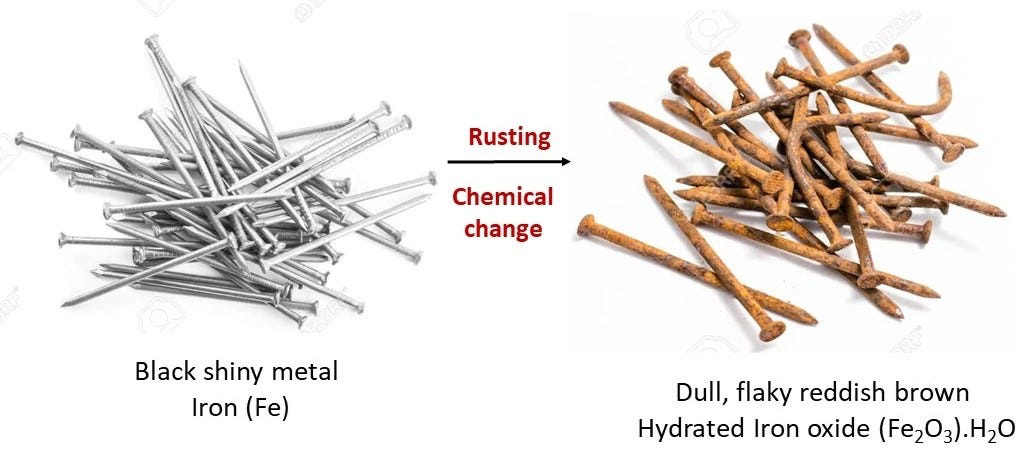
Scientists look for evidence of a chemical reaction by comparing properties before and after substances interact. For rusting, important properties include mass, color, and surface texture. Iron oxide has a different color than iron and often forms a rough, flaky coating. Another important clue is mass. When iron rusts, oxygen atoms become part of the solid material. Because oxygen is added to the iron, the mass of the nail can increase.
In an investigation, students can measure the mass of an iron nail before and after it is exposed to water and air for several days. Students can also record observations of color and texture. If the mass increases while the nail changes color and forms a new surface material, that is evidence that a new substance formed. These before-and-after changes support the conclusion that rusting is a chemical reaction.
By analyzing and interpreting property data before and after interaction, students can decide whether the evidence fits a chemical reaction or a physical change.
Diagram 2.
Source: https://ifty.club/lists/suggestions/Iron-Rust/
Table 1.
Nail # | Mass Before (g) | Color Before | Texture Before |
|---|
Nail 1 | 5 | Shiny gray | Smooth |
Nail 2 | 5.02 | Shiny gray | Smooth |
Nail 3 | 4.98 | Shiny gray | Smooth |
Graph of Information - Figure 1.
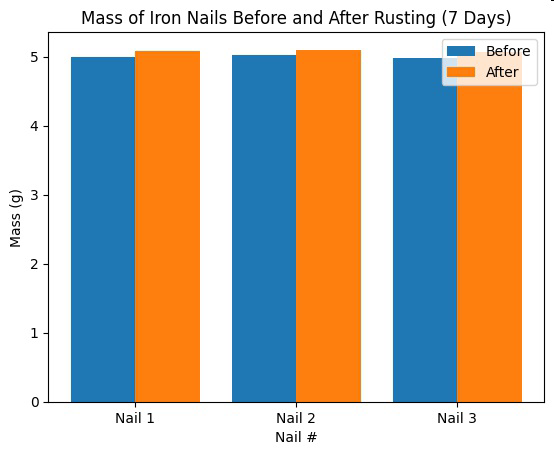
Table 2.
Nail # | Mass After (g) | Color After | Texture After |
|---|
Nail 1 | 5.08 | Reddish-brown | Rough/flaky |
Nail 2 | 5.1 | Reddish-brown | Rough/flaky |
Nail 3 | 5.06 | Reddish-brown | Rough/flaky |
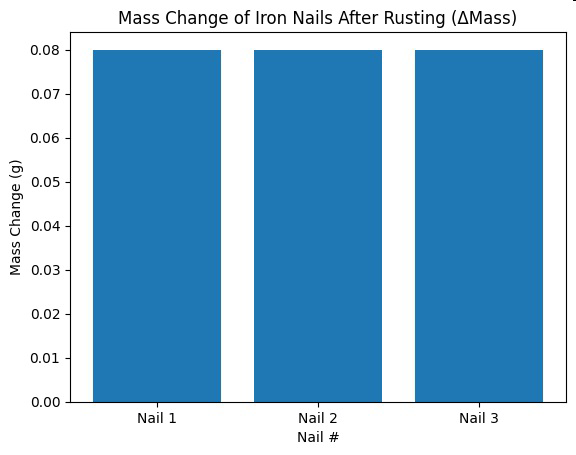
Graph of Information - Figure 2.