A Moving Cart Slowing Down After Hitting a Soft Barrier
Diagram 1.
Source: https://www.headsupb2b.com/blog/types-of-crash-barriers-ensuring-road-safety
Real-World Phenomenon
A cart rolls down a track and hits two different barriers placed at the end. When the cart hits a rigid barrier, it stops very quickly. When it hits a padded barrier, it stops more gradually and compresses the padding before coming to rest.
A moving object has kinetic energy because of its motion. When forces act on a moving object and cause it to slow down or stop, work is done on that object. This work transfers energy out of the object’s system.
In this investigation, the system is the moving cart. As the cart rolls, it has kinetic energy. When the cart hits a barrier, the barrier applies a force to the cart in the opposite direction of its motion. This force causes the cart to slow down and eventually stop.
When the cart hits a rigid barrier, it stops over a very short distance. The barrier does a large amount of work on the cart in a short time, transferring energy out of the cart system quickly. Most of the cart’s kinetic energy is transferred to the surroundings as sound, thermal energy, and slight deformation of the materials.
When the cart hits a padded barrier, the stopping distance is longer because the padding compresses. The force applied to the cart is spread out over a longer distance and time. Even though the stopping distance and force change, the barrier still does work on the cart and transfers energy out of the cart system.
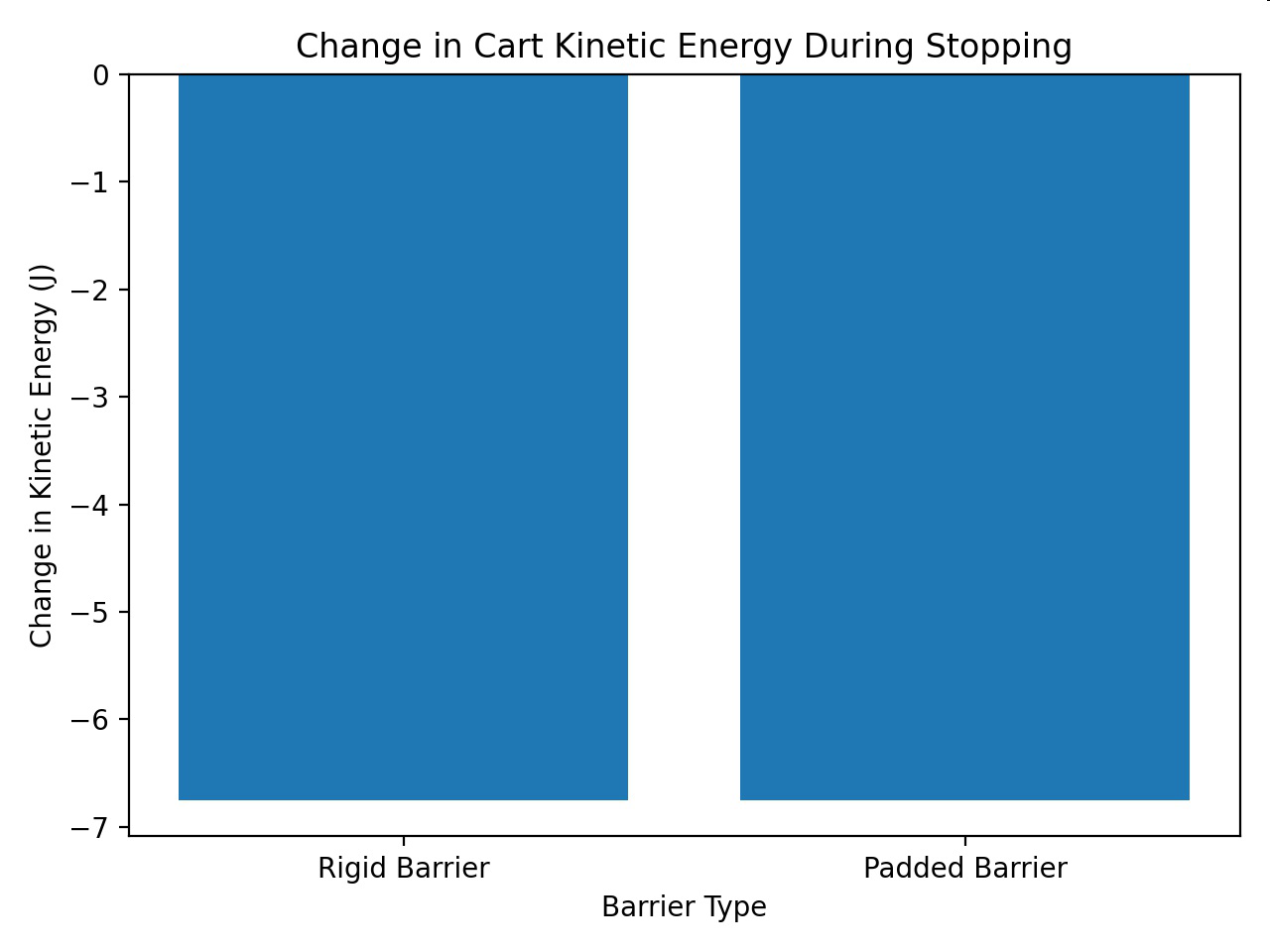
In both cases, the cart ends with zero kinetic energy because it stops. This means the total energy transferred out of the cart system is the same if the cart starts with the same speed. The difference is how the energy is transferred, not whether energy is transferred.
This phenomenon demonstrates that when work is done on a system, the energy of that system changes. The barriers do work on the cart, and energy is transferred out of the cart system, causing a decrease in kinetic energy until the cart stops.
Table 1.
Barrier Type | Initial Speed of Cart (m/s) | Mass of Cart (kg) | Stopping Distance (m) | Change in Kinetic Energy (J) |
|---|---|---|---|---|
Rigid Barrier | 3 | 1.5 | 0.05 | -6.75 |
Padded Barrier | 3 | 1.5 | 0.25 | -6.75 |
Graph of Information - Figure 1.
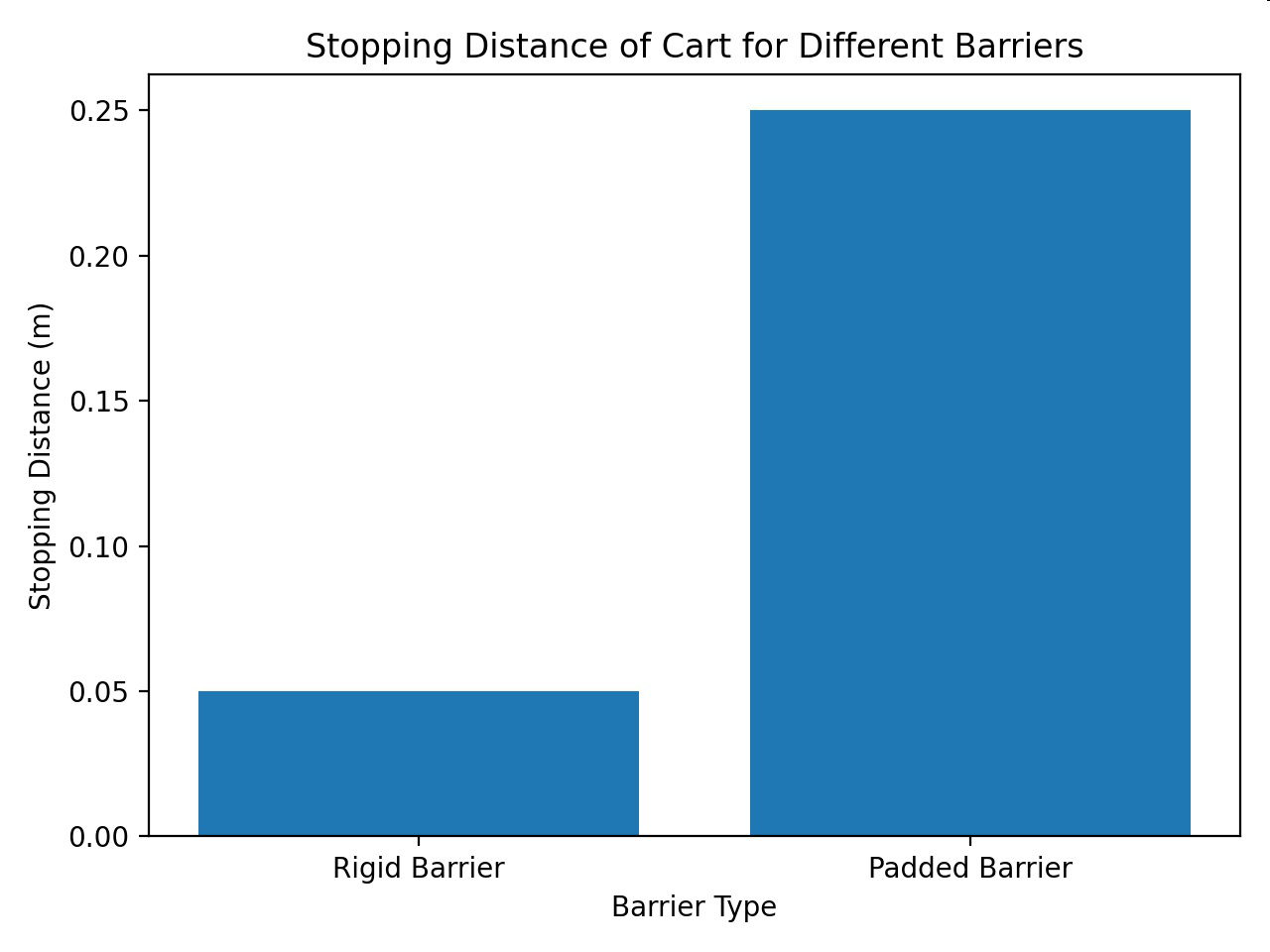
Graph of Information - Figure 2.