Bowling Ball vs Tennis Ball (Rolling Down a Ramp)
Diagram 1.
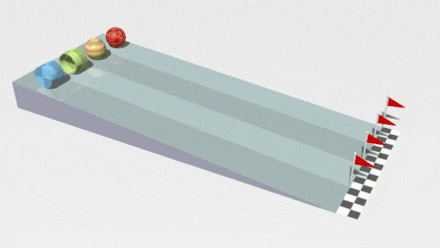
Source: https://ar.inspiredpencil.com/pictures-2023/rolling-ball-down-hill
Diagram 2.
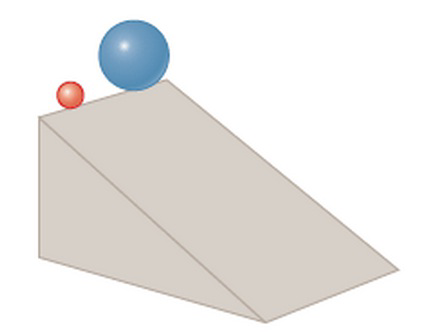
Source: https://www.chegg.com/homework-help/questions-and-answers/two-balls-mass-different-radii-roll-ramp-see-figure--balls-start-rest-one-has-larger-angula-q6893019
Real-World Phenomenon
A bowling ball and a tennis ball can roll at similar speeds, but the bowling ball has much more kinetic energy because it has much more mass. Also, when the same ball rolls faster, its kinetic energy increases a lot.
Kinetic energy is the energy an object has because it is moving. Scientists describe kinetic energy as depending on two main variables: the mass of the object and the speed of the object. If either mass or speed increases, kinetic energy increases.
Comparing a bowling ball and a tennis ball helps show the mass relationship clearly. Even if both balls roll at the same speed across the floor, the bowling ball has much more kinetic energy because it has much more mass. You can observe this difference in real life because the bowling ball is harder to stop and can cause a larger effect during a collision.
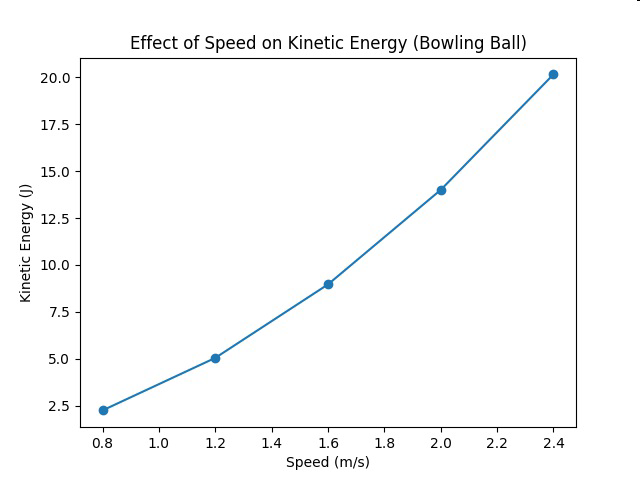
Speed also has a strong effect on kinetic energy. When the same object moves faster, its kinetic energy increases rapidly. This is why faster-moving objects (like a ball rolling quickly or a bicycle moving fast) can cause much larger effects than the same object moving slowly.
In an investigation, students can collect data by measuring mass and speed and then calculating kinetic energy. If two objects move at nearly the same speed, differences in kinetic energy are mainly explained by differences in mass. If the mass stays the same but speed changes, differences in kinetic energy must be explained by speed.
Graphs make it easier to see patterns: kinetic energy increases as mass increases (when speed is constant), and kinetic energy increases as speed increases (when mass is constant). Using data and graphs together allows students to describe these relationships clearly and support claims with evidence.
Table 1.
Object | Mass (kg) | Speed (m/s) | Kinetic Energy (J) |
|---|
Tennis Ball | 0.06 | 1.8 | 0.0972 |
Bowling Ball | 7 | 1.8 | 11.34 |
Graph of Information - Figure 1.
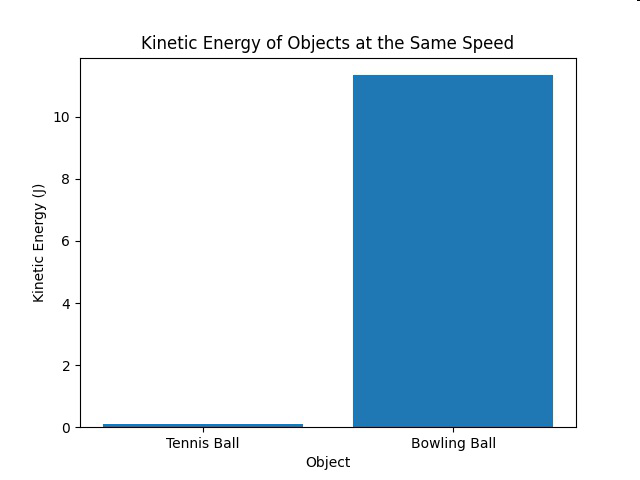
Table 2.
Speed (m/s) | Kinetic Energy (J) | Change in KE from Slowest (J) |
|---|
0.8 | 2.24 | 0 |
1.2 | 5.04 | 2.8 |
1.6 | 8.96 | 6.720000000000001 |
2 | 14 | 11.76 |
2.4 | 20.16 | 17.92 |
Graph of Information - Figure 2.