Car Speed and Crash Energy
Diagram 1.
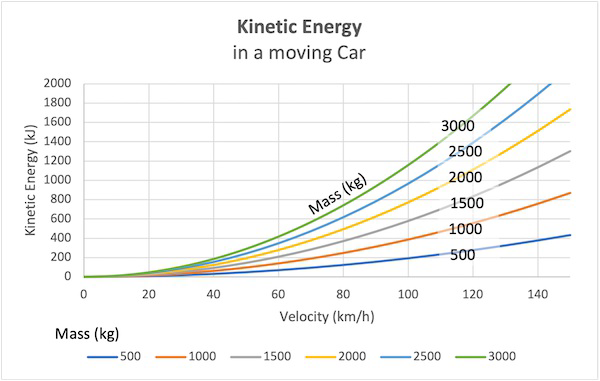
Source: https://www.engineeringtoolbox.com/kinetic-energy-d_944.html
Real-World Phenomenon
The same car has much more kinetic energy at highway speed than at neighborhood speed. Even a moderate increase in speed can cause a large increase in crash energy.
Kinetic energy is the energy of motion. For any moving object, kinetic energy depends on two variables: the object’s mass and its speed. When the mass stays the same, changes in kinetic energy are caused only by changes in speed.
A car is a useful real-world example because its mass usually stays nearly constant during a trip, but its speed can change a lot. When a car moves faster, its kinetic energy increases quickly. This is important because kinetic energy must be transferred somewhere when the car stops suddenly, such as in a crash. More kinetic energy means more energy needs to be absorbed by the car, seat belts, airbags, and passengers, which can increase damage.
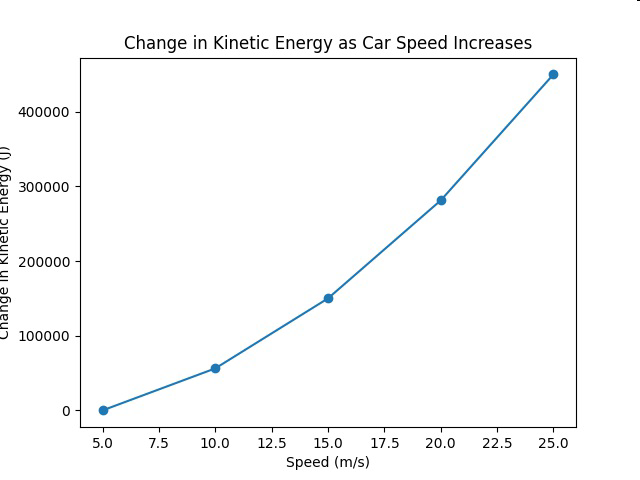
Speed has a powerful effect on kinetic energy because kinetic energy increases with the square of speed. That means that doubling the speed does not just double the kinetic energy, it increases kinetic energy by a factor of four. For example, if a car’s speed increases from 10 m/s to 20 m/s, the kinetic energy becomes four times larger (if the mass stays the same). This relationship is visible in graphs: a graph of kinetic energy versus speed curves upward, showing that kinetic energy increases more and more rapidly as speed increases.
In this investigation, students use data to calculate kinetic energy at different speeds for the same car, and then graph the relationship between speed and kinetic energy. Interpreting the graph helps students describe how kinetic energy changes with speed and why higher speeds lead to much larger crash energies. By using numerical evidence from tables and graphs, students can clearly describe the relationship between kinetic energy and speed.
Diagram 2.
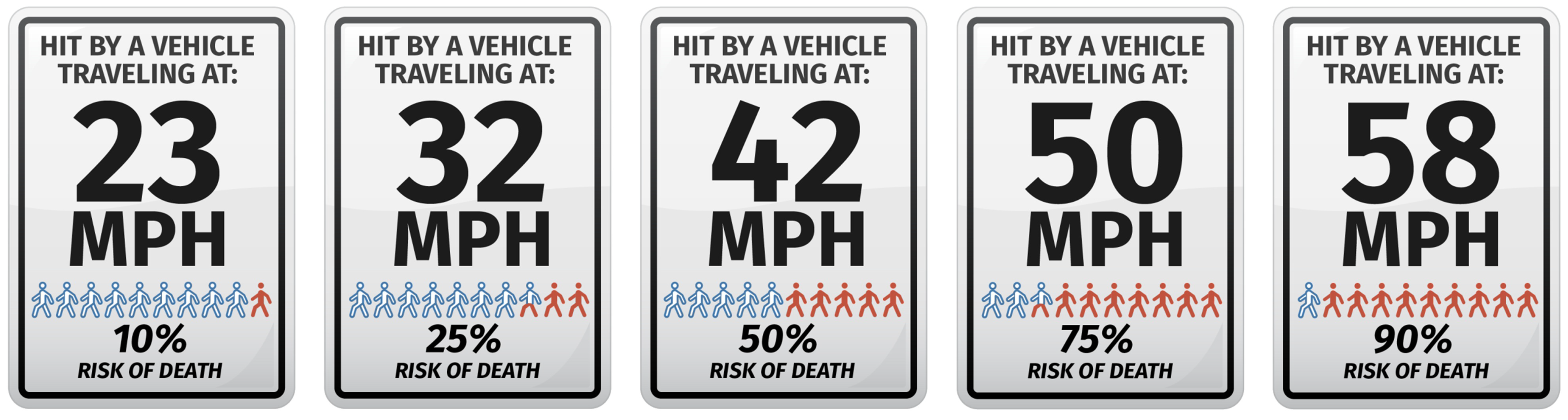
Source: https://www.transportation.gov/safe-system-approach/safer-speeds
Table 1.
Car Mass (kg) | Speed (m/s) | Kinetic Energy (J) | Change in KE from Slowest (J) |
|---|
1500 | 5 | 18750 | 0 |
1500 | 10 | 75000 | 56250 |
1500 | 15 | 168750 | 150000 |
1500 | 20 | 300000 | 281250 |
1500 | 25 | 468750 | 450000 |
Graph of Information - Figure 1.
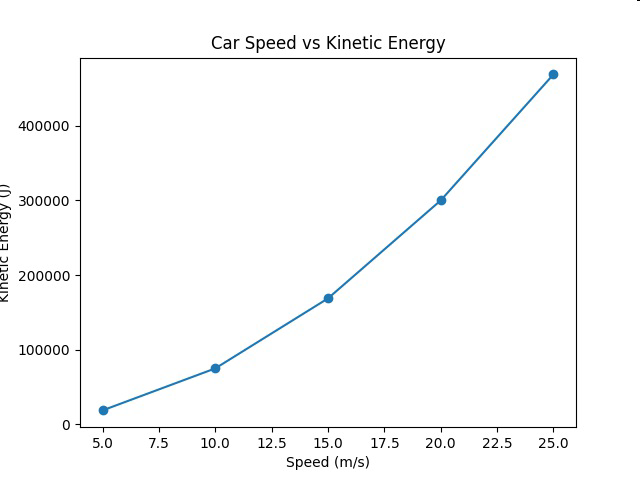
Graph of Information - Figure 2.