Heating Equal Masses of Water and Cooking Oil
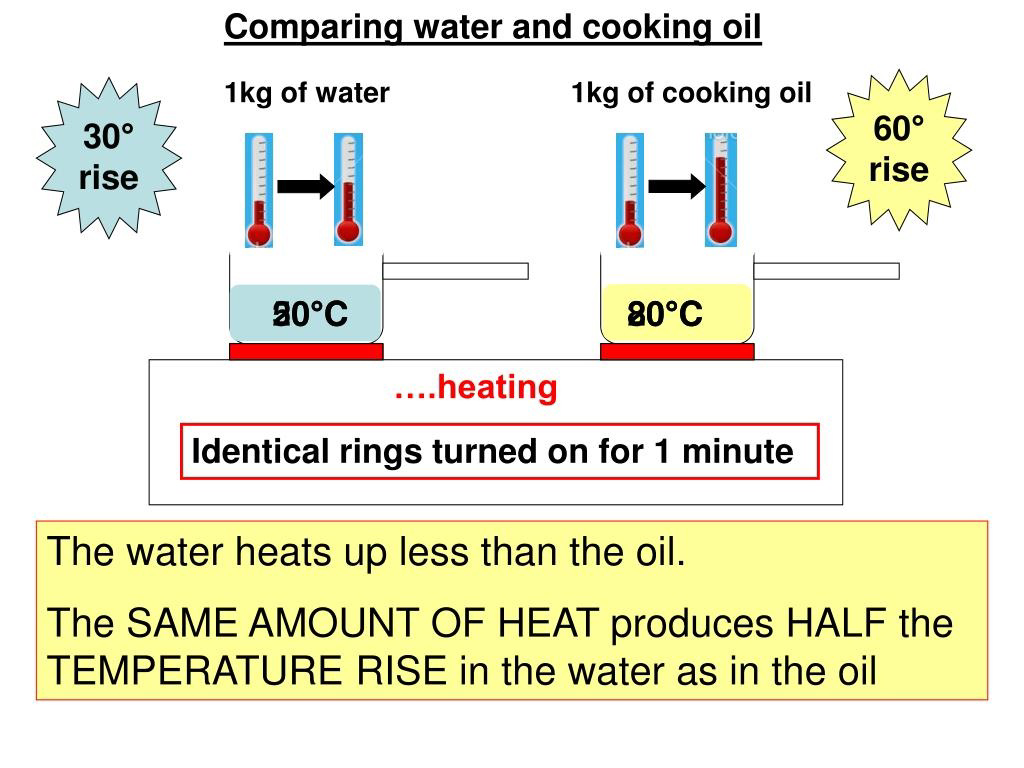
Diagram 1.
Source:
https://www.slideserve.com/wendy-velez/specific-heat-capacity
Real-World Phenomenon
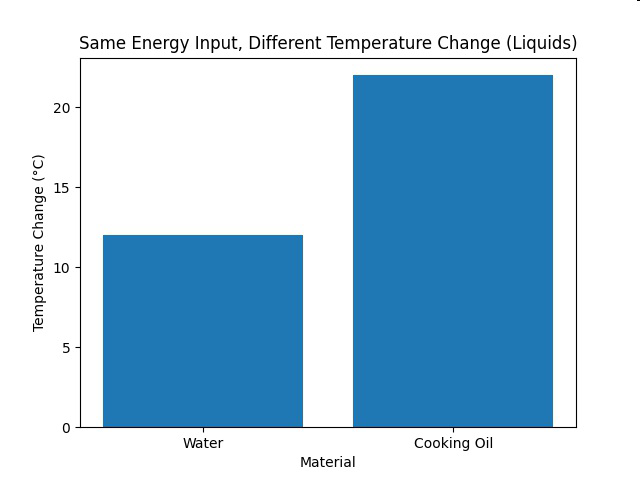
When equal masses of water and cooking oil are heated using the same heat source for the same amount of time, the oil’s temperature increases more than the water’s temperature. This shows that even with the same energy transfer and mass, the type of matter affects how much the temperature changes.
When thermal energy is transferred into a substance, the temperature of that substance usually increases. However, the amount of temperature change depends on several factors: the energy transferred, the mass of the substance, and the type of matter. Different materials respond differently to the same energy input because their particles store thermal energy in different ways.
In this investigation, students compare water and cooking oil, two common liquids with different thermal properties. Both samples have the same mass and begin at the same starting temperature. They are heated for the same amount of time using the same heat source, so the amount of energy transferred into each sample is assumed to be similar.
After heating, students observe that the cooking oil’s temperature increases more than the water’s temperature. This occurs because water has a higher ability to store thermal energy. In other words, it takes more energy to raise the temperature of water by one degree than it does for cooking oil. As a result, the same energy transfer produces a smaller temperature change in water and a larger temperature change in oil.
This pattern is important in real-world situations. For example, hot oil in a pan can become much hotter than boiling water under similar heating conditions, which explains why oil burns can be more severe than burns from hot water.
In this example, students keep mass and energy input constant while changing the type of matter. By organizing the results in data tables and graphs, students can identify clear relationships and explain how material type affects temperature change during energy transfer.
Table 1.
Material | Mass (g) | Start Temperature ($^\circ\text{C}$) | End Temperature ($^\circ\text{C}$) | Temperature Change ($^\circ\text{C}$) | Assumed Energy Input (J) |
|---|
Water | 250 | 22 | 34 | 12 | 5500 |
Cooking Oil | 250 | 22 | 44 | 22 | 5500 |
Graph of Information - Figure 1.
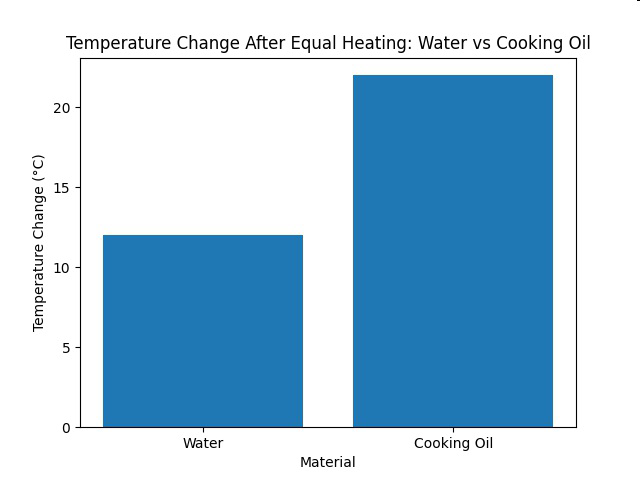
Graph of Information - Figure 2.