Hot Metal vs Hot Water Cooling
Diagram 1.
Source:
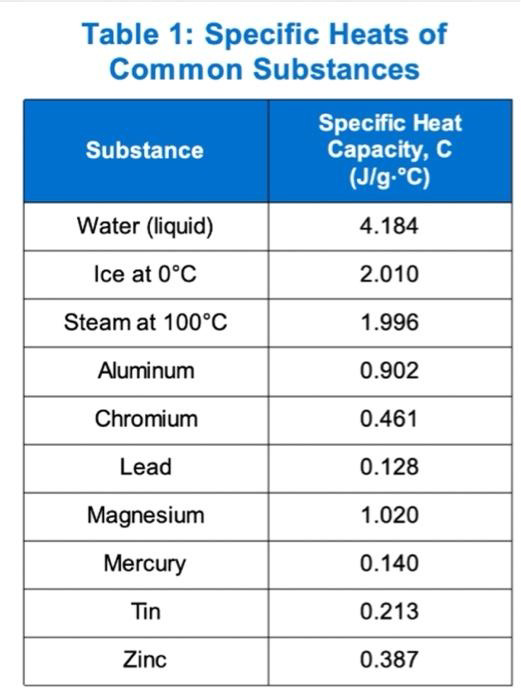
https://www.chegg.com/homework-help/questions-and-answers/table-1-specific-heats-common-substances
Diagram 2.
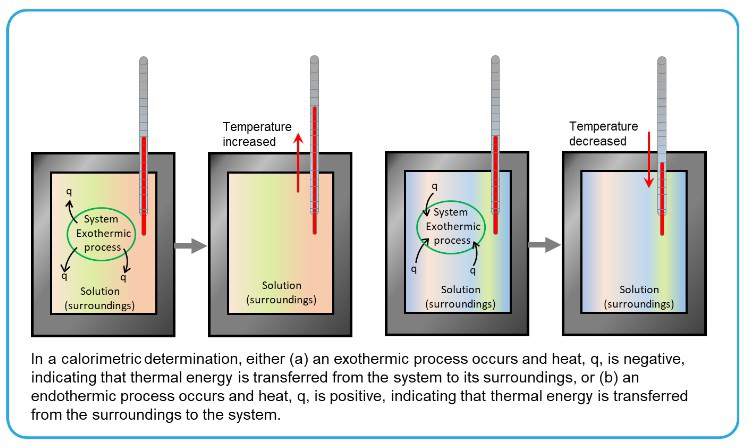
Source: https://www.aakash.ac.in/important-concepts/physics/calorimeter
Two samples start at the same high temperature. One is hot water and the other is a hot metal block. Even when they cool in the same room for the same amount of time, the metal’s temperature drops more than the water’s temperature. This suggests that the relationship between energy transferred and temperature change depends on the type of matter and the mass of the sample.
When thermal energy is transferred into or out of a sample of matter, the temperature of that sample can change. The size of the temperature change depends on several factors: the amount of energy transferred, the mass of the sample, and the type of matter. Different materials respond differently to the same energy transfer because their particles store and release thermal energy in different ways.
In this investigation, students compare two samples: a sample of water and a sample of metal (such as aluminum or steel). Both samples begin at the same starting temperature and cool in the same room conditions. As thermal energy transfers from the hot samples to the cooler air, each sample’s temperature decreases. However, the metal often shows a larger temperature decrease than the water over the same time interval. This happens because water typically requires more energy per kilogram to change its temperature than many metals.
Students can measure the mass of each sample and track temperature over time. The energy transferred can be compared by using a consistent setup, such as cooling for the same length of time in the same environment, or by estimating energy transfer using the change in temperature together with the mass and type of material. Even if the exact energy transferred is not measured directly, a well-controlled investigation can still reveal clear relationships among the variables.
In this example, students can control the starting temperature and cooling conditions, then analyze how different materials and masses change temperature. Graphing results helps students interpret patterns and explain how the same energy transfer conditions can produce different temperature changes depending on the material and mass.
Table 1.
Material | Mass (g) | Start Temperature (°C) | End Temperature (°C) | Temperature Change (°C) | Specific Heat (J/g°C) | Estimated Energy Transferred (J) |
|---|
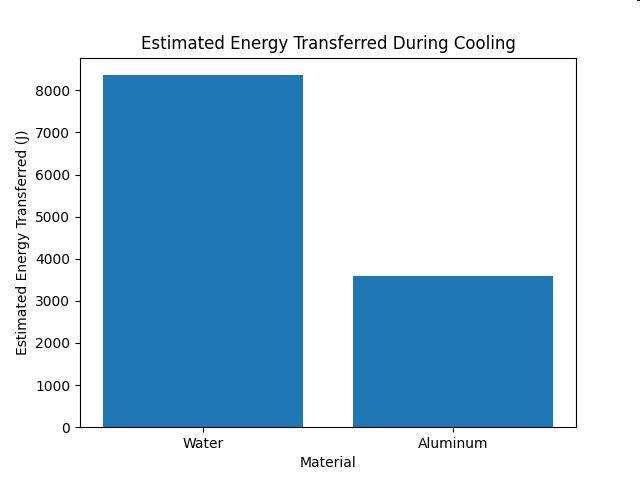
Water | 200 | 80 | 70 | 10 | 4.18 | 8360 |
Aluminum | 200 | 80 | 60 | 20 | 0.9 | 3600 |
Graph of Information - Figure 1.
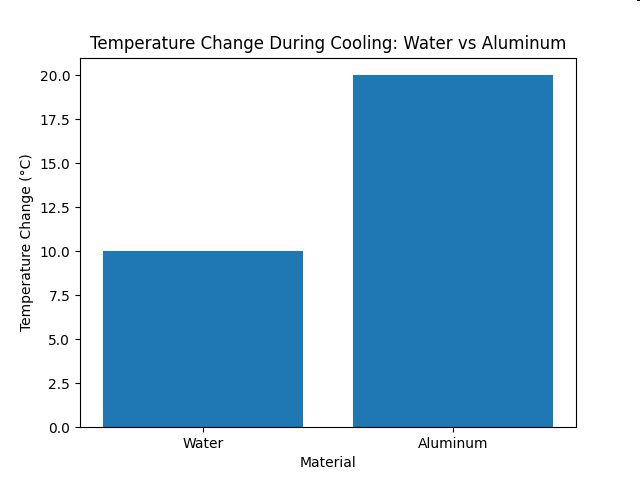
Graph of Information - Figure 2.