Ice-Melt Protection Pack
Diagram 1.
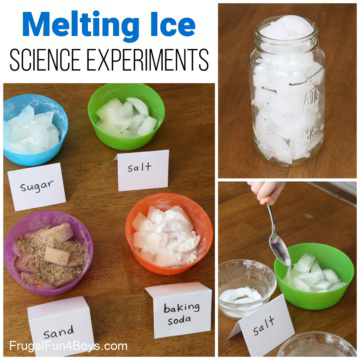
Source: https://frugalfun4boys.com/melting-ice-science-experiments/
Real-World Design Problem
Ice melts when thermal energy transfers from the warmer surroundings into the ice. Some containers slow melting much better than others. The challenge is to design a device that minimizes thermal energy transfer so ice stays solid for as long as possible.
Thermal energy naturally transfers from warmer objects to cooler objects. Ice is colder than the surrounding air, so thermal energy flows into the ice, causing it to melt. This energy transfer can occur through conduction, convection, and radiation.
When an ice cube is left exposed to air, thermal energy transfers quickly. Warm air moves around the ice by convection, energy is conducted through any surface the ice touches, and radiation transfers energy from nearby warmer objects. To slow melting, a device must reduce these forms of energy transfer.
In this design challenge, students create an ice-melt protection pack, a container or wrap designed to slow thermal energy transfer into the ice. Materials such as foam, felt, cotton, bubble wrap, cardboard, or reflective foil can be used. Trapped air pockets reduce conduction, tight seals reduce convection, and reflective layers reduce radiation.
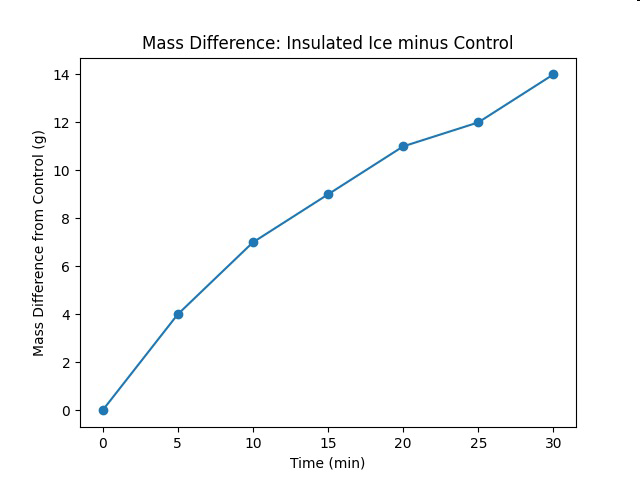
Students test their designs by placing identical ice cubes into different containers and measuring how much ice remains after set time intervals. A design that works well will show less melting over time compared with an unprotected ice cube. This provides evidence that the device successfully minimized thermal energy transfer.
In this investigation, students use ideas about heat transfer to guide material choices, then evaluate performance using data. By comparing ice mass or meltwater volume over time, students can determine which design best reduces energy transfer and explain why it works.
Graph of Information - Figure 1.
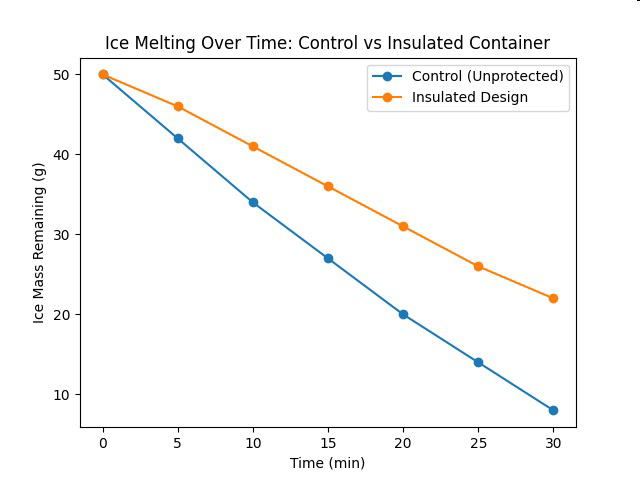
Graph of Information - Figure 2.