Mass Effect in Water Heating
Real-World Phenomenon
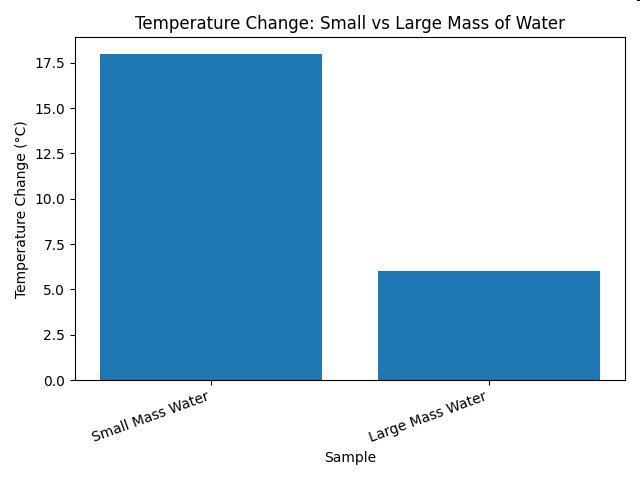
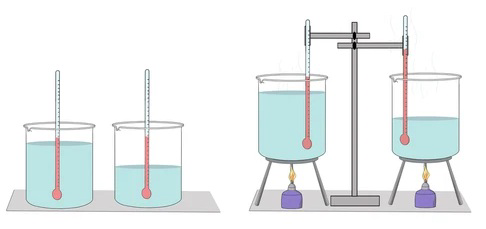
If you heat a small cup of water and a large cup of water for the same amount of time on the same hot plate (same energy input), the smaller mass of water warms up more. The larger mass warms less, even though both received the same energy transfer.
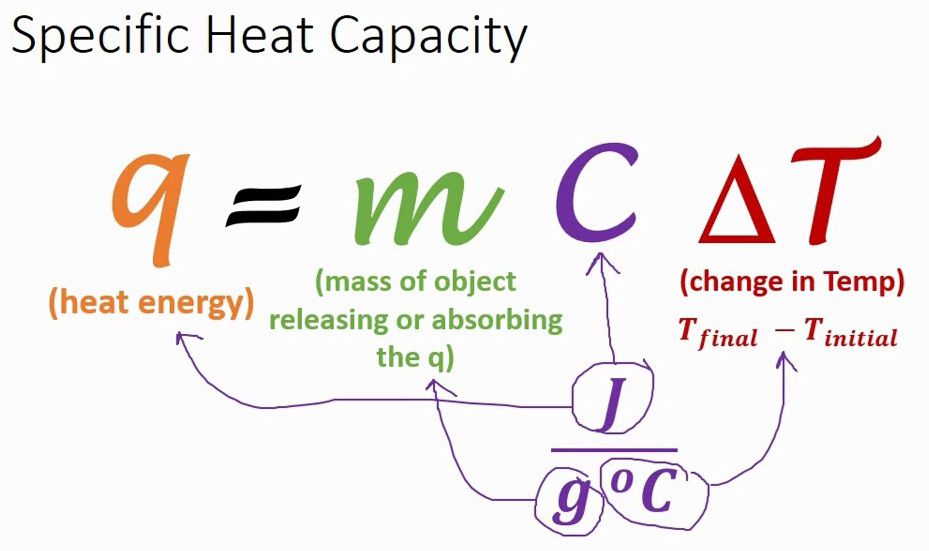
When thermal energy is transferred into a substance, the temperature of that substance can increase. How much the temperature increases depends on four key factors: the amount of energy transferred, the type of matter, the mass of the sample, and the change in temperature.
In this investigation, the type of matter stays the same: both samples are water. The main variable that changes is the mass of the water. Students heat both samples under the same conditions, such as using the same hot plate setting for the same length of time. Because the heat source and time are kept constant, the energy transferred into the water is assumed to be similar for both samples.
Diagram 1.
 Source: https://www.shutterstock.com/search/beaker-heating
Even with the same energy input, the smaller mass of water shows a larger temperature increase. This happens because the same amount of transferred energy is spread across a smaller amount of matter. With fewer grams of water, each gram receives a larger “share” of the energy, causing a greater temperature change. In the larger sample, the same energy is distributed across more grams of water, so the temperature change is smaller.
Students collect data by measuring the starting temperature and ending temperature of each sample, then calculating the temperature change. They also record the mass of each sample. By comparing the results, students can determine the relationship: as mass increases, temperature change decreases when energy transferred stays constant.
This investigation mirrors real-life situations, such as why a small pot of water heats faster than a large pot on the same stove. Graphing the results helps students clearly see how mass affects temperature change when energy transfer conditions are controlled.
Diagram 2.
 Source: https://www.baamboozle.com/classic/422030
Table 1.
Sample | Mass (g) | Start Temperature ($^{\circ}C$) | End Temperature ($^{\circ}C$) | Temperature Change ($^{\circ}C$) | Assumed Energy Input (J) |
|---|
Small Mass Water | 200 | 22 | 40 | 18 | 5000 |
Large Mass Water | 600 | 22 | 28 | 6 | 5000 |
Graph of Information - Figure 1.
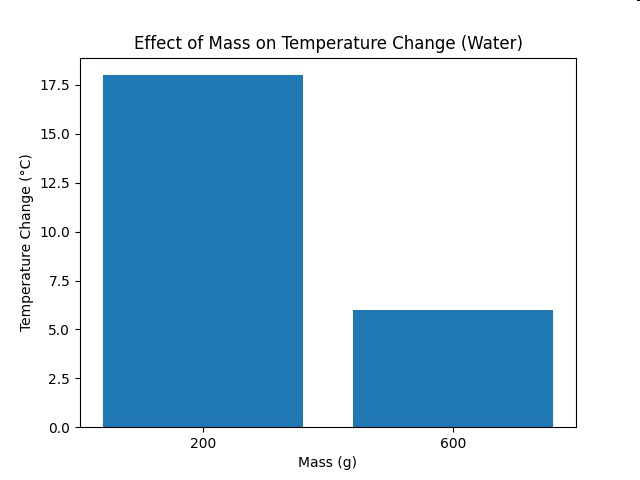
Graph of Information - Figure 2.