Pulling a Loaded Wagon Across Different Surfaces
Real-World Phenomenon
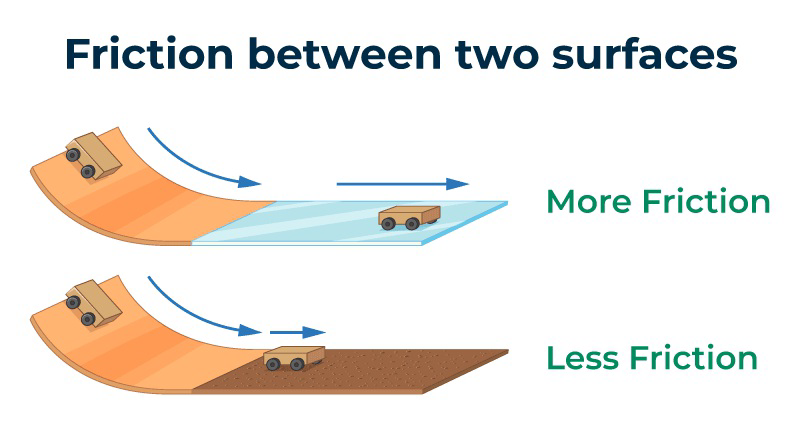
A student pulls the same loaded wagon across pavement, grass, and carpet using the same pulling motion. The wagon moves easily on pavement but slows down much faster on grass and carpet, even though the wagon and pulling effort appear the same.
Diagram 1.
Source:
https://animalia-life.club/qa/pictures/sliding-friction-examples
When an object moves, it has energy because of its motion. This type of energy is called kinetic energy. The amount of kinetic energy an object has depends on its mass and how fast it is moving. When a force is applied to an object and causes it to move, work is being done on that object.
In the case of a student pulling a wagon, the student does work on the wagon by applying a force that moves it forward. This work transfers energy from the student to the wagon, increasing the wagon’s kinetic energy so it can move. However, as the wagon rolls across the ground, another force acts on it: friction.
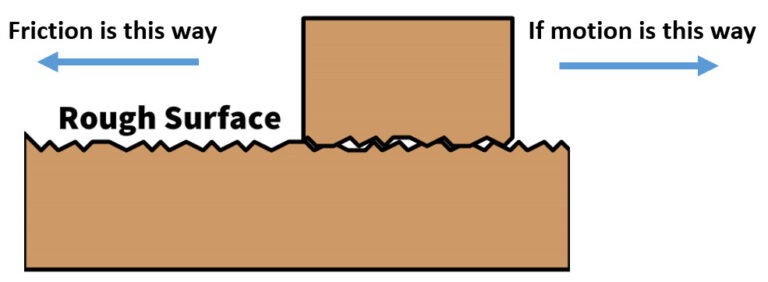
Friction is a force that opposes motion when two surfaces rub against each other. Rougher surfaces, like grass or carpet, create more friction than smoother surfaces like pavement. When friction acts on the wagon, it does work on the wagon in the opposite direction of its motion. This transfers energy out of the wagon system.
Diagram 2.
Source: https://stickmanphysics.com/stickman-physics-home/forces/frictional-force/
As energy is transferred out of the wagon, its kinetic energy decreases, causing the wagon to slow down and eventually stop. The energy removed from the wagon does not disappear. Instead, it is transferred to the surroundings, mostly as thermal energy due to friction between the wheels and the surface.
Even if the student pulls the wagon with the same effort, the amount of energy transferred out of the wagon system depends on the surface. More friction means more work done by the surface on the wagon, resulting in a larger decrease in the wagon’s energy.
This shows that when work is done on or by a system, the energy of that system changes. The wagon’s energy changes because energy is transferred between the wagon and its surroundings as work is done.
Table 1.
Surface Type | Initial Speed (m/s) | Distance Traveled After Release (m) |
|---|
Pavement | 3.2 | 8.5 |
Grass | 3.2 | 4.3 |
Carpet | 3.2 | 2.1 |
Graph of Information - Figure 1.
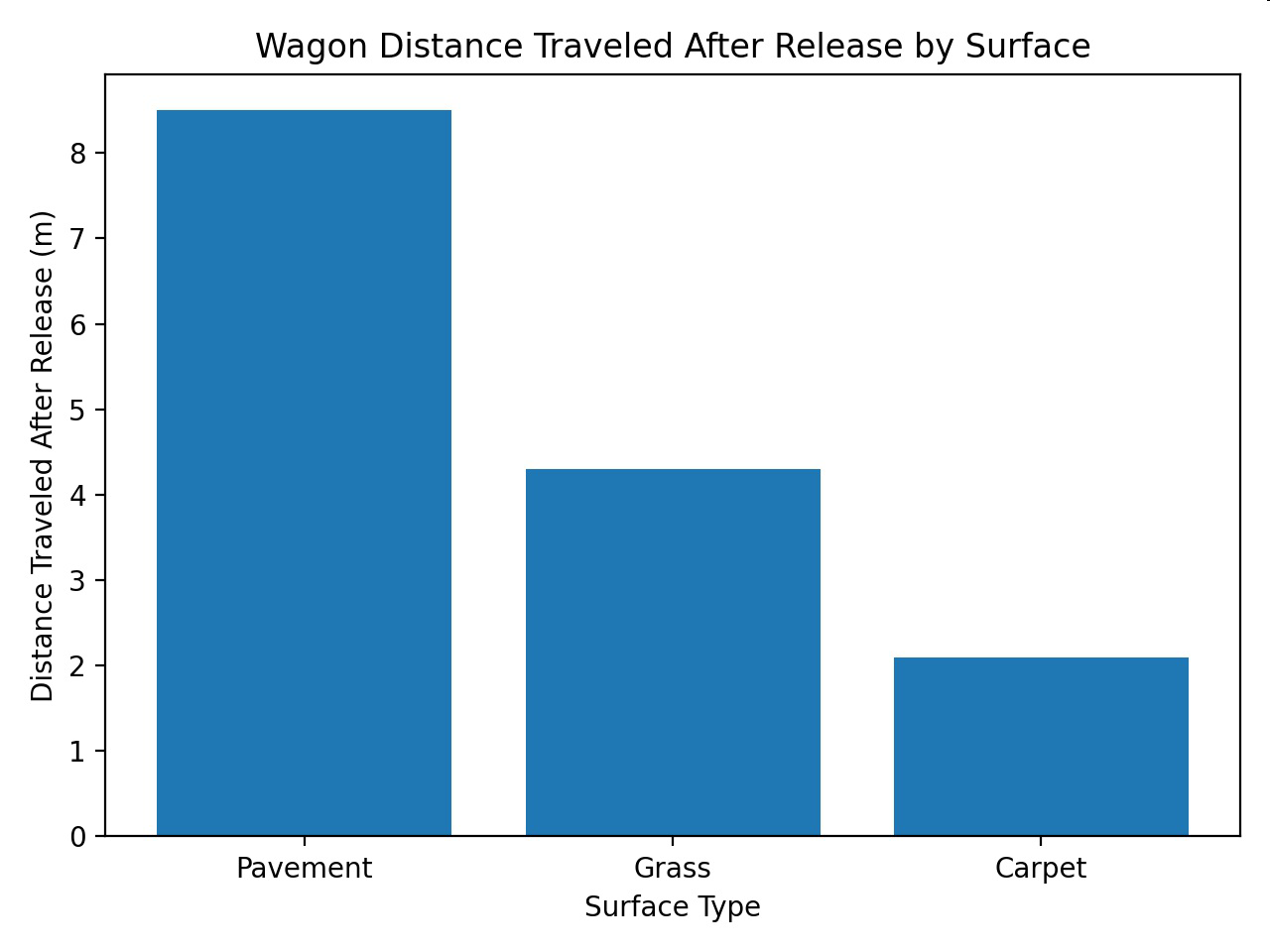
Table 2.
Surface Type | Estimated Friction Force (N) | Decrease in Kinetic Energy (J) |
|---|
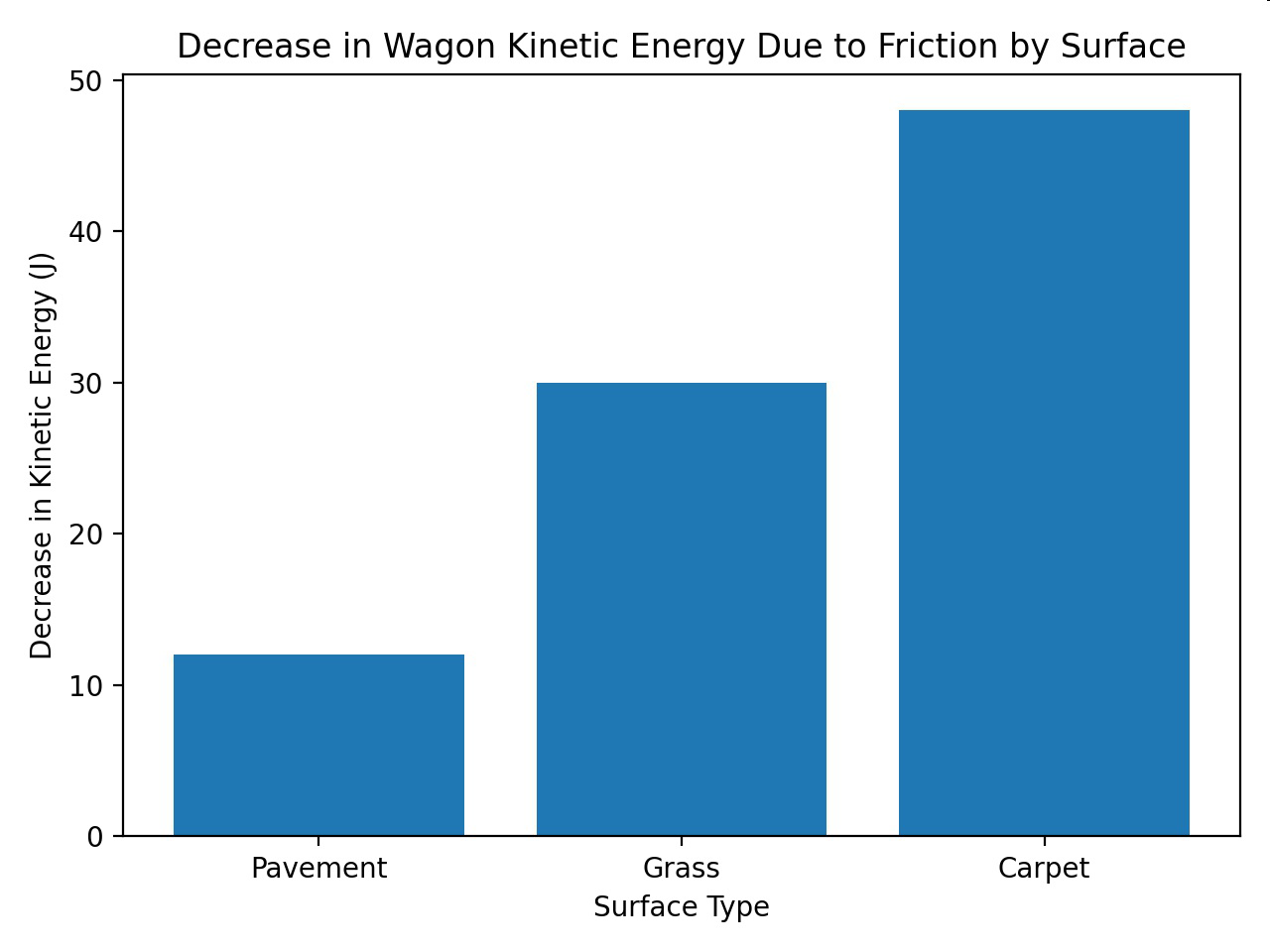
Pavement | 1.41 | 12 |
Grass | 6.98 | 30 |
Carpet | 22.86 | 48 |
Graph of Information - Figure 2.