Same Speed, Different Mass (Rolling Carts)
Diagram 1.
 Source: https://www.wired.com/story/physics-momentum-principle-work-energy-principle/
Real-World Phenomenon
Two carts roll at the same speed, but the cart with greater mass has more kinetic energy and causes a larger effect when it collides with a barrier or compresses a spring more.
Kinetic energy is the energy an object has because it is moving. The amount of kinetic energy an object has depends on two factors: the mass of the object and its speed. When objects move at the same speed, differences in kinetic energy must be caused by differences in mass.
Imagine two carts rolling along a track at the same speed. One cart is empty, and the other has extra mass added. Even though both carts are moving just as fast, the heavier cart has more kinetic energy. This can be observed when the carts interact with another object. For example, the heavier cart may push a barrier farther or compress a spring more than the lighter cart. These observations show that mass affects kinetic energy.
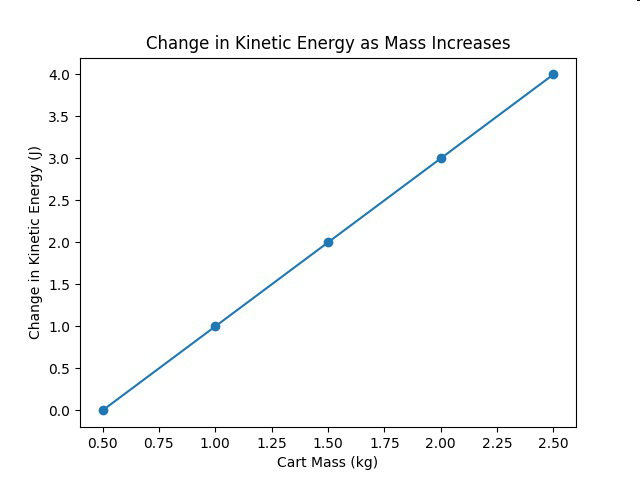
Scientists describe kinetic energy using a mathematical relationship that shows kinetic energy increases as mass increases when speed stays the same. This means that if the mass of an object doubles, its kinetic energy also doubles, as long as its speed does not change. This relationship creates a linear pattern when kinetic energy is graphed against mass.
To investigate this relationship, scientists collect data by measuring the mass of the carts and calculating their kinetic energy while keeping speed constant. By graphing kinetic energy versus mass, they can look for patterns that describe how the two variables are related. Interpreting these graphs helps scientists explain how kinetic energy changes when mass changes.
In this investigation, students use graphs to describe the relationship between mass and kinetic energy. When the data show a straight-line pattern, it provides evidence that kinetic energy is directly proportional to mass when speed is constant.
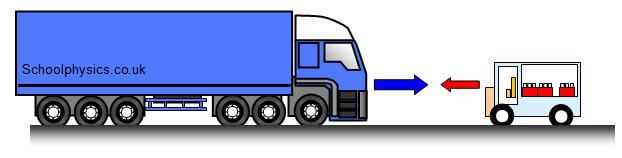
Diagram 2. Imagine this Collision!
 Source: https://www.schoolphysics.co.uk/age14-16/Mechanics/Forces%20in%20motion/text/Collisions_/index.html
Table 1.
Cart Mass (kg) | Speed (m/s) | Kinetic Energy (J) | Change in KE from Lightest (J) |
|---|
0.5 | 2 | 1 | 0 |
1 | 2 | 2 | 1 |
1.5 | 2 | 3 | 2 |
2 | 2 | 4 | 3 |
2.5 | 2 | 5 | 4 |
Graph of Information - Figure 1.
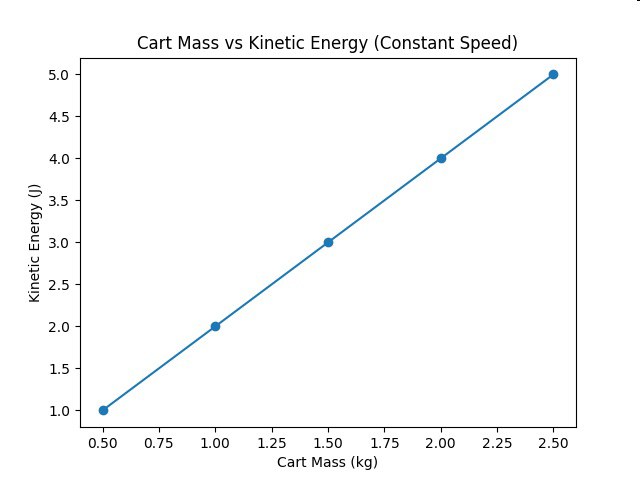
Graph of Information - Figure 2.