Speed and Energy
What is Energy?
Imagine you want to make something happen – like kicking a ball, turning on a light, or cooking food. To do any of these things, you need energy. Think of energy as the "ability to do work" or the "ability to cause change." It's what makes things move, grow, and change. Energy isn't something you can touch or hold like a toy. It's more like a property that things have.
There are many different forms of energy, such as:
Light Energy: What helps you see.
Heat (Thermal) Energy: What makes things warm.
Sound Energy: What you hear.
Chemical Energy: Stored in things like food or batteries.
Electrical Energy: What powers your electronics.
And, of course, there's Motion Energy!
What is Motion Energy (Kinetic Energy)?
Motion energy, also called kinetic energy, is the energy an object has because it is moving. If something is still, it doesn't have motion energy. But as soon as it starts to move, it gains motion energy.
Think about these examples:
A rolling ball has motion energy.
A running person has motion energy.
A car driving down the road has motion energy.
The wind blowing has motion energy.
The faster an object moves, the more motion energy it has. And the heavier an object is, the more motion energy it has when it moves at the same speed.
How are Speed and Motion Energy Related?
Speed tells us how fast an object is moving. For example, a car going 50 miles per hour is moving faster than a car going 20 miles per hour.
The relationship between speed and motion energy is very important:
The faster a given object moves, the more motion energy it has. This is because it takes more "push" or "work" to make an object go faster. When you give it that extra push, you are giving it more energy. An object with more motion energy can do more "work" or cause a bigger change.
Imagine throwing a ball gently compared to throwing it really hard. The ball thrown harder (faster) will hit something with a much bigger impact because it has more motion energy.
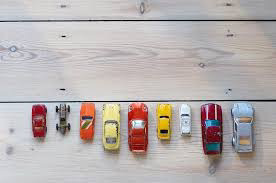
Imagine two identical toy cars, one being gently pushed across the floor and the other being given a strong shove. Both cars will eventually stop, but you'll notice a significant difference in how far they travel and what happens if they hit something. The car given a strong shove not only travels further but also has a greater impact if it collides with another object. This difference in their behavior is directly related to the energy they possess while in motion. The faster an object moves, the more energy it has, and this energy can be transferred to other objects or used to do work, such as moving other things.
Diagram 1.
Data Table 1: Toy Car Experiment
Trial | Speed of Car (cm/s) | Distance Traveled (cm) | Height of Block Moved (cm) |
|---|
1 | 10 | 25 | 0.5 |
2 | 20 | 75 | 1.5 |
3 | 30 | 150 | 3.0 |
4 | 40 | 250 | 5.0 |
Energy is the ability to do work. Energy can be thought of as a currency which is universally accepted as the way to make things happen. All moving objects have energy. The amount of energy depends on their speed and mass. The faster an object moves, the more energy it has, and the more work it can do on other objects with which it interacts.
Falling objects are pulled downward by their weight, a gravitational force from the Earth. In many cases, where air resistance is low, the object’s downward speed will increase until it hits the surface. Its final speed will depend on its starting height. The higher it starts, the faster it will be moving at impact.
Diagram 2.
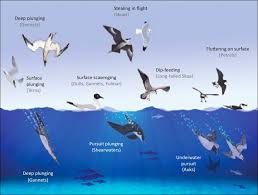
Some seabirds, including the Northern Gannet, feed on fish swimming near the surface. In a behavior known as “plunge diving”, the Gannets tuck-back their wings and feet and dive from an altitude as high as 60 meters to hit the water at speeds up to 60 miles per hour. After entering the ocean, the Gannets strikes a fish, stunning or injuring it. The bird’s momentum can carry it deep as 10 meters below the surface. The gannet will swallow the stunned fish before returning to the surface.
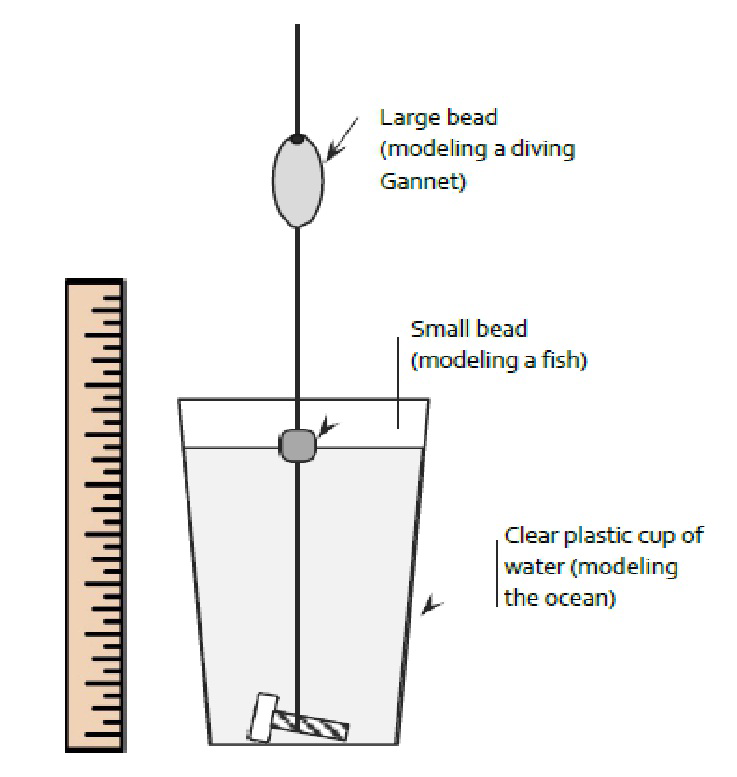
The energy carried by the Gannet during its dive is transferred to the water and the fish it strikes. Pushing something through water is hard work and requires a lot of energy. That is why the Gannet needs a high speed and must begin diving from a great height. Plunging deeper requires more energy. That comes from moving faster. That comes from starting higher.
Diagram 3.
 Source: https://digitalcommons.imsa.edu