Electric Charges and Stored Potential Energy
Real-World Phenomenon
Two charged objects placed closer together store more potential energy in the system than when they are farther apart. Holding charged objects close requires more effort, even though they are not touching, showing that energy is stored due to their arrangement at a distance.
Energy can be stored in a system when objects interact through forces that act at a distance. Electric forces are one example of this type of interaction. When objects become electrically charged, they create electric fields around them. These fields allow charged objects to exert forces on each other without direct contact.
The amount of energy stored in an electric system depends on how the charged objects are arranged. When two charged objects are far apart, the interaction between their electric fields is weaker, and less potential energy is stored. As the charged objects are moved closer together, the electric interaction becomes stronger, and more electric potential energy is stored in the system.
This stored energy exists even when the objects are not moving. If the objects are released, the stored electric potential energy can be transferred into motion as the objects move toward or away from each other, depending on whether the charges attract or repel. This shows that energy was stored due to the arrangement of the objects, not because of motion.
Diagram 1.
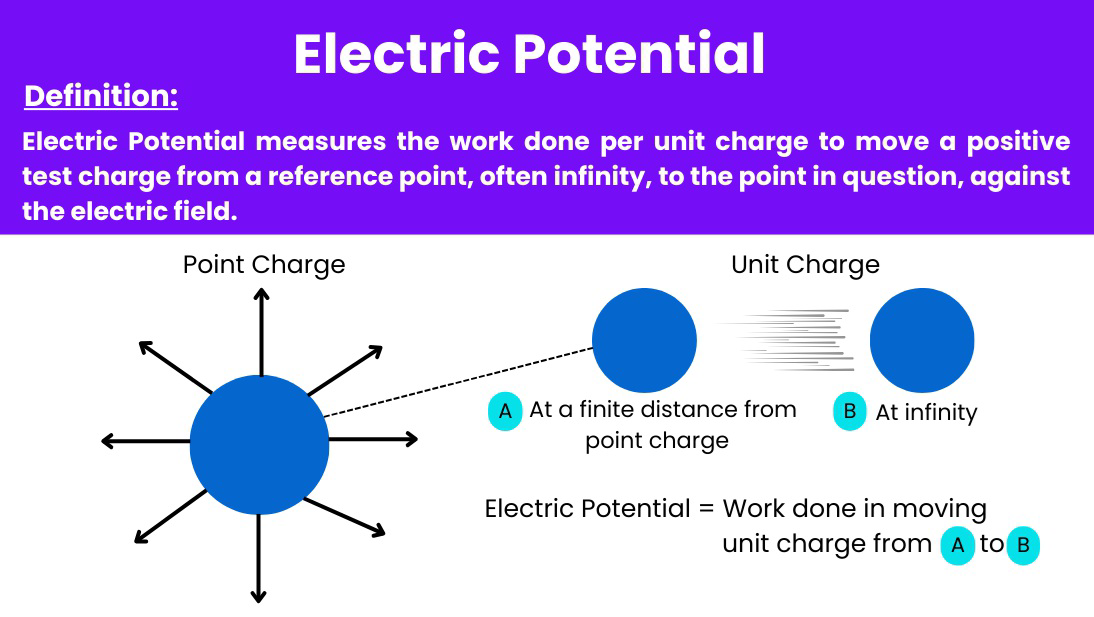
Source: https://www.examples.com/physics/electric-potential.html
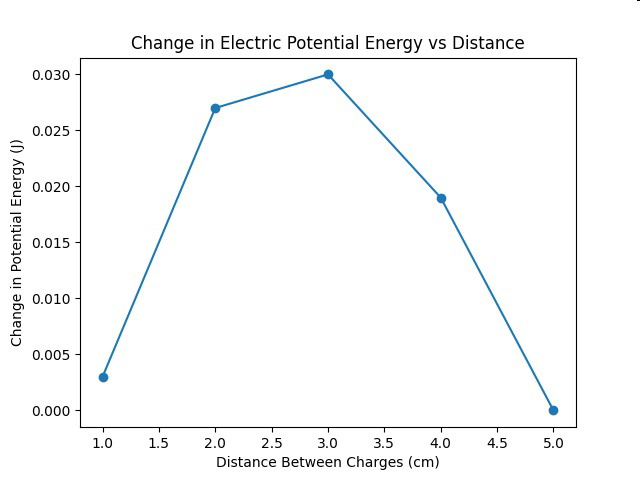
To investigate this relationship, scientists can measure the force required to hold charged objects at different distances. Using this information, they can estimate the amount of potential energy stored in the system. When the data are organized into tables and graphs, a clear pattern appears: decreasing the distance between charged objects increases the amount of stored potential energy.
In this electric system, the data tables and graphs act as a model that shows how distance affects stored energy in a system involving electric fields.
Table 1.
Distance Between Charges (cm) | Force (N) | Electric Potential Energy (J) | Change in PE from Farthest (J) |
|---|
1 | 4.8 | 0.048 | 0.003 |
2 | 3.6 | 0.072 | 0.027 |
3 | 2.5 | 0.075 | 0.029 |
4 | 1.6 | 0.064 | 0.019 |
5 | 0.9 | 0.045 | 0 |
Graph of Information - Figure 1.
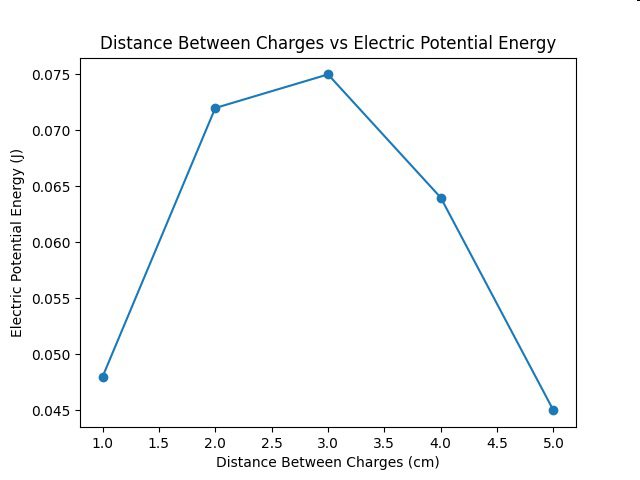
Graph of Information - Figure 2.