Heating Equal Masses of Water and Sand
Real-World Phenomenon
On a sunny day, sand heats up much faster than water, even when both receive energy from the Sun for the same amount of time. This happens even when the mass of sand and water is the same. The difference in temperature change shows that the type of matter affects how energy transfer changes temperature.
When energy is transferred into a substance, its temperature can increase. However, the size of the temperature change depends on several factors: the amount of energy transferred, the mass of the substance, and the type of matter. Different materials respond differently to the same energy input because their particles store thermal energy in different ways.
In this investigation, students compare equal masses of water and sand that are heated using the same energy source for the same amount of time, such as a heat lamp or hot plate set to the same power level. Because the heating conditions are kept constant, the amount of energy transferred to each sample is assumed to be similar.
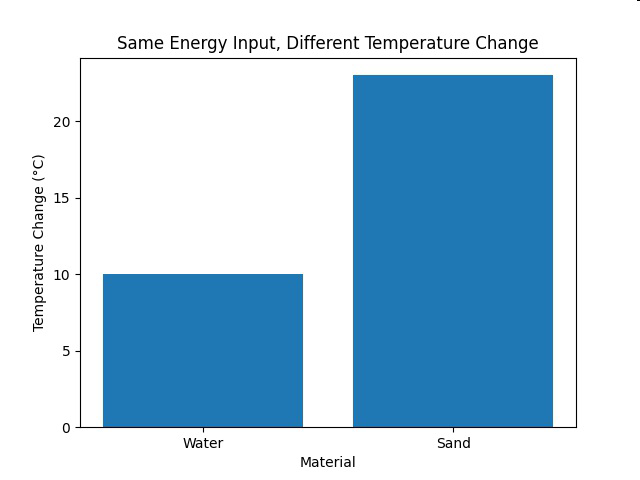
Even though both samples receive the same energy, sand typically shows a larger temperature increase than water. This is because water requires more energy per gram to increase its temperature than sand does. As a result, the same energy transfer causes a smaller temperature change in water and a larger temperature change in sand.
Students measure the starting and ending temperatures of each sample and record the mass. By comparing the temperature change, students can determine how type of matter affects the relationship between energy transferred and temperature change. This investigation mirrors real-world patterns, such as why beaches heat up quickly during the day while nearby water stays cooler.
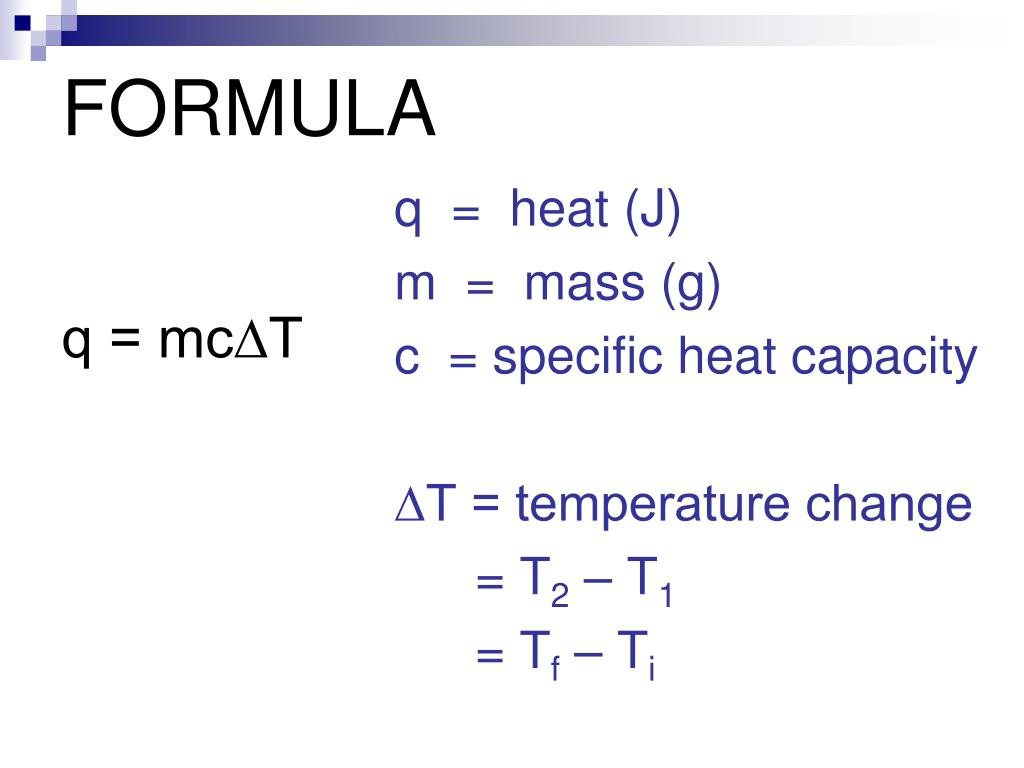
Diagram 1.
Source: https://www.slideserve.com/emilia/unit-3-thermochemistry
In this example, students hold mass and energy input constant while changing the type of matter. Data tables and graphs help reveal the relationship between material type and temperature change under the same energy transfer conditions.
Table 1.
Material | Mass (g) | Start Temperature ($\degree C$) | End Temperature ($\degree C$) | Temperature Change ($\degree C$) | Assumed Energy Input (J) |
|---|
Water | 300 | 22 | 32 | 10 | 6000 |
Sand | 300 | 22 | 45 | 23 | 6000 |
Graph of Information - Figure 1.
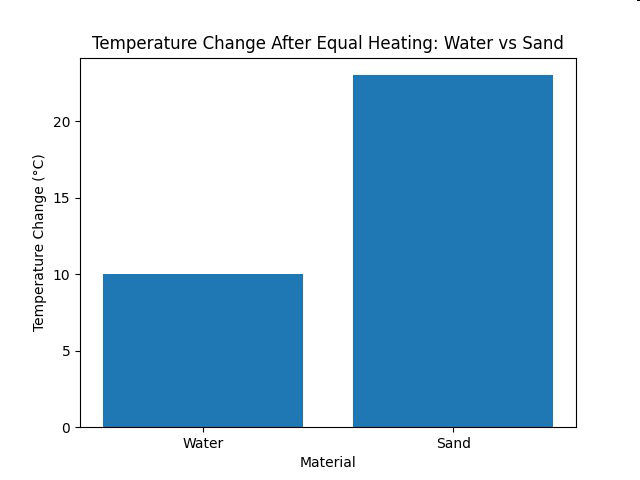
Graph of Information - Figure 2.