Egg Drop Landing Pad for a Falling Egg
Diagram 1.

Source:
https://teachbesideme.com/the-ultimate-egg-drop-challenge-classic-stem-idea/
Real-World Phenomenon
When a fragile object like an egg falls and hits the ground, it often breaks. During the collision, the egg pushes on the surface and the surface pushes back on the egg. Engineers design landing surfaces, such as padding or cushioning, to reduce damage when objects collide with the ground.
Whenever two objects collide, they exert forces on each other. According to Newton’s Third Law of Motion, these forces are equal in size and opposite in direction. When an egg hits a landing surface, the egg pushes downward on the surface, and the surface pushes upward on the egg with an equal force.
Even though the forces are equal, the outcome of the collision can be changed by design. What matters is how quickly the egg’s motion changes. If the egg stops very suddenly, the force during the collision is large and the egg is more likely to crack. If the egg slows down over a longer period of time, the force is spread out and the egg is less likely to break.
Engineers design landing pads to increase the stopping distance and collision time. Soft materials compress during impact, allowing the egg to slow down gradually. The egg and the pad still exert equal and opposite forces on each other, but the design changes how long those forces act.
To test a landing pad design, engineers drop the egg from the same height each time and measure how long the collision lasts and whether the egg breaks. They may also measure rebound height or force. Based on the data, engineers modify the pad by changing material thickness, layering materials, or adding air gaps.
By analyzing collision data and applying Newton’s Third Law, students can explain how a landing pad design reduces damage without violating the laws of motion.
Diagram 2.
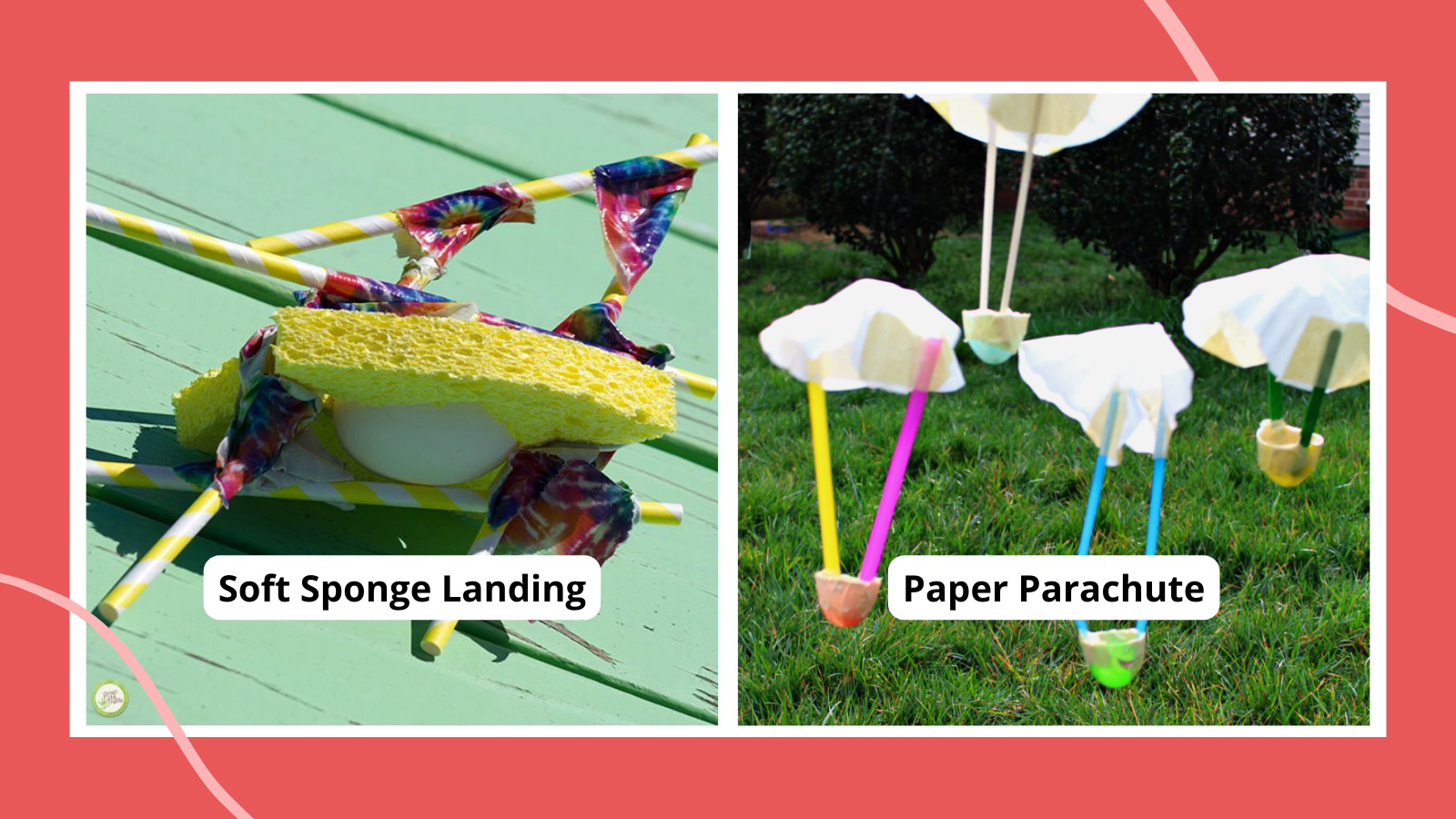 Source: https://ar.inspiredpencil.com/pictures-2023/egg-drop-project-parachute-ideas
Table 1.
Trial | Drop Height (m) | Collision Time (ms) | Peak Force on Egg (N) | Egg Outcome |
|---|
Trial 1 | 1 | 4 | 5300 | Cracked |
Trial 2 | 1 | 5 | 5000 | Cracked |
Trial 3 | 1 | 4 | 5400 | Cracked |
Trial 4 | 1 | 5 | 5100 | Cracked |
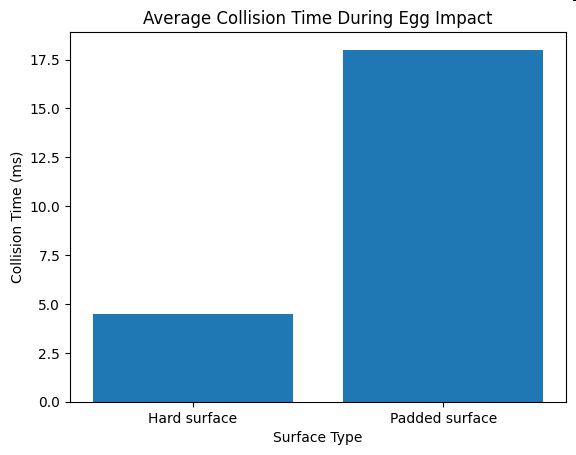
Graph of Information - Figure 1.
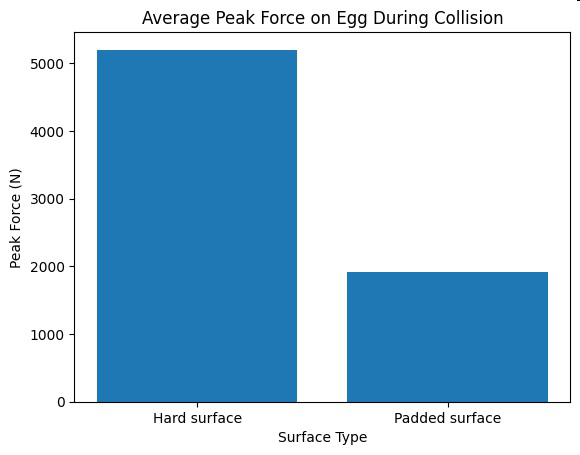
Table 2.
Trial | Drop Height (m) | Collision Time (ms) | Peak Force on Egg (N) | Egg Outcome |
|---|
Trial 1 | 1 | 18 | 1900 | Not Cracked |
Trial 2 | 1 | 17 | 2000 | Not Cracked |
Trial 3 | 1 | 19 | 1800 | Not Cracked |
Trial 4 | 1 | 18 | 1950 | Not Cracked |
Graph of Information - Figure 2.