Falling Distance and Gravitational Attraction
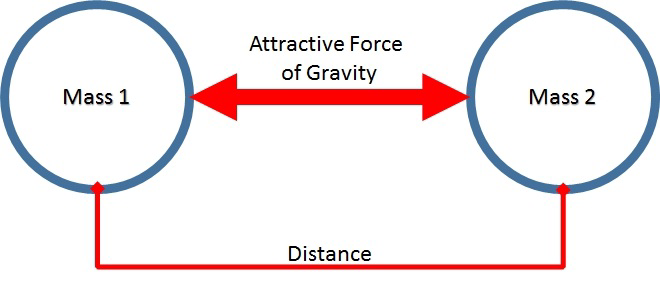
Diagram 1.
Source: https://vhmsscience.weebly.com/mass-weight--gravity.html
Real-World Phenomenon
When an object is dropped from a higher height, it hits the ground with a greater speed than when the same object is dropped from a lower height. In both cases, the object is pulled toward Earth.
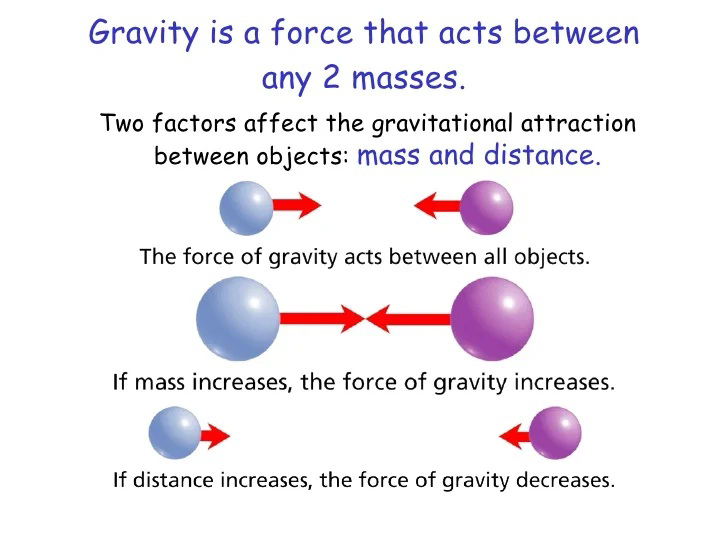
Gravity is a force that causes objects with mass to attract one another. On Earth, gravity pulls objects toward the center of the planet. This attraction explains why dropped objects fall downward instead of floating or moving upward.
In this investigation, the object and Earth are the two interacting masses. Earth has a very large mass, and the object has a much smaller mass. Because Earth’s mass is so large, the gravitational attraction between Earth and the object causes the object to accelerate downward as soon as it is released.
Diagram 2.
 Source: https://www.slideshare.net/slideshow/gravity-4940766/4940766
When an object falls, gravity continues to pull on it during the entire fall. If the object starts from a higher position, it is farther from Earth’s surface at the beginning, but gravity still acts on it the whole time it is moving. As the object falls a greater distance, it has more time to speed up due to Earth’s gravitational pull. This causes the object to reach a greater speed by the time it hits the ground.
Scientists study gravitational interactions by collecting data about motion, distance, and time. For falling objects, they can measure how fast an object is moving just before it reaches the ground. By comparing data from different drop heights, scientists can look for patterns that show how gravity affects motion.
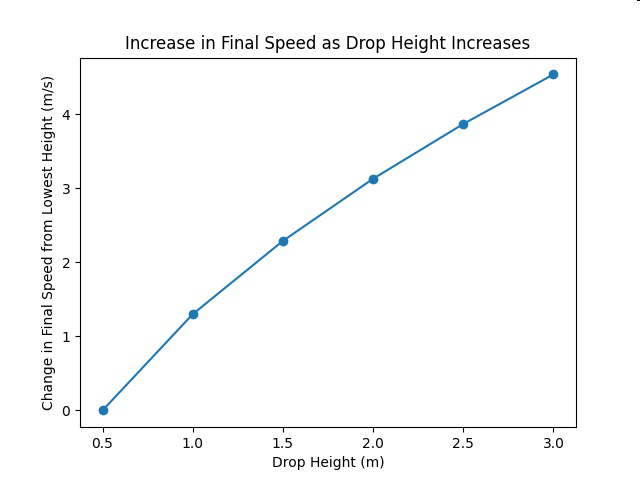
Asking questions about data helps scientists understand how gravitational force depends on distance. Questions such as “How does increasing the distance an object falls affect its speed?” help connect motion data to the idea that gravity is an attractive force that acts over a distance. When the data show that objects falling from greater heights reach greater speeds, this provides evidence that gravitational interactions are attractive and depend on distance between objects.
Table 1.
Drop Height (m) | Time to Fall (s) | Final Speed (m/s) | Change in Speed from Lowest (m/s) |
|---|
0.5 | 0.32 | 3.13 | 0 |
1 | 0.45 | 4.43 | 1.3 |
1.5 | 0.55 | 5.42 | 2.29 |
2 | 0.64 | 6.26 | 3.13 |
2.5 | 0.71 | 7 | 3.87 |
3 | 0.78 | 7.67 | 4.54 |
Graph of Information - Figure 1.
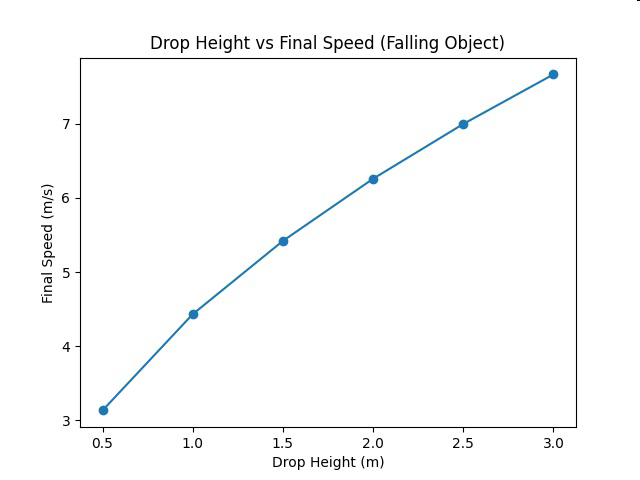
Graph of Information - Figure 2.