Planet Mass and Moon Gravitational Pull
Diagram 1.
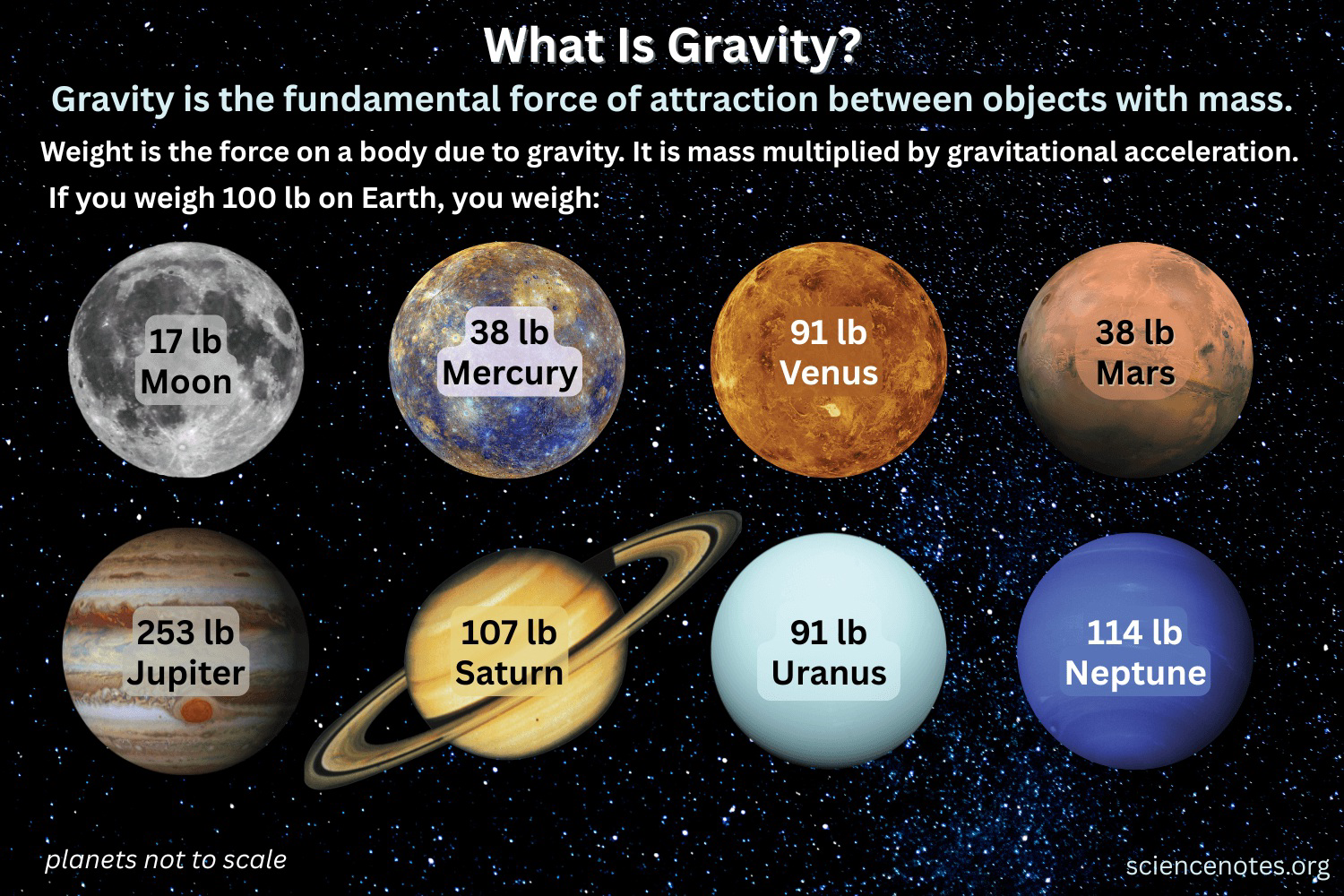
Source:
https://animalia-life.club/qa/pictures/mass-and-gravity-of-planets
Real-World Phenomenon
Jupiter has many large moons, and several of them orbit very quickly compared to moons around smaller planets. This happens because Jupiter’s much larger mass creates a stronger gravitational attraction.
Gravity is an attractive force between any two objects that have mass. The strength of the gravitational interaction depends on two main factors: the masses of the interacting objects and the distance between them. When one of the objects is extremely massive, like a planet, its gravity can strongly affect nearby objects such as moons and satellites.
Moons stay in orbit because gravity pulls them toward the planet while their forward motion keeps them from falling straight down. If a planet has a larger mass, it produces a stronger gravitational pull on nearby objects. That stronger pull can cause moons to orbit faster (shorter orbital periods) at similar distances than they would around a less massive planet.
In this example, we compare orbit data to look for a pattern: when the planet’s mass increases, the gravitational pull becomes stronger, which affects how moons move. Jupiter is much more massive than Earth or Mars, so it can hold many moons and keep them in stable orbits. Moons close to Jupiter complete orbits in just a few days, showing that Jupiter’s gravity is strongly influencing their motion.
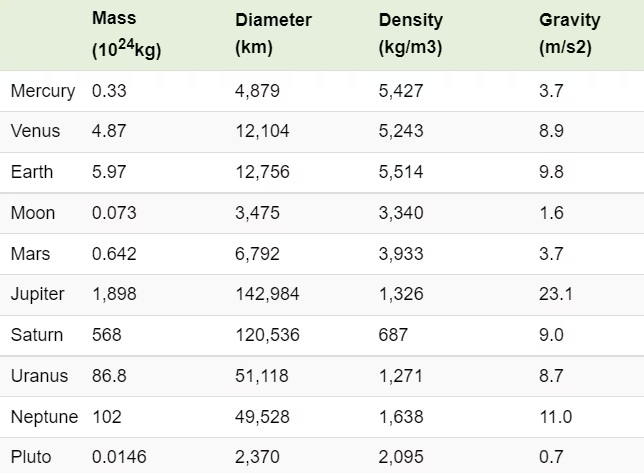
Diagram 2.
In this investigation, the “attractive” part is shown by the fact that moons stay pulled toward the planet rather than flying away. The “mass” part is shown by comparing planets: a more massive planet has stronger gravitational interactions with orbiting objects. By using data on planet mass and moon orbit times (and distance from the planet), students can build an evidence-based argument that gravity depends on the masses of interacting objects and the distance between them.
Table 1.
Planet | Planet Mass relative to Earth | Orbital Distance (km) | Orbital Period (days) |
|---|
Mars | 0.11 | 400000 | 44 |
Earth | 1 | 400000 | 27.3 |
Jupiter | 317.8 | 400000 | 1.5 |
Graph of Information - Figure 1.
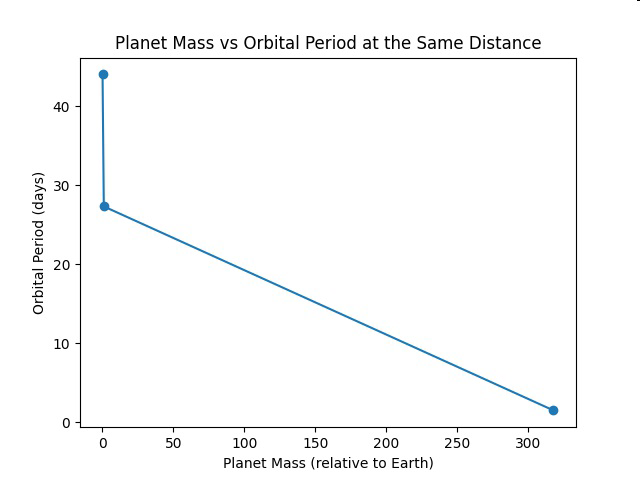
Table 2.
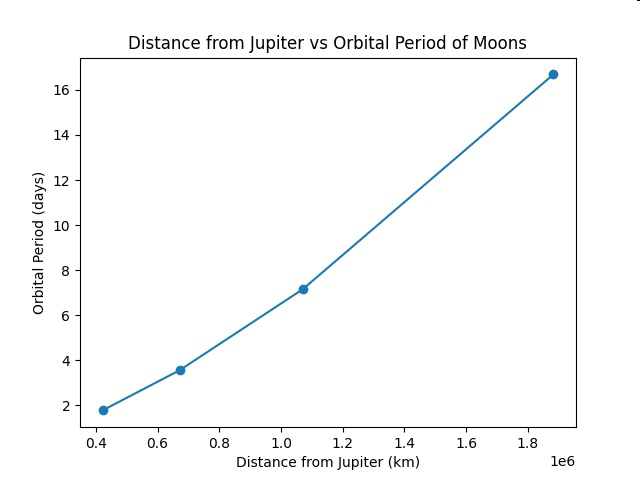
Moon | Distance from Jupiter (km) | Orbital Period (days) | Change in Period from Closest (days) |
|---|
Io | 421700 | 1.77 | 0 |
Europa | 671100 | 3.55 | 1.8 |
Ganymede | 1070400 | 7.15 | 5.4 |
Callisto | 1882700 | 16.69 | 14.9 |
Graph of Information - Figure 2.