Pushing the Same Cart with Different Masses
Diagram 1.
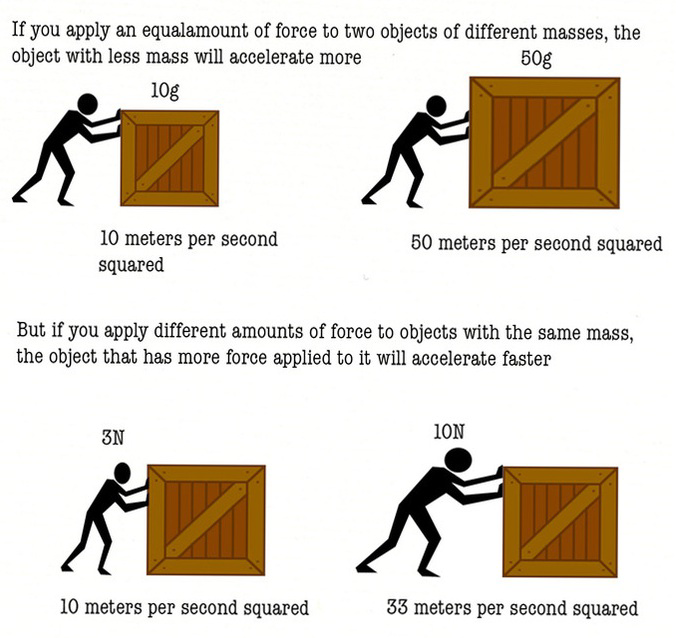
Source: https://newtonslawsophysics.weebly.com/second-law-of-motion.html
Real-World Phenomenon
When the same steady push is used on a cart, a light cart speeds up quickly, but a heavier cart speeds up more slowly, even though both are pushed in the same direction.
When you push an object, you are applying a force. If that force is not balanced by other forces, the object experiences a net force (the sum of all forces acting on it). A net force causes a change in motion, such as speeding up, slowing down, or changing direction.
In this investigation, the direction of motion stays the same, so the key change we observe is how quickly the cart’s speed increases. That change in motion is called acceleration. Acceleration depends on two things: the net force on the object and the object’s mass (how much matter it has). If the net force stays the same, changing the mass changes how the object responds.
A heavier cart has more mass, which means it has more inertia. Inertia is an object’s resistance to changes in motion. Because a heavy cart resists changes in its motion more than a light cart, the same push does not increase its speed as quickly.
Scientists describe this relationship using Newton’s Second Law, which states that acceleration depends on the net force divided by mass. That means:
If the net force stays constant and mass increases, acceleration decreases.
If mass stays constant and net force increases, acceleration increases.
In this cart investigation, we keep the push (force) as similar as possible while changing the mass on the cart. By measuring how the cart’s motion changes for different masses, we can collect evidence that motion changes depend on both net force and mass, just as the standard says.
Diagram 2.
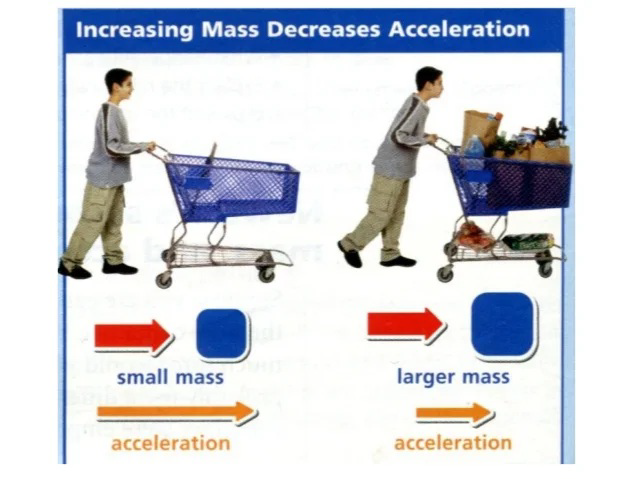
Table 1.
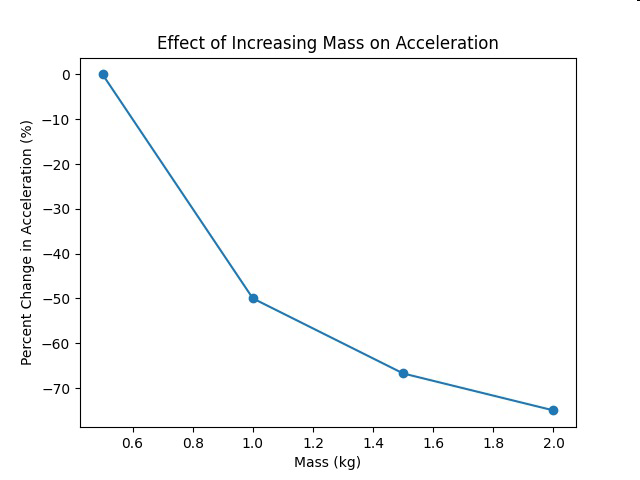
Mass (kg) | Net Force (N) | Acceleration (m/s$^2$) | Percent Change From Lightest (%) |
|---|
0.5 | 2 | 4 | 0 |
1 | 2 | 2 | -50 |
1.5 | 2 | 1.33 | -66.75 |
2 | 2 | 1 | -75 |
Graph of Information - Figure 1.
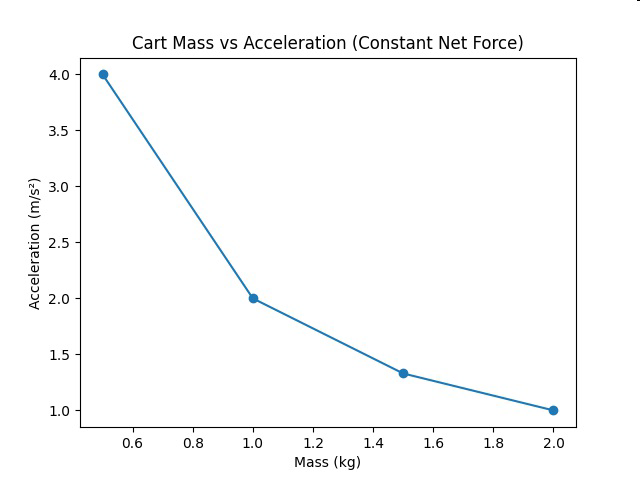
Graph of Information - Figure 2.