Car Bumper “Crash Box” for Low-Speed Collisions
Real-World Phenomenon
In a low-speed crash (like a parking lot collision), a car’s front bumper collides with another car or a barrier. Even at low speeds, repairs can be expensive if the collision transfers a large force quickly into the car’s body. Engineers design crash boxes (energy-absorbing bumper inserts) to change how the collision affects the motion of the colliding objects.
When two objects collide, each object exerts a force on the other. Newton’s Third Law states that these forces are equal in size and opposite in direction. In a car collision, the car pushes on the barrier, and the barrier pushes back on the car with an equal force at the same time.
Even though the forces are equal and opposite, engineers can still design a solution that changes the result of the collision. One important factor is how long the collision lasts. If the collision happens in a very short time, the car’s motion changes very quickly and the forces can be very large. If the collision lasts longer, the car can slow down more gradually, which can reduce the peak force during impact.
A crash box is a part of the bumper system designed to crumple or compress during a collision. When it deforms, it increases the collision time and absorbs energy. This helps reduce the force transmitted to the car’s frame and expensive internal parts. The crash box doesn’t remove Newton’s Third Law force pair. The barrier and car still push on each other with equal and opposite forces. But the crash box changes how the car’s motion changes by increasing the time over which the car slows down.
Diagram 1.
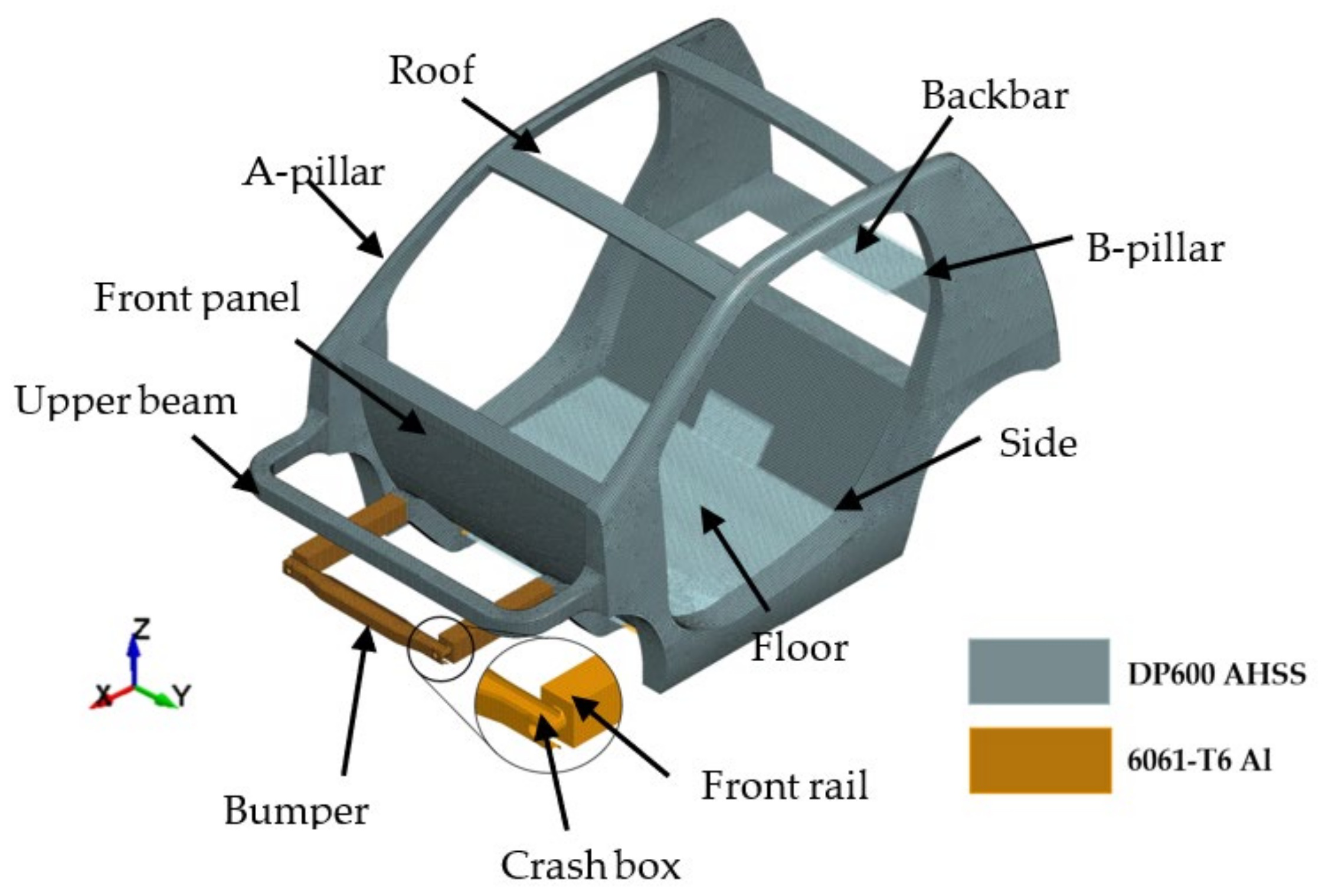 Source:
https://www.mdpi.com/2071-1050/14/20/13458
Engineers test crash box designs by measuring collision time, speed before and after, and peak force. Then they modify the design (changing material, thickness, or shape) to reduce peak force and reduce rebound. By analyzing data from tests, students can explain how Newton’s Third Law applies and how design changes improve collision outcomes.
Diagram 2.
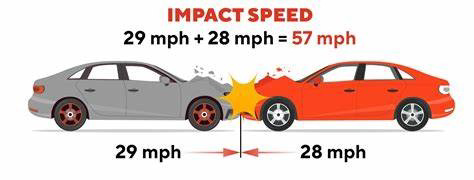
Source: https://www.elementfleet.com/cei-blog/fleets-feel-the-impact-from-speeding-drivers
Table 1.
Trial | Speed Before Collision (m/s) | Speed After Collision (m/s) | Collision Time (ms) | Peak Force (N) |
Trial 1 | 3 | 0.9 | 8 | 9500 |
Trial 2 | 3 | 0.8 | 9 | 9100 |
Trial 3 | 3 | 0.9 | 8 | 9400 |
Trial 4 | 3 | 0.7 | 7 | 8800 |
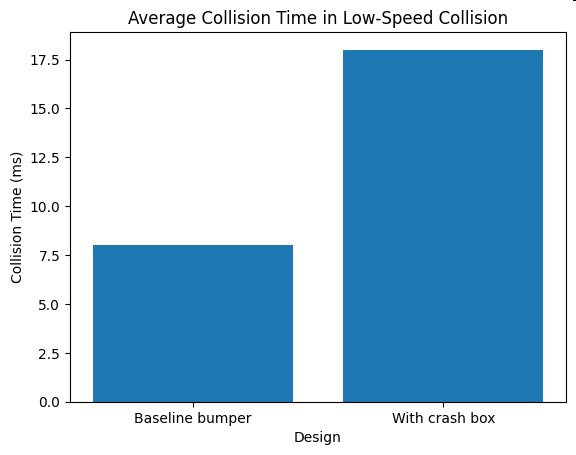
Graph of Information - Figure 1.
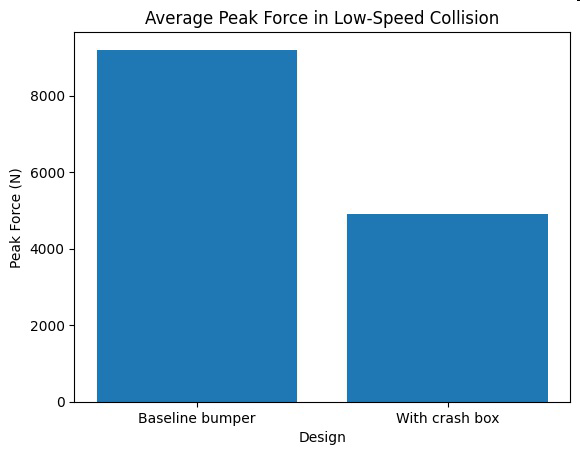
Table 2.
Trial | Speed Before Collision (m/s) | Speed After Collision (m/s) | Collision Time (ms) | Peak Force (N) |
Trial 1 | 3 | 0.3 | 18 | 5100 |
Trial 2 | 3 | 0.2 | 19 | 4800 |
Trial 3 | 3 | 0.3 | 17 | 5000 |
Trial 4 | 3 | 0.4 | 18 | 4700 |
Graph of Information - Figure 2.