Magnets
Magnets in household items
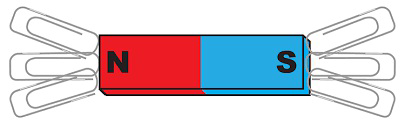
A magnet is a solid object, usually a rock or piece of metal, that has the ability to attract certain materials. An object must be made out of metal to be attracted, but not all metals are attracted.) Metals such as iron, nickel, and cobalt are attracted to magnets. Steel has iron in it, so it is also attracted to magnets.
Many common household items have magnets in them and are part of what makes these items work. Electronic devices such as refrigerators, washing machines, lamps, telephones, TVs, and stereos all have magnets in them.
Attraction and Repulsion
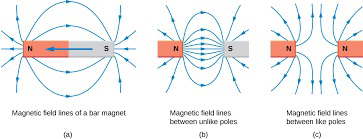
All magnets have two ends where the pull is strongest – a north pole and a south pole. The poles are named this way because if a magnet is floating in water or is suspended by a string tied around its middle, it will align itself in a north-south direction, consistent with the magnetic field of the Earth.
Diagram 1.
Magnetic Field
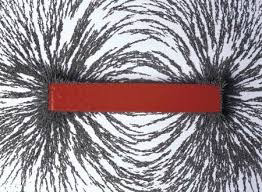
The invisible area around a magnet which attracts another object is called a magnetic field. Magnetic objects (such as paperclips) will get pulled towards the magnet if they are placed in this field. You can see the magnetic field of a magnet using iron metal filings in a Ziploc bag or iron filings in a sealed case.
Lay a bar magnet on a table. Gently shake the bag or case to evenly distribute the iron filings and lay it on top of the magnet. Observe the pattern of the iron filings. The magnetic field is strongest at the poles. You can see this because the iron filings cluster at these points. The iron filings allow us to visibly see how the magnetic field is shaped and how multiple magnetic fields can interact with each other.
Diagram 2.
You’re testing how distance affects the force between a magnet and paperclips. The magnet doesn’t touch the paperclips—you just measure how many clips it can attract at different distances.
Investigation Setup:
Materials:
Procedure:
Place a pile of 10 paperclips on a table.
Hold the magnet at specific distances above the pile
(0 cm, 1 cm, 2 cm, 3 cm, 4 cm, 5 cm).
Count how many paperclips are pulled up without touching them.
Record your results.
Diagram 3.
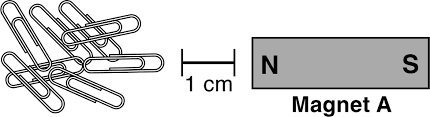
Data Table: Number of Paperclips Attracted at Different Distances
Distance Between Magnet and Paperclips (cm) | Number of Paperclips Attracted |
|---|
0 cm (touching) | 10 |
1 cm | 8 |
2 cm | 6 |
3 cm | 4 |
4 cm | 2 |
5 cm | 0 |
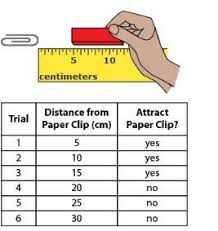
You’re testing how distance affects the force between a magnet and a single paperclip. The magnet doesn’t touch the paperclips - you just measure how far away the magnet can attract one paper clip.
Investigation Setup:
Materials:
Procedure:
Place a paperclip on a table.
Hold the magnet at specific distances away
(5 cm, 10 cm, 15 cm, 20 cm).
Determine if the paperclip is pulled toward the magnet.
Record your results.