Material Between Magnets and Magnetic Force Strength
Diagram 1.
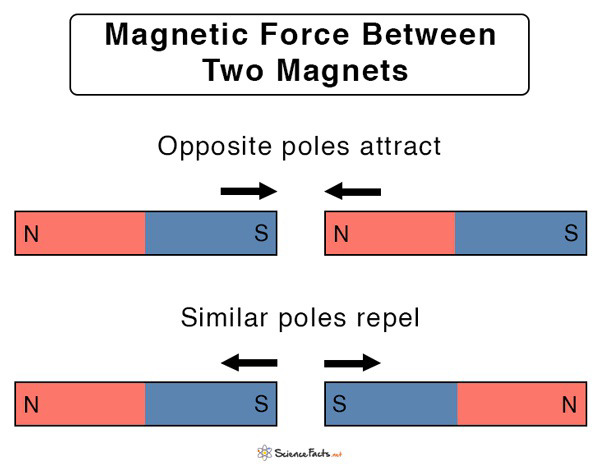 Source: https://www.sciencefacts.net/magnetic-force.html
Real-World Phenomenon
When you place different materials between two magnets, the magnets do not always pull (or repel) with the same strength. Some materials let the magnets interact almost normally, while others reduce how strongly the magnets affect each other.
Magnetic forces act at a distance through a magnetic field. Even though you cannot see the field, you can observe its effects when magnets attract or repel. The strength of the magnetic force can change depending on several factors. One important factor is the material between the magnets.
Some materials allow magnetic fields to pass through with very little change. For example, materials like plastic, paper, or cardboard usually do not block magnetic fields much, so magnets can still attract or repel through them. Other materials interact with magnetic fields more strongly. Certain metals and alloys can change how magnetic field lines move through space. In some cases, a material can act like a magnetic shield, reducing the effect one magnet has on the other.
Diagram 2.

Source: https://www.exploratorium.edu/snacks/magnetic-shielding
Scientists investigate magnetic forces by collecting data and looking for patterns. In a classroom investigation, students can measure force strength in safe, indirect ways. For instance, they can use a spring scale to measure the pull between magnets, or they can count how many paper clips a magnet can lift when a material is placed between the magnet and the paper clips. If the measured force changes when the material changes, that is evidence that the material is a factor affecting force strength.
By using data to compare materials, students can determine that the type of material between magnets affects the strength of magnetic forces.
Table 1.
Material | Thickness (mm) | Magnetic Force (N) |
|---|
Plastic | 1 | 3 |
Paper | 0.5 | 2.9 |
Cardboard | 2 | 2.7 |
Aluminum | 0.8 | 2.2 |
Steel | 0.5 | 1.5 |
Graph of Information - Figure 1.
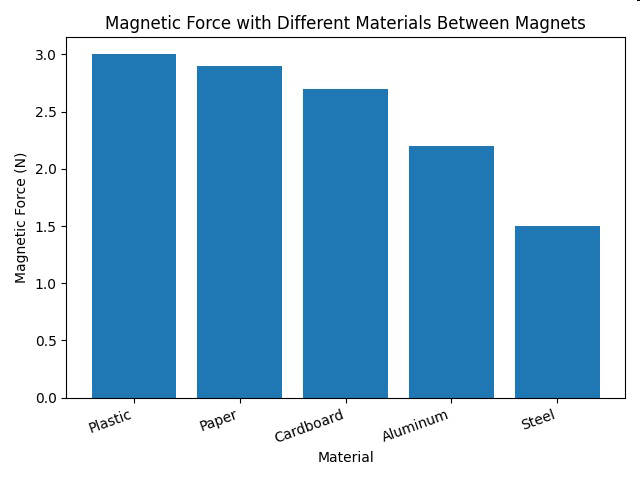
Table 2.
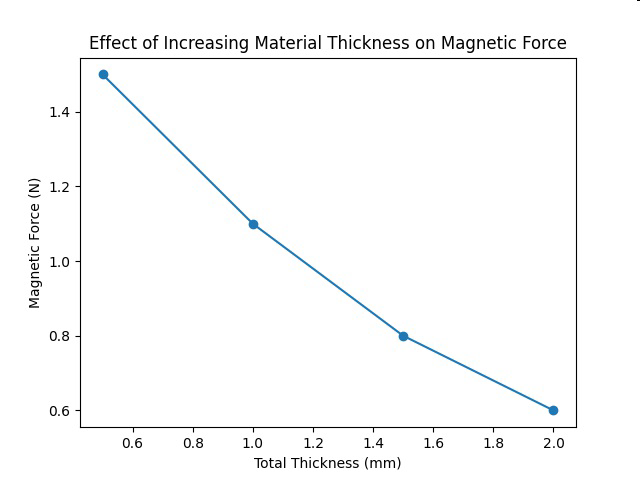
Layers | Total Thickness (mm) | Magnetic Force (N) | Change in Force from 1 Layer (N) |
|---|
1 | 0.5 | 1.5 | 0 |
2 | 1 | 1.1 | -0.4 |
3 | 1.5 | 0.8 | -0.7 |
4 | 2 | 0.6 | -0.9 |
Graph of Information - Figure 2.