Tug-of-War on a Rolling Platform
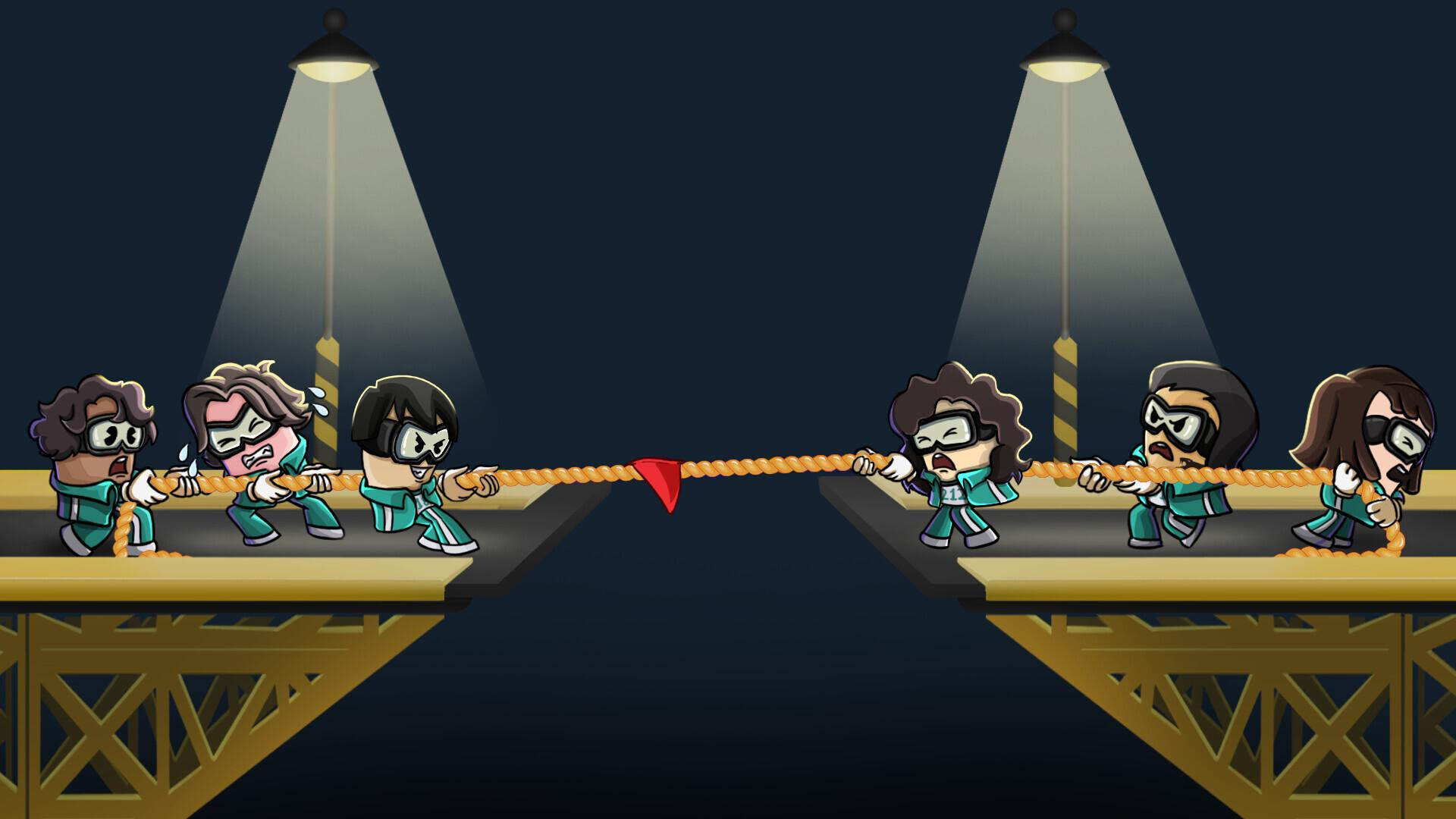
Diagram 1.
Source:
https://wallpaperaccess.com/tug-of-war
Real-World Phenomenon
In a tug-of-war using a rolling cart/platform, when two groups pull in opposite directions, the cart moves toward the side with the greater total pull. If both sides pull equally, the cart does not speed up.
Forces are pushes or pulls. Often, more than one force acts on an object at the same time. To predict how an object’s motion will change, we need to consider the net force, which is the sum of all the forces acting on the object. When forces act in opposite directions, the net force is found by subtracting the smaller force from the larger one. The direction of the net force is the direction of the stronger side.
In this tug-of-war investigation, a cart is pulled left and right at the same time. If the pulls are equal, the forces are balanced and the net force is $0\ \text{N}$. When the net force is zero, the cart’s motion does not change. It might stay still, or it might keep moving at a constant speed, but it will not speed up or slow down.
If one side pulls harder than the other, the forces are unbalanced. The net force is not zero, and the cart’s motion changes. A nonzero net force causes the cart to accelerate in the direction of the net force, meaning its speed increases in that direction.
Newton’s Second Law explains how force and mass work together: acceleration depends on the net force and the mass of the object. For the same cart (constant mass), a larger net force causes a larger acceleration. That means a cart pulled with a net force of $3\ \text{N}$ will speed up more quickly than the same cart pulled with a net force of $1\ \text{N}$.
By measuring the pull forces on both sides, calculating net force, and measuring acceleration, students can collect evidence that the change in motion depends on the sum of the forces and the mass of the object.
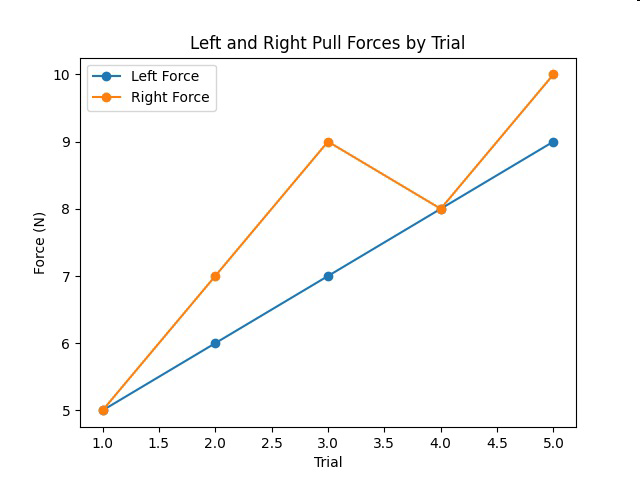
Table 1.
Trial | Left Force (N) | Right Force (N) | Net Force (N) | Mass (kg) | Acceleration (m/s2) |
|---|
1 | 5 | 5 | 0 | 2 | 0 |
2 | 6 | 7 | 1 | 2 | 0.5 |
3 | 7 | 9 | 2 | 2 | 1 |
4 | 8 | 8 | 0 | 2 | 0 |
5 | 9 | 10 | 1 | 2 | 0.5 |
Graph of Information - Figure 1.
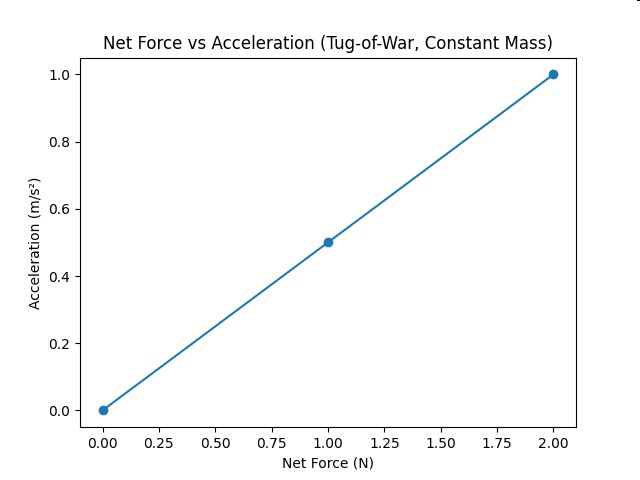
Table 2.
Net Force (N) | Acceleration (m/s2) | Direction | Change From Zero (m/s2) |
|---|
0 | 0 | None | 0 |
1 | 0.5 | Right | 0.5 |
2 | 1 | Right | 1 |
Graph of Information - Figure 2.