Ice Melting and the “Temperature Pause” During a Phase Change
Real-World Phenomenon
An ice cube left on a plate warms up, melts into liquid water, and eventually becomes warmer water. But if you track temperature while it melts, it often stops rising for a while near $0^\circ\text{C}$, even though the ice is clearly changing. This happens because thermal energy can go into changing state instead of raising temperature.
All matter is made of particles that are always moving. Temperature is a measure of the average motion (kinetic energy) of particles. When a substance gains thermal energy, its particles usually move faster and the temperature increases. When a substance loses thermal energy, particles move slower and the temperature decreases.
However, temperature does not always change smoothly when thermal energy is added or removed. During a phase change (like melting or freezing), thermal energy is used to change how particles are arranged and how strongly they attract each other, not to increase their average speed. This energy involved in a phase change is called latent heat.
Ice is solid water. In a solid, particles are packed closely and mainly vibrate in place. As ice warms from below $0^\circ\text{C}$, its temperature rises because particle motion increases. When the ice reaches about $0^\circ\text{C}$, melting begins. At this point, added thermal energy is used to loosen the attractions holding the solid structure together so particles can slide past one another as a liquid. Because that energy is going into changing the state, the temperature can stay near $0^\circ\text{C}$ until most of the ice has melted.
After the ice has fully melted, continued heating increases the temperature of the liquid water because the particles are already in the liquid state and added energy mainly increases particle motion. By building a model that connects thermal energy transfer, particle motion, and phase, students can predict when temperature will rise steadily and when it will “pause” during melting or freezing.
Diagram 1.
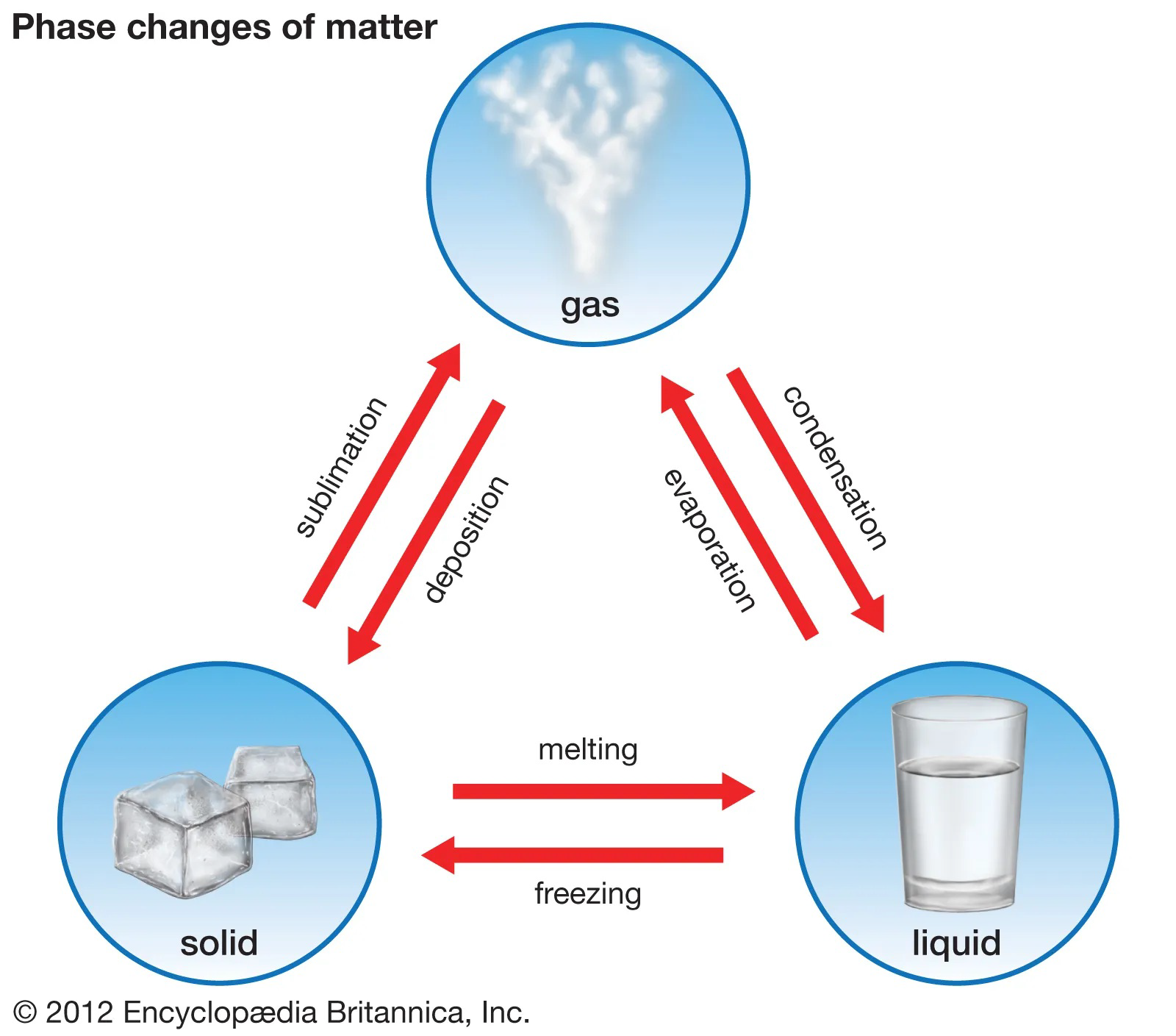 Source: https://www.britannica.com/science/melting
Diagram 2.
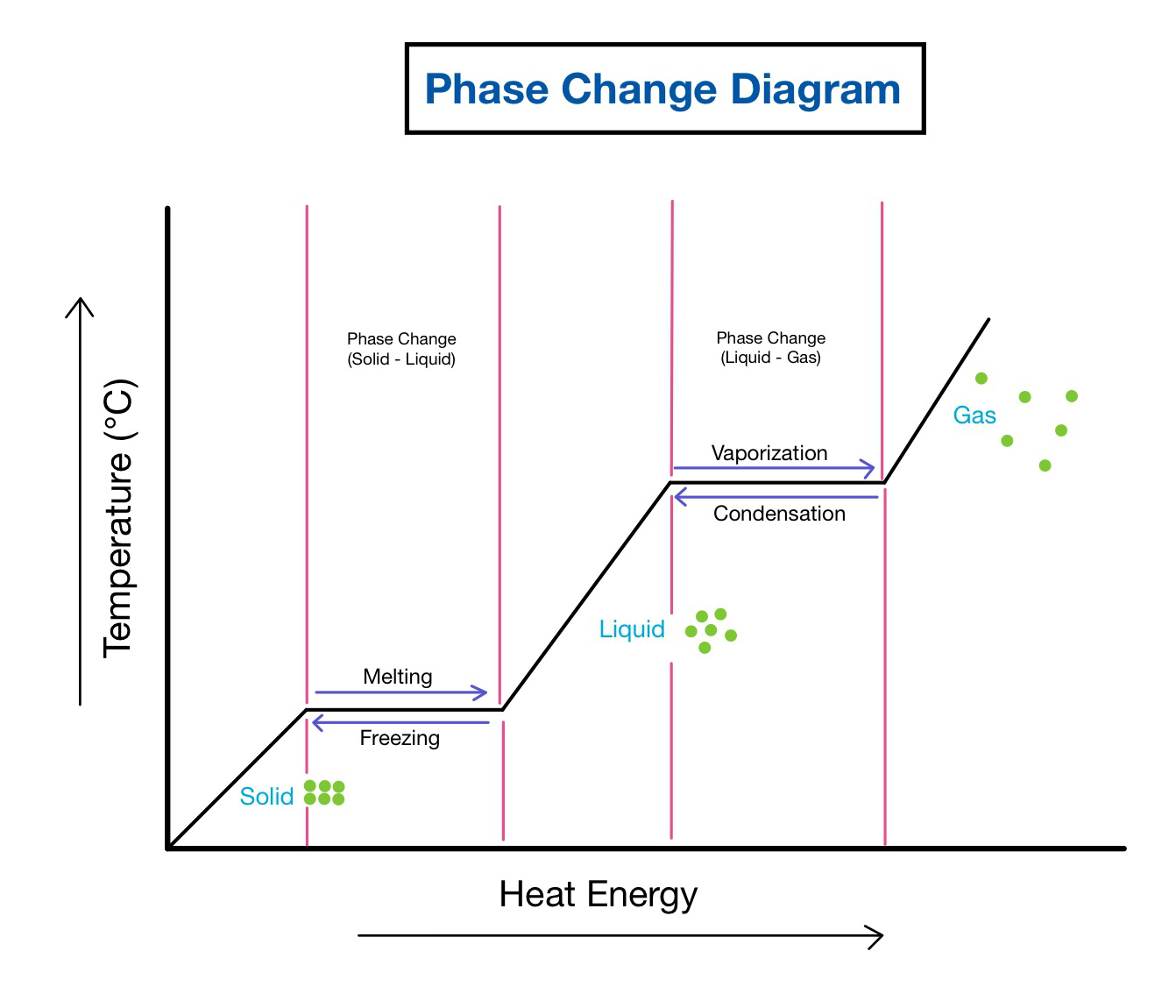 Source:
https://www.expii.com/t/phase-change-diagrams-overview-examples-8057
Table 1.
Time (minutes) | Temperature (oC) | Observation |
|---|
0 | -10 | Solid ice |
4 | -5 | Solid ice |
8 | 0 | Start melting |
10 | 0 | Melting |
12 | 0 | Melting |
14 | 0 | Fully melted |
18 | 4 | Liquid water |
20 | 6 | Liquid water |
Graph of Information - Figure 1.
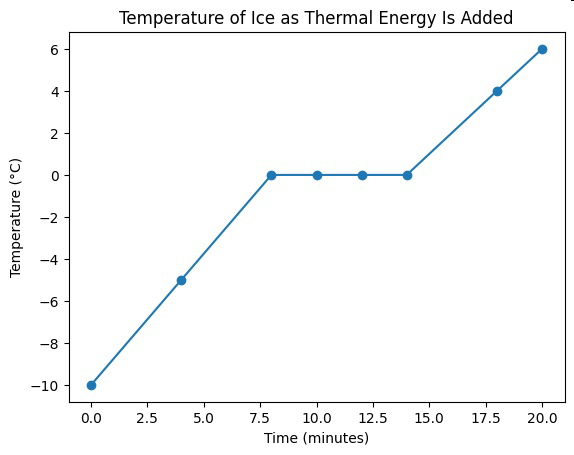
Table 2.
Checkpoint Time (minutes) | Phase | Relative Particle Motion | Thermal Energy Use |
|---|
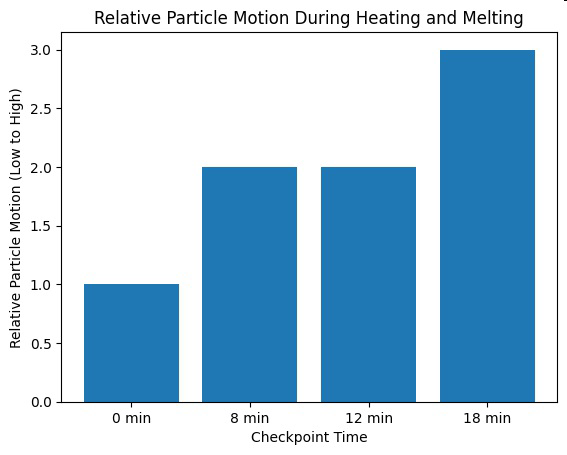
0 | Solid | Low | Warming particles |
8 | Solid + Liquid | Medium | Changing phase |
12 | Solid + Liquid | Medium | Changing phase |
18 | Liquid | High | Warming particles |
Graph of Information - Figure 2.