Iron in a Mixture
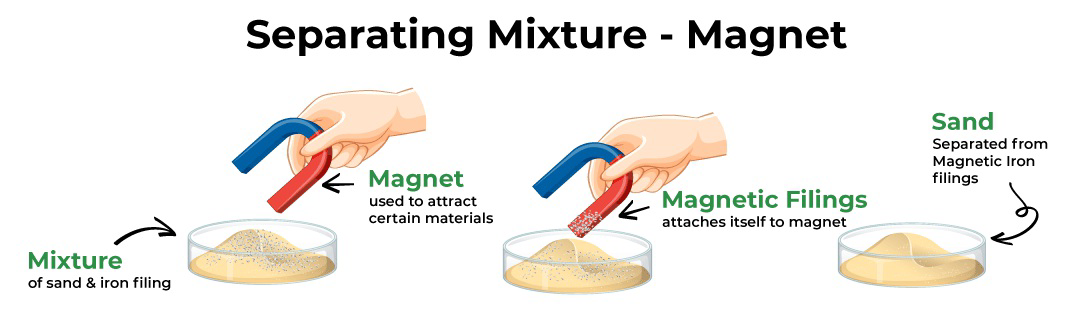
Diagram 1.
Source: https://www.geeksforgeeks.org/chemistry/separation-of-mixtures/
Real-World Phenomenon
Some breakfast cereals are labeled “iron-fortified.” When crushed cereal is mixed with water and a magnet is held near the mixture, tiny dark particles can collect near the magnet. This investigation shows that the cereal mixture contains different substances that can be separated, providing evidence that mixtures are combinations of substances.
A mixture forms when two or more substances are physically combined without forming a new substance. In a mixture, each substance keeps its own properties. Because the substances remain unchanged, mixtures can often be separated using physical methods such as sorting, filtering, evaporating, or using magnetism.
Iron is a substance that can be attracted by a magnet. Many foods are fortified with iron, meaning iron is added to them for nutritional reasons. The iron in fortified cereal is mixed into the cereal during manufacturing. Even though the cereal looks uniform, it can still contain more than one substance.
In an investigation, students can crush cereal, mix it with water, and stir it to create a cereal-water mixture. When a magnet is placed on the outside of the container, iron particles in the mixture can move toward the magnet and separate from the rest of the cereal mixture. This separation works because iron keeps its magnetic property in the mixture.
Diagram 2.
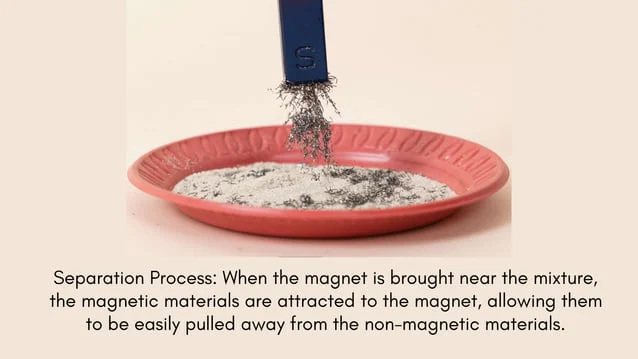 Source: https://www.slideshare.net/slideshow/science-6-separating-mixtures-using-magnetpptx/265597637
If iron can be separated from cereal using a magnet, that is evidence that the cereal contains multiple substances physically combined. The cereal and the iron did not chemically react to form something new. Instead, they remained separate substances within the mixture.
By planning and conducting an investigation that includes mixing, observing, and separating, students can demonstrate that mixtures are combinations of substances. The ability to separate one component using magnetism supports the idea that substances in a mixture keep their properties and can be identified and removed.
Table 1.
Material | Mass (g) |
|---|
Crushed cereal | 50 |
Water | 150 |
Total mixture | 200 |
Graph of Information - Figure 1.
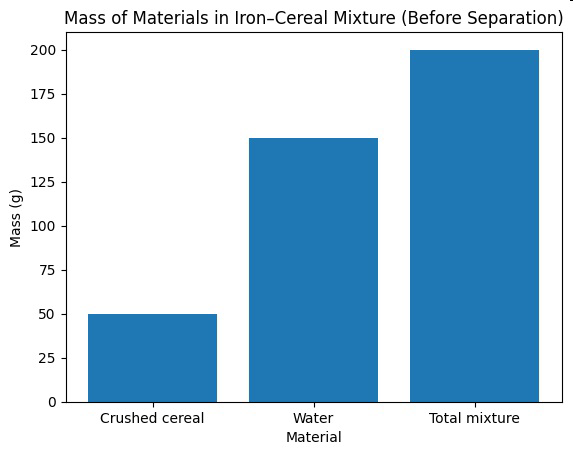
Table 2.
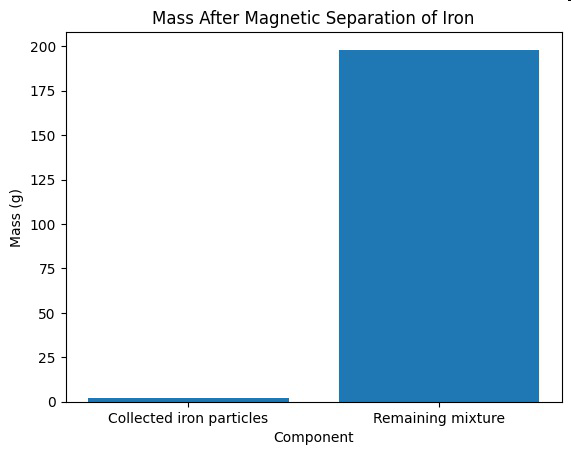
Component | Mass (g) |
|---|
Collected iron particles | 2 |
Remaining mixture | 198 |
Graph of Information - Figure 2.